





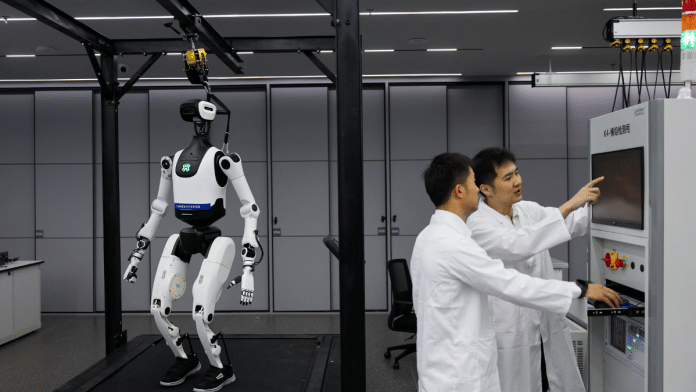


New Delhi: In a major escalation in the US–China tech rivalry, the Federal Communications Commission (FCC) in Washington imposed an immediate ban on new imports of humanoid robots, drawing sharp criticism from China and threatening to overshadow Chinese President Xi Jinping’s planned September meeting with US President Donald Trump.
The Chinese Commerce Ministry on Thursday denounced the US move, saying it would “severely undermine the stability of China-U.S. economic and trade relations, and seriously disrupt the stability of global industrial and supply chains.”
If the US proceeds with the ban “China will resolutely retaliate to safeguard its legitimate rights and interests”, the ministry said in a statement.
The latest development complicates the picture ahead of Chinese President Xi Jinping’s planned U.S. visit to meet President Trump in September.
In response to the ban, Chinese Foreign Ministry’s spokesperson Mao Ning on Wednesday accused the U.S. of protectionism. “China firmly opposes the U.S. overstretching the concept of national security and going after Chinese companies. Protectionism does not make the U.S. more competitive and will only hurt the interests of U.S. companies and consumers. China will continue to do what is necessary to firmly defend the legitimate and lawful rights and interests of Chinese companies.”
Also Read: Trump’s China visit is already a spectacle on Chinese internet. Strategists are cautious
Federal Communications Commission documents
The documents released by the FCC included two new categories of devices—namely advanced robotic devices and connected power inverters produced in foreign countries—in its “Covered List”.
Items on Covered List include equipment and services determined to “pose an unacceptable risk to the national security of the United States or the security and safety of United States persons.”
Chinese tech giants such as Huawei Technologies Company and ZTE Corporation are already on the list.
The FCC said that importing foreign-made advanced robots presents “unacceptable supply chain and cybersecurity vulnerabilities”. The document argues that such robotic devices accumulate user data which can be leveraged by “malign actors to surveil Americans, enhance the capabilities of foreign intelligence services, or to remotely commandeer the robots.”
Meanwhile, the foreign made power inverters were banned citing potential vulnerabilities they can introduce to the US grid system. FCC says such vulnerabilities could “enable foreign firms to turn off the inverters or use them to collect and exfiltrate data, facilitate remote access and surveillance by foreign government actors, or be otherwise exploited through a cyberattack.”
FCC Chairman Brendan Carr welcomed the decision. “Following President Trump’s leadership, the FCC will continue to do our part to secure America’s critical supply chains and, with today’s action, the FCC is acting in lock step with our national security agencies to do just that,” he said in a statement.
The document includes a small exception. Foreign produced advanced robotic systems granted “conditional approval” by the Department of War (DoW), on the grounds that the concerned device does not pose security risks, can be imported.
While the released document does not explicitly mention China, Chinese producers account for nearly 90% of global humanoid shipments. Chinese start-ups produce humanoid robots far cheaper and at a greater scale than their competitors around the globe.
China has acquired a significant lead in industrial robotics as well, with more than 2 million robots operating in Chinese factories in 2024, and another 300,000 added during the year.
Beijing dismissed the concerns expressed by the U.S., accusing Washington of “overstretching the concept of national security”.
(Edited by Ajeet Tiwari)
Also Read: How does China see US’ Indo-Pacific name change?