





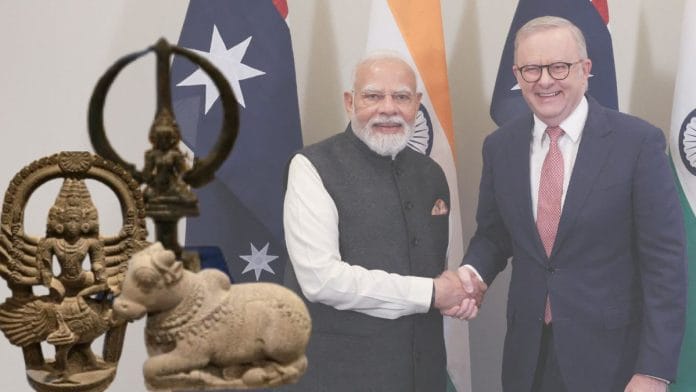


New Delhi: Australia will repatriate three artefacts from Tamil Nadu to India, while India will return the remains of a First Nations ancestor currently housed at the Government Museum in Chennai. Australian Prime Minister Anthony Albanese announced the reciprocal repatriation following the third India-Australia Annual Summit in Melbourne.
“I welcome progress to repatriate the remains of an Australian First Nations ancestor held in the Government Museum of Chennai. The ancestor will be voluntarily and unconditionally repatriated by India to their traditional custodians,” Albanese said during the joint press statement standing alongside Prime Minister Narendra Modi.
Announcing the repatriation, Albanese said: “In the spirit of friendship, Australia will voluntarily return several items of cultural significance to India, previously held in the collections of the National Gallery of Australia and the Art Gallery of New South Wales.”
The three artefacts Australia will repatriate are a metal trident depicting the goddess Bhadrakali, a stone idol of Nandi and a stone idol of the six-headed Kartikeya (Shanmukha). All three originated in Tamil Nadu, from the districts of Thanjavur and Thiruvarur.
Australia to repatriate Indian artefacts- metal Trident with image of Goddess Bhadrakali, stone idol of Nandi and stone idol of six-headed Kartikeya pic.twitter.com/NfXc03v85a
— ANI (@ANI) July 9, 2026
Also Read: India and Australia aim for next-level relationship with key pacts in uranium, LNG, defence
The repatriated artefacts
The metal trident is surmounted by an image of the goddess Bhadrakali in her Shakti form and is crafted in the style of South Indian temple ritual metalwork. It originates from the Sri Kasiviswanathaswamy Temple in Kollumangudi, Tamil Nadu, and dates to between the 13th and 16th centuries CE, spanning the late Chola and early Vijayanagara Empire’s period.
The second artefact being returned to India is a stone idol of a Nandi, the sacred bull of Lord Shiva. The artefact was also crafted during the same time period as the metal trident and was also located at the Sri Kasiviswanathaswamy Temple.
The final artefact being returned by Australia is a stone idol of a six-headed Karttikeya, (Shanmukha) (more commonly known as Lord Murugan in Tamil Nadu). The stone idol was likely crafted in the 11th CE at the Naganathaswamy Temple in Thanjavur district. The temple was built by Chola king Rajendra I, who ruled the Imperial Cholas roughly between 1014 CE and 1044 CE.
The Government Museum in Chennai is reported to have received the skull of a First Nations ancestor sometime in 1935. In exchange for that skull, the Government Museum of Chennai (then known as Madras) had sent a skull of a 30-year-old male Telugu.
It is unclear whether these are the specific remains being repatriated to Australia. However, during the late 19th and early 20th centuries, museums around the world—particularly those in colonial empires—extensively acquired and exchanged human remains as their imperial reach expanded.
For example, the Museo Egizio in Turin is home to what is widely regarded as the world’s second-largest collection of Egyptian antiquities and is said to house around 116 mummies and other human remains. Similar examples can be found across the world, with museums holding human remains originating from other countries and cultures.
Australia, which is home to the First Nations people, which was later colonised by the United Kingdom, has in recent years focused on the repatriation of the remains of ancestors and their sacred objects.
For nearly 250 years, the remains of First Nation ancestors and their objects were removed from the communities and placed in museums around the world and in Australia. The Australian government has brought back roughly 1,789 First Ancestor remains in the last thirty-five years as of December 2025. Roughly 1,336 of these remains were returned from the United Kingdom.
Modi is in Australia for a two-day visit that began Thursday with the third annual India – Australia summit. Apart from the official meetings with Albanese, Modi also met with the Governor-General of Australia, Sam Mostyn.
Prime Minister Narendra Modi is scheduled to address a community event for the Indian diaspora later in the day. On Friday, he will depart for Auckland after attending a sports showcase at the Melbourne Cricket Ground. The Melbourne visit is the second leg of his three-nation tour, which began in Indonesia and will conclude in New Zealand.
(Edited by Harini Ts)
Also read: India & Australia announce PACTS for a deeper cyber, critical tech and supply chain partnership