





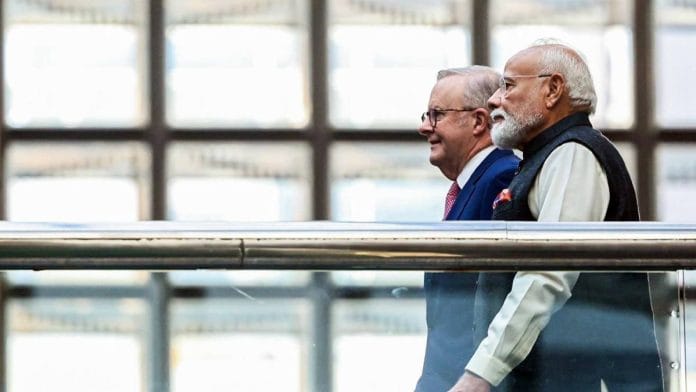

New Delhi: India and Australia Thursday signed an agreement to partner in cyber, critical technologies and supply chains, as the two countries seek to deepen their relationship in emerging sectors, while minimising dependence on any single country.
“In the field of critical minerals, our cooperation, strategic security, and clean energy transition are important. With this in mind, we have established the Australia-India Partnership on Cyber, Critical Technologies, and Supply Chains (PACTS),” Prime Minister Narendra Modi said in a joint press statement alongside Australian PM Anthony Albanese in Melbourne.
Under PACTS, both leaders “recognise” that cyber security, critical technologies and supply chains are “central to national security and can be used to shape values and global norms”.
The agreement was announced after Modi and Albanese held the third India-Australia Annual Summit in Melbourne. Modi is on a two-day visit to the nation.
“Under each interrelated pillar, India and Australia will identify opportunities and specific projects to support collaboration between the private sector, universities, research institutions and government agencies. This will underpin and extend government-to-government cooperation, increase two-way investment into new technologies, and support the translation of intellectual property into products that deliver economic growth,” a statement issued by the Ministry of External Affairs said.
The agreement envisions five pillars for future cooperation, namely: supply chain resilience and diversification, critical technology, cybersecurity, digital resilience, and defence research collaboration.
The two countries also identified the nodal agencies managing the new partnership—a senior level official at the Australian Deputy Secretary International and Security Group, Department of the Prime Minister and Cabinet and the Indian Deputy National Security Adviser.
Each of the five pillars will have an annual senior officials’ meeting to identify projects for cooperation, as well as share information on new and emerging risks, especially in cybersecurity.
Since the COVID-19 pandemic, there have been fears over the continuing dependence on China for critical minerals required for the next generation of technologies.
Beijing has become the world leader in the refining processes of a number of components required for artificial intelligence, batteries and other emerging technologies. India has sought to diversify supply chains, to prevent any economic instability due to dependence.
The first two pillars will be managed by India’s National Security Council Secretariat (NSCS) and the office of the Australian ambassador for cyber affairs and critical technologies. The next two pillars—cybersecurity and digital resilience—will be handled by the respective divisions of the Ministry of External Affairs, while defence research collaboration will be led by the Ministry of Defence of India and the Australian Department of Defence.
Under supply chain resilience, New Delhi and Canberra are aiming to “develop a bilateral mechanism for collaboration on trusted vendor frameworks”. The focus is semiconductor supply chains, and ensuring the flow of critical minerals through coordinated investment and regulatory alignment.
Under critical technology, the two countries are aiming for closer partnership in space technologies and artificial intelligence. PM Albanese announced the commissioning of a temporary space tracking terminal on the Cocos Keeling Islands to support India’s human space flight mission, Gaganyaan.
Both India and Australia are also seeking ways to deepen areas of cooperation in sectors such as digital public infrastructure and the enhancement of trade between cybersecurity firms of both countries.
“Strengthen our dialogue on defence science and technology priorities through the Defence Ministers’ Dialogue, Defence Policy Talks, and Joint Working Group on Defence Industry, Research, and Material. Build institutional connections between Australia’s Defence Science and Technology Group and India’s Defence Research and Development Organisation and regularise working level exchanges to accelerate research cooperation,” states the PACTS agreement.
The two leaders also announced the signing of a memorandum of understanding (MoU) of the Australia-Canada-India Technology and Innovation Partnership (ACITI), which was first announced last year during a trilateral meeting between Modi, Albanese and Canadian Prime Minister Mark Carney. The three countries are identifying areas of cooperation and projects to support under the ACITI, to better pool resources.
(Edited by Nida Fatima Siddiqui)