





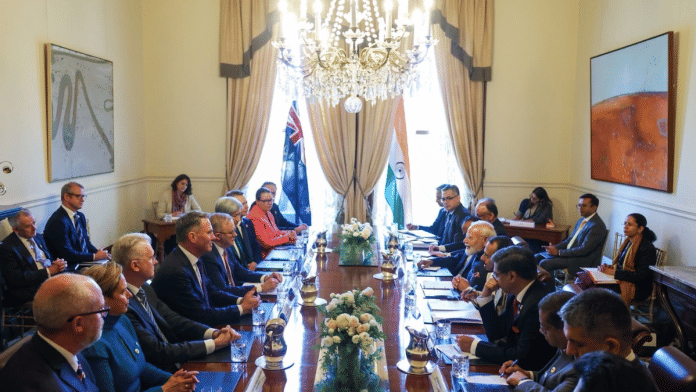


New Delhi: India and Australia Thursday “re-affirmed” their commitment for the finalisation of a Comprehensive Economic Cooperation Agreement (CECA), which has been under negotiations for the better part of the last four years.
The two countries swiftly concluded negotiations and operationalised the Economic Cooperation and Trade Agreement (ECTA)—a foundational trade agreement that came into force on 29 December, 2022. The idea was that the ECTA, which liberalised around 85 percent of Australian export tariff lines to India to zero duties immediately, would eventually lead to a more comprehensive trade deal covering different areas.
India will reduce tariffs on a further five percent of tariff lines by 2028, allowing greater market access for Australian exporters in sectors such as wool, lamb, barley, oats, fresh rock lobsters, cosmetics and many metallic ores, critical minerals, non-ferrous metals and titanium dioxide.
“In 2022, the scope of our trade and investment has increased with the Economic Cooperation and Trade Agreement. Now, we have decided to act quickly on the Comprehensive Economic Cooperation and Trade Agreement, which will be a balanced, ambitious, and a win-win for both countries,” Prime Minister Narendra Modi said in a statement to the press in Melbourne.
The relationship between Australia and India has never been stronger 🇦🇺🇮🇳
And today we’re building on our ties in defence, trade, investment and energy.
As well as our work in education and technology.
Because together, we can be a force for peace and prosperity in our… pic.twitter.com/o7YPm6MIMq
— Anthony Albanese (@AlboMP) July 9, 2026
Modi is in Australia for a two-day visit and met with his Australian counterpart Anthony Albanese. The two leaders held the third India-Australia annual summit. Modi will also attend a sports showcase at the famous Melbourne Cricket Ground (MCG) Friday before departing for New Zealand.
The push for a CECA comes as the two countries’ trade in goods remains stagnant since the ECTA was first operationalised. Merchandise trade grew to $25 billion in the 2021-2022 financial year, according to data released by the Indian Ministry of Commerce and Industry.
It peaked in the 2022-2023 financial year touching $25.9 billion. The following two financial years trade in goods fell to roughly $24 billion, before falling further to $21 billion in the 2025-2026 financial year.
Australia is keen to see India further liberalise tariff lines in areas such as agriculture as well as services as a part of the CECA. For India, the key remains securing critical minerals, as well as proper mobility mechanisms.
Free Trade Agreement (FTA) negotiations originally began in 2011 before it was suspended in 2016 in favour of negotiations surrounding the Regional Comprehensive Economic Partnership Agreement (RCEP). India withdrew from these negotiations in 2019, and restarted bilateral negotiations with Australia in 2021.
The ECTA was meant to be an agreement signifying that the easier portions of the negotiations would be completed and operationalised, allowing for the other more pressing issues to be negotiated in due time.
It consists of 14 chapters, much smaller than more comprehensive deals, and does not include chapters on digital trade, intellectual property, government procurement, competition policy, and those related to small and medium enterprises.
“The Prime Ministers welcomed continued growth in two way trade under the India–Australia ECTA, and reducing non-tariff barriers, noting its tangible benefits for businesses and consumers in both countries. They re-affirmed their commitment to progressing an ambitious, balanced and mutually beneficial CECA to unlock the full potential of the economic relationship and strengthen prosperity for both countries,” the joint statement issued by both leaders said.
“The Prime Ministers also underscored the importance of enhancing investment and supported increased engagement between private sector investors, including through stronger coordination of finance between relevant institutions of both countries.”
India was able to sign a FTA with New Zealand on 27 April, which is said to be comprehensive covering multiple sectors except dairy. Modi is set to make a two-day visit to Auckland, as both countries continue to legally verify the agreement before looking for a mutual date to operationalise it.
(Edited by Tony Rai)
Also Read: India and Australia aim for next-level relationship with key pacts in uranium, LNG, defence