



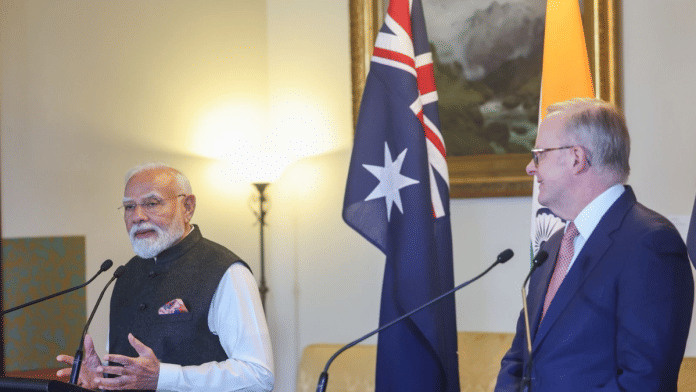
New Delhi: India and Australia on Thursday signed key pacts on nuclear, energy and defence that seeks to bind the two countries closer along the Indo-Pacific model.
Following talks between Prime Minister Narendra Modi and his Australian counterpart Anthony Albanese, both countries “finalised the administrative arrangements necessary” to enable the export of Australian uranium to India for exclusively peaceful purposes and under International Atomic Energy Agency (IAEA) safeguards, as provided for under the Australia-India Nuclear Cooperation Agreement (2015).
Sources said that while an overarching agreement was signed in 2015, there has been no commercial supply of uranium because certain technical formalities had to be completed for which negotiations kept continuing.
ThePrint had earlier reported that India and Australia are set to reach an understanding on the uranium supply.
The Modi government is pushing for making India a major centre for new data centres used for Artificial Intelligence (AI) which will require massive power capacity. That is where nuclear energy comes in. With the administrative protocols in, the two sides will encourage commercial transactions between entities for uranium supply.
Another key agreement reached between the two sides was on supply of Australian Liquified Natural Gas (LNG), diesel and coal. A joint statement issued by the two sides said that recognising Australia’s role as an important supplier of liquefied natural gas to India and India’s role as an important supplier of liquid fuels and other downstream products to Australia, the two countries have committed to support the continued flow of energy products and further enhance energy trade.
Australia and India also reiterated the importance of encouraging investment opportunities across the energy value chain. They have also agreed to working together to strengthen energy supply chain resilience, including through deepening regional cooperation, accelerating energy transition, promoting uptake of renewable energy resources and upholding open trade arrangements for energy and liquid fuels.
Both countries recognise that increasing electrification of respective energy systems will be a valuable source of energy security into the future. They have also agreed to strengthen energy security, including maintaining a stable, secure and reliable supply of energy products, such as coal, diesel, other liquid fuels and natural gas.
Both countries have also committed to accelerating energy transition and strengthening cooperation on low carbon fuels.
Also Read: US, Five Eyes allies warn Chinese spies using LinkedIn, other job platforms for espionage
Defence cooperation
Another key area of collaboration between the two sides agreed by the two prime ministers is in the defence sector. Both prime ministers said that defence and security cooperation is a cornerstone of the partnership in an increasingly complex strategic environment, and agreed to more partnerships and cooperation in defence innovation ecosystems and to develop arrangements for advanced defence science and technology collaboration.
They announced a Joint Declaration on Defence and Security Cooperation, reflecting a step change in the depth and ambition of the bilateral defence and security relationship, and contribution to regional strength and security. Both also agreed to enhance maritime cooperation through the India-Australia Maritime Security Collaboration Roadmap.
Through this, India and Australia reaffirmed their shared commitment to a peaceful and prosperous Indo-Pacific recognising that effective maritime cooperation is essential to regional security.
They agreed to collaborate in areas of information sharing, capability development, capacity building and operational coordination. The leaders welcomed the conclusion of a Memorandum of Understanding (MoU) between Australia’s Maritime Border Command and the Indian Coast Guard to support a secure maritime environment.
The prime ministers acknowledged the significance of defence industry, research and material cooperation.
The Leaders welcomed the ongoing work to develop an MoU for the Provision of Defence Articles and Defence Services, and efforts to promote connections between Australian and Indian defence industries, including through Australia’s first defence trade mission to India and the Australia-India Defence Industry Roundtable, the joint statement said.
Without mentioning China, the two leaders expressed concerns over geostrategic uncertainty and threats to regional peace and stability. We encourage all parties to work together peacefully and call for the resolution of disputes without the threat or use of force or coercion and in accordance with international law, they said.
“We reaffirm our unwavering commitment to an open, peaceful, stable and prosperous Indo-Pacific region underpinned by: a rules-based architecture based on adherence to international law; respect for sovereignty and territorial integrity; an open, stable and secure maritime domain underpinned by adherence to the 1982 United Nations Convention on the Law of the Sea (UNCLOS) including freedom of navigation and overflight; and effective, inclusive and transparent institutions,” the joint statement said.
Both countries agreed to strengthen comprehensive defence cooperation, deepening strategic dialogue and intensifying cooperation by agreeing to consult on defence-related developments in the Indo-Pacific that affect shared interests, increasing the complexity of defence exercises, including with partners and accelerating efforts to build interoperability and information sharing between defence forces.
Both countries also agreed to expand aircraft deployments from each other’s territories and deepening connections between defence force personnel, including through exchanges, education and training, and liaison roles. An interesting decision was to explore opportunities to cooperate in recruiting for skilled defence workforces.
(Edited by Nardeep Singh Dahiya)