


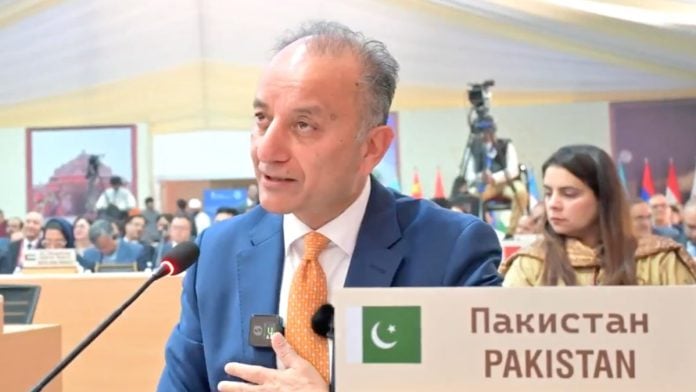
New Delhi: Invoking the poetry of Mirza Ghalib and Delhi’s layered history, Pakistan Minister for Climate Change, Musadik Malik, appealed for cultural understanding and dialogue among nations Saturday. He described the Indian capital as a city strengthened, rather than diminished, by successive waves of civilisations.
“Delhi has not been diminished by civilisations and people coming from outside; rather, it has grown stronger,” he said.
Speaking at the Shanghai Cooperation Organisation’s (SCO) Civilisational Dialogue Forum at Delhi’s Purana Qila, Malik said he felt uncomfortable addressing the gathering in English while sitting just a few miles from the grave of Ghalib, one of Urdu literature’s most celebrated poets.
“It felt very strange to sit here a few miles away from Ghalib’s grave and speak in English,” he said. “So I decided to speak to you in Urdu, the language of my heart.”
Malik reflected on the irony that Ghalib, whose grandfather came from Samarkand and who considered himself a great Persian poet, lies buried in Nizamuddin, having achieved worldwide recognition through his Urdu poetry.
“Ghalib has a different style of expression,” Malik said, arguing that the poet’s legacy demonstrated how distinct voices and identities could coexist and enrich a shared cultural tradition.
During his visit, Malik sought permission to visit the Taj Mahal in Agra and the Nizamuddin Dargah in New Delhi. While the request to travel to Agra was granted, permission to visit the Nizamuddin Dargah was denied for security reasons.
He described Delhi as a city with a distinctive literary and cultural identity, alongside other historic centres such as Lucknow and Lahore.
Culture beyond diplomacy
Using Purana Qila as an example, Malik pointed to its historical associations with two rulers from different backgrounds: Humayun, whose dynasty had Central Asian roots, and Sher Shah Suri, the Afghan ruler who expanded and developed the fort.
“One wall, two rivals, two rulers and one qila,” he said, describing the monument as a reflection of the cultural diversity that the forum had gathered to celebrate.
For Malik, the significance of the gathering lay in the exchange of ideas across different civilisations without requiring countries to abandon their individual identities. Dialogue, he suggested, depended on recognizing distinct histories, cultures and perspectives, as well as the willingness to engage with them openly.
The Pakistani minister also spoke about the value of informal exchanges with representatives from neighbouring countries, describing conversations with delegates from Central Asia, Nepal and other participating nations as particularly meaningful.
In an earlier interaction with journalists Friday, Malik said the forum provided an opportunity for countries whose representatives rarely meet or engage directly to understand one another’s perspectives.
He said conversations around music, literature and culture offered insights that formal diplomatic engagements often failed to provide.
Such interactions, he added, helped build confidence and encouraged countries to understand one another’s difficulties, concerns and experiences. He also called for greater use of multilateral platforms to address regional challenges, including terrorism and instability in neighbouring countries.
Terrorism and regional cooperation
When asked about cross-border terrorism, he said thousands of people had been killed in Pakistan too over the past 18 to 24 months and called for a transparent mechanism through which countries could share evidence and investigate allegations.
“We have to bring transparency, we have to bring evidence from both sides,” he said, adding that regional security concerns should not be reduced to isolated bilateral disputes or exchanges of accusations.
He described the neighbourhood as a complicated region facing multiple challenges, including instability in Iran, Afghanistan and Central Asia, and said these issues required sustained regional cooperation.
Malik maintained that the purpose of such forums should be to find solutions through patience, evidence and collective engagement rather than allowing individual incidents to dominate relations between countries.
His remarks came during a visit that carries diplomatic significance. Malik is the first Pakistan federal minister to visit India since the military confrontation between the two countries in May 2025, following the Pahalgam terror attack and India’s subsequent Operation Sindoor.
India had extended an invitation to Pakistan’s culture minister Aurangzeb Khichi; Pakistan instead chose to send Musadik Malik, the minister for climate change.
In June, Malik threatened “to cut off” India’s “hands” if it touches the Indus waters. The comment came as India continues to hold the Indus Waters Treaty of 1960 in abeyance following the terror attack in Jammu and Kashmir’s Pahalgam, which left 26 people dead.
He is also the first Pakistan federal minister to visit India since former Foreign Minister Bilawal Bhutto Zardari attended an SCO meeting in Goa in 2023. The SCO Civilisational Dialogue Forum, being held for the first time from 20 to 22 November, is an Indian initiative aimed at encouraging cultural exchanges among member countries, including India, Pakistan, China, Russia and several Central Asian nations.
Earlier in September, India’s SCO Coordinator Alok Dimri had visited Lahore.
(Edited by Anupama Yadav)