



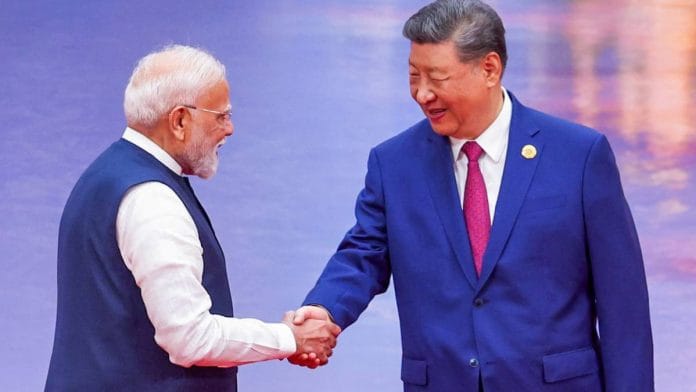
New Delhi: Ahead of President Xi Jinping’s likely visit to India for the BRICS summit in September, the Chinese Embassy is pushing to curtail media access to groups such as the Falun Gong, as well as Tibetans, ThePrint has learnt.
Senior embassy officials raised concerns about media access for news organisations linked to these groups and the potential for them to question the Chinese delegation attending the leaders’ summit scheduled for September 12 and 13 in the national capital.
The Ministry of External Affairs launched the media accreditation process for the summit last week. As chair of the BRICS summit, media accreditation and access to media spaces at the summit venue is under control of the Indian government.
Falun Gong claims to be a spiritual organisation and has been banned in China since 1999. The group is linked to multiple news organisations such as The Epoch Times, published in New York City.
Similarly, India is home to a large number of Tibetan refugees, especially in Dharamshala, and multiple news organisations have since been established by the refugee communities.
Radio Free Asia—funded by the American government—has reporters in India covering stories on the Tibetan refugee communities. Similarly, the Voice of Tibet is another media house established in Dharamshala.
A number of media organisations connected to Falun Gong and Tibet are blocked in China. India has for years allowed different media outlets to operate in the country as long as they follow local rules and regulations.
The request to curtail access to these organisations comes as President Xi is likely to make his first visit to India in seven years following his last trip to Mamallapuram for an informal summit with Prime Minister Narendra Modi.
Months after his last visit, ties between India and China deteriorated following the clashes at Galwan during the summer of 2020.
India and China agreed to disengage at the friction points across the Line of Actual Control (LAC) in October 2024, leading to Modi and Xi meeting in the Russian city of Kazan a few days after the disengagement agreement on the margins of the BRICS leaders’ summit.
Modi travelled to the Chinese city of Tianjin last year to attend the heads of states’ meeting of the Shanghai Cooperation Organisation (SCO) and met with Xi on the summit’s margins.
Both sides have since worked to introduce confidence building measures to stabilise the political relationship. India resumed issuing visas to Chinese citizens last year, while Beijing restarted the Kailash Mansarovar Yatra, which was held in 2025 and is currently ongoing.
The BRICS summit is set to be India’s biggest international summit since the G20 summit held in September 2023.
A number of international leaders are expected to visit New Delhi, including Russian President Vladimir Putin, Chinese President Xi, Iranian President Masoud Pezeshkian, Egyptian President Abdel Fattah El-Sisi, and Malaysian Prime Minister Anwar Ibrahim. Malaysia is a BRICS partner country.
Tarique Rahman, Prime Minister of Bangladesh, has been invited and is expected to attend the summit in his role as the chair of BIMSTEC, as part of the larger BRICS outreach efforts led by India. Brazilian President Lula da Silva is not expected to attend the summit due to elections in the South American country at the time.
BRICS consists of 11 member-states and 10 partner countries. The 11 members include Brazil, Russia, India, China, South Africa, Egypt, Ethiopia, Iran, UAE, Indonesia and Saudi Arabia.
(Edited by Nida Fatima Siddiqui)
Also Read: New Delhi raises Chinese occupation of Indian territory as it counters Beijing’s ‘sovereignty’ claim