


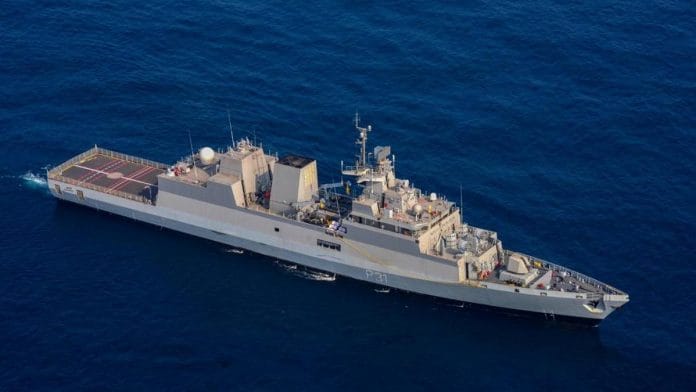
New Delhi: The public sector defence shipyards that were awarded contracts to build eight Next Generation Corvettes (NGCs) for the Indian Navy have moved to outsource part of the order to the private sector, a source familiar with the matter told ThePrint on Friday, adding that an announcement could be made soon. The move will allow at least one private shipyard to build a relatively large, heavily armed frontline warship for the Indian Navy for the first time.
The Ministry of Defence (MoD) signed contracts worth Rs 53,866.50 crore for the eight corvettes on 2 November with Garden Reach Shipbuilders & Engineers Limited (GRSE), Kolkata, and Goa Shipyard Limited (GSL), Vasco da Gama, both defence public sector undertaking (DPSU) shipyards.
“Both GRSE and GSL will outsource the construction of a total of three NGCs. The aim is to rope the private sector into major naval platform manufacturing and ensure that production capacity does not constrain naval shipbuilding,” the source said.
“This will allow at least one Indian private sector shipyard, which will be considered the partner shipyard of a public sector counterpart, to build such a large and capable frontline warship for the Indian Navy for the first time,” the source added.
While declining to identify the private shipyard that will take on the role, the source said the move was in line with the dual production pipeline initiative outlined by defence officials in recent months. Under this approach, two or more production lines including existing public sector capacity are established for the same equipment or similar categories of equipment to ensure both scale and speed of production.
“The government would like to see the public and private sectors working together,” the source said. “The thinking is that, in the case of shipbuilding, a whole-of-industry approach through public-private cooperation could lead to faster execution of contracts than is possible in isolation.”
Also Read: Japan to use Indian ranges for missile tests as New Delhi-Tokyo move to boost defence ties
Following the AMCA model
A similar dual production model is already on its way to being implemented in military aviation through the initiative for the country’s first stealth combat aircraft, the Advanced Medium Combat Aircraft (AMCA).
The AMCA is being developed through an industry partnership model. The process of selecting a company or consortium that will help develop and build its prototypes is underway, with the winning bidder expected to be announced soon.
There are three contenders: the Tata Group and two consortia led by the Kalyani Group and Larsen & Toubro (L&T), respectively. Whichever bidder is selected will end state-run Hindustan Aeronautics Limited’s (HAL) monopoly over combat aircraft manufacturing by creating an additional production line in the country.
Now, it appears that an effort is underway to replicate the same in naval shipbuilding.
What are the Next Generation Corvettes?
The eight NGCs will be built to an indigenous design developed by the Indian Navy, according to the MoD’s statement issued when the contracts were signed.
Each warship will have a deadweight tonnage of 4,950 tonnes, an endurance of 14 days at sea without replenishment and a maximum speed of 26 knots. They will have a crew of 11 officers and 139 sailors.
Powered by a combined diesel and gas turbine–cross-connect propulsion arrangement, the NGCs are designed for a range of maritime missions. These include offensive ship-to-ship and ship-to-surface missile strikes, anti-missile defence, anti-submarine warfare, escort duties, maritime interdiction operations—including visit, board, search and seizure—and local naval defence.
They will be equipped with medium-range anti-ship missiles, Israeli-Indian Medium-Range Surface-to-Air Missiles (MRSAM), torpedoes, an upgraded OTO Melara 76 mm super rapid gun mount, an AK-630 close-in weapon system, and 12.7 mm stabilised remote-controlled guns integrated with an electro-optic-based fire control system.
The sensor suite will feature an electro-optical infrared search-and-track system and an Israeli-Indian Multi-Function Surveillance, Track and Guidance Radar (MFSTAR). The corvettes will also have helicopter-operating capabilities.
Responses to queries emailed to GRSE and GSL are awaited. This report will be updated when they are received.
(Edited by Chingkheinganbi Mayengbam)
Also Read: First Tejas Mk1A squadron to be formed by end of March 2027, says IAF chief Dixit