


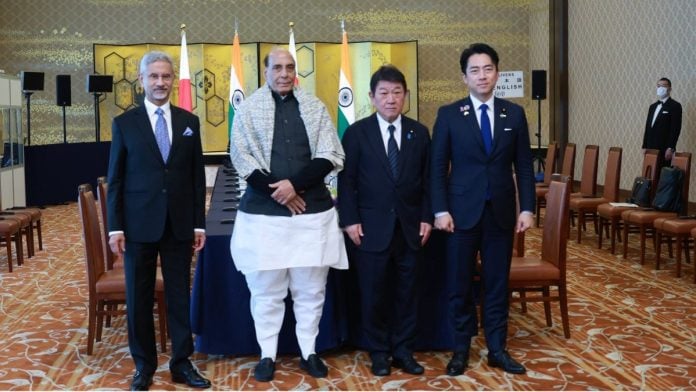
New Delhi: Japan has announced that its Self-Defence Forces will begin using Indian firing ranges next year to test long-range missiles, following the conclusion of meetings between the foreign ministers and defence ministers of the two countries Thursday for the 2+2 Dialogue in Tokyo.
India has also raised its expectation for early consideration of the agreements related to co-production of the UNICORN (Unified Complex Radio) naval antenna. The first agreement on the co-production of UNICORN was announced earlier this year by Prime Minister Narendra Modi during Japanese Prime Minister Sanae Takaichi’s visit to New Delhi in July.
The Joint Statement issued following the 2+2 Dialogue highlighted the expectation for Acceptance of Necessity for the UNICORN naval radio antenna by February 2027.
“This 2+2 meeting takes place at a time when the global order is being subjected to multiple shocks. There are two major ongoing conflicts whose impact have been felt even in distant regions. Coupled with the growing economic volatility and the after effects of the Covid pandemic, there are very strong concerns about energy, trade, food and health security. As we seek to secure ourselves on these fronts, trusted and substantive partnerships like ours become more valuable,” S. Jaishankar, India’s External Affairs Minister said in a statement to the press, following the 2+2 Dialogue.
He added, “Our 2+2 meeting naturally took into account the changing nature of warfare. We are witnessing the effective application of smart weapons and innovative solutions. Our cooperation here feeds into a larger engagement on innovation and startups. The big picture that our cooperation seeks to support is a multi-polar Asia and a multi-polar world.”
Defence Minister Rajnath Singh highlighted that he and his counterpart Shinjirō Koizumi “concurred” in moving forward to “swiftly realise concrete cooperation in fields of maritime and air domain awareness, search and rescue and information sharing agreements”.
He said, “We expressed our expectations for the early consideration of the UNICORN-related agreements and look forward to further strengthening our defence industrial cooperation under the framework of ‘Design with Japan and Make in India’.”
The Indian Defence Minister also highlighted the “need” for early conclusion of a maritime ship repair arrangement, which would allow for reciprocal provisions of ship repair facilities. Additionally, Singh underlined that niche technologies, underwater technologies and space domain awareness was also discussed. The two ministers agreed to “enhance” cooperation in anti-mine measures as well.
The major announcement of Japanese Self-Defence Forces using Indian testing ranges was made by Koizumi in a statement on X.
“We agreed that next year, the Self-Defense Forces will use an Indian firing range for the first time. This is also a major step strategically,” he wrote.
日印2プラス2共同記者会見。成果を発表しました。来年、自衛隊が初めてインドの射場を活用することで合意。戦略的にも大きな一歩です。@rajnathsingh @DrSJaishankar @moteging pic.twitter.com/1XDwFbI0Ix
— 小泉進次郎 (@shinjirokoiz) November 19, 2026
Last month, the Japanese Ground Self-Defence Force Chief of Staff General Masayoshi Arai had confirmed to local media that officials had been dispatched to India to inspect possible testing ranges for training with the Type-25 surface-to-ship missile. This missile has a range of roughly 1,000 kilometres.
“They welcomed the signing of LOI (Letter of Intent) toward the utilisation of firing ranges in India, whereby Japan Self-Defence Forces would, for the first time, conduct live-fire training etc., including those involving surface-to-ship missiles, at firing ranges in India,” Thursday’s Joint Statement read.
On Wednesday, Singh and Koizumi toured the Japanese Maritime Self-Defence Forces base at Yokosuka. Singh inspected the Mogami-class frigate JS Natori.
Jaishankar and Singh co-chaired the 2+2 Dialogue Thursday. The Indian External Affairs Minister reached Tokyo Wednesday, following his two-day visit to Manila alongside Prime Minister Narendra Modi for the India-ASEAN (Association of Southeast Asian Nations) summit.
Singh and Koizumi have met three times in the last three months. They had met in New Delhi in August, and in Cebu, the Philippines last month on the margins of the ASEAN Defence Ministers’ Meeting-Plus. The intensification of high-level meetings points to growing strategic convergences between New Delhi and Tokyo.
Jaishankar also held the India-Japan Foreign Ministers’ Strategic Dialogue during his visit to Tokyo, along with his Japanese counterpart Toshimitsu Motegi.
Apart from the 2+2 Dialogue, the two countries also launched a commemorative logo representing 75 years of the establishment of diplomatic ties, which will be celebrated in 2027.
Also Read: Trump pushes AI, military cooperation at Quad summit; India pushes safety of seafarers
China’s looming shadow
For Japan, India has increasingly become key to its strategic agenda as ties with China continue to remain tense. Japanese PM Takaichi travelled to China’s Shenzhen Wednesday to attend the Asia-Pacific Economic Cooperation (APEC) forum, following her two-day visit to the Philippines for ASEAN-related summits.
However, China has sought to recast Japan’s recent military build-up as one that has potential to “destabilise Asia”, according to a report by The New York Times.
China and Japan have been in a war of words, especially after Takaichi announced that Japan may be forced to defend Taiwan—the self-governing territory, recognised by India as Chinese territory—in case of any future invasion by China.
Takaichi has moved to loosen export rules for military weapons, and increased defence spending to two percent of Japan’s gross domestic product (GDP) about two-years earlier than planned. In the looming shadow extended by Beijing, New Delhi has sought to describe its relationship with Tokyo as one that has an important role for stability across the Indo-Pacific.
“We also spoke about a growing tendency to weaponise connectivity, resources, services, supply chains and market shares. Many of these have direct implications for our national security. Strengthening resilience and exploring new options must be seen in that context. Concerns about connectivity and chokepoints have grown in the light of experiences in the Gulf,” said Jaishankar in his remarks to the press.
“We are two significant nations of the Indo-Pacific with a long and continuous history of friendship and goodwill. As we enter an era where each nation has to step-up its contributions to the global order, a stronger India-Japan relationship can certainly play a more important role. Our 2+2 discussions today and the understanding we reached were a very good step in that direction.”
As the war of words between China and Japan intensified this year, Beijing has imposed a number of export restrictions on merchandise flowing to Tokyo, pointing to the “weaponisation” of resources and supply chains. One of the earliest export restrictions on rare earth elements (REEs) was imposed by China in 2010 on exports to Japan, following a boat collision in the disputed territory of Senkaku islands.
(Edited by Mannat Chugh)
Also Read: ASEAN Summit: Modi proposes free e-visas for tourists, nuclear energy technical exchanges