


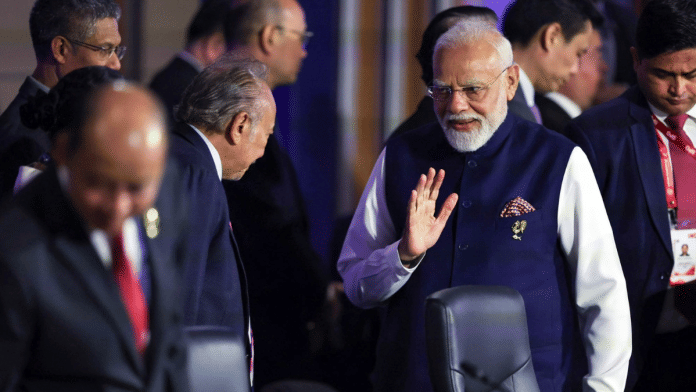
New Delhi: India and the Association of Southeast Asian Nations (ASEAN) adopted a joint statement on cooperation in disaster management Tuesday, while Prime Minister Narendra Modi made several proposals, including free e-visas for citizens from the group’s member-states, and nuclear technical exchanges.
“This is my thirteenth interaction with ASEAN leaders in this format. Over the past few years, our Act East Policy has given new momentum and greater depth to India-ASEAN relations. Our partnership has now expanded beyond our shared culture and heritage, acquiring new dimensions in areas such as digital technology, defence, and space,” said Modi while addressing the India-ASEAN summit in the Philippine capital of Manila.
The Indian Prime Minister added: “Over the past twelve years, we have given fresh momentum to our partnership. Now, together, we must give a new direction to the future of our region. India’s commitment to ASEAN unity and centrality in this partnership has been, and will remain, unwavering.”
The summit is a part of the larger ASEAN dialogue mechanisms. ASEAN is a regional organisation of 11 member-states including the Philippines, Singapore, Brunei Darussalam, Myanmar, Malaysia, Indonesia, Cambodia, Laos, Vietnam, Thailand and Timor-Leste.
Modi underlined that the future of the region depends on “cooperation” and not “competition”, while reiterating India’s long-standing support for a “free, open, inclusive and rules-based Indo-Pacific,” according to the statement published by the Ministry of External Affairs.
The Prime Minister made nine proposals to strengthen engagement between India and ASEAN including cooperation on critical minerals and mining, a space hackathon, a cyber forensics training programme, and a long-term maritime cooperation plan to enhance connectivity, scientific research, disaster management, Coast Guard cooperation, maritime domain awareness and seafarers’ safety.
The issues raised by the Indian PM indicate the growing convergences between India and the 11-member organisation focused around space, defence and maritime cooperation. India and ASEAN have signed a number of joint statements and vision documents over the years. The latest area of focus is the joint statement on cooperation in disaster management.
Under the new joint statement, India and the organisation will focus on enhancing cooperation on early warning systems, have regular consultations between disaster management agencies, building on ongoing space cooperation to use the technologies in disaster cooperation, hold joint training exercises and other training programmes.
Modi is on a two-day visit to the Philippine capital. Apart from attending the India-ASEAN summit, the Prime Minister will also speak at the East Asia Summit—an inter-governmental forum bringing together the ASEAN member-states and eight other countries—as well as attend the Quad leaders’ summit.
For India, the ASEAN dialogue format remains a key pillar of New Delhi’s “Act East” Policy. In the last 12 years, India has taken up more than 100 initiatives to strengthen people-to-people ties and over 250 Quick Impact Projects (development projects that cost less than $50,000 each), and provided over 10,000 skill-building scholarships to the region.
The visit to Manila is Modi’s third visit to an ASEAN member-state this year, and he noted that the current summit is his “thirteenth interaction” with the regional organisation in the current format.
“Over the past few years, the world has faced one crisis after another. Today, what the world needs most is peace, stability, and predictability. In this context, this year’s theme, ‘Navigating Our Future, Together’, holds special significance. Together, India and ASEAN represent nearly one-fourth of the world’s population. That is why it is essential to ensure that our future is shaped not by competition, but by cooperation,” said Modi.
India’s stepped up its efforts to cooperate closer with countries a part of the grouping in recent years. Vietnam and the Philippines are both the first foreign countries to purchase the BrahMos supersonic missile platform, jointly produced by India and Russia. India has stepped up efforts to collaborate with countries in the region when it comes to maritime domain awareness.
The regional organisation has seen its strategic importance increase in recent years, as China has stepped up its efforts to engage with the region, while the US and now increasingly India have all highlighted their interests to cooperate with ASEAN.
None of the statements by the leaders reflected the ongoing review of the ASEAN-India Trade in Goods Agreement (AITIGA), which came into force in 2010. The trade agreement has seen trade between India and ASEAN grow substantially in the last 16 years. However, the trade deficit has grown from $7 billion in 2011 to around $44 billion in 2024, in favour of ASEAN member-states.
The review has been ongoing since 2020. For India, its main ask remains that countries such as Vietnam and Indonesia open their markets for Indian goods, as per the terms of the original agreement. Indonesia has opened up only around 51 percent of its tariff lines for Indian goods, as prescribed in the AITIGA, while other countries like Singapore have fully opened their markets for Indian merchandise. The target for the conclusion of the review remains before the end of the current fiscal year.
Also Read: What is ASEAN and why does the bloc matter?