


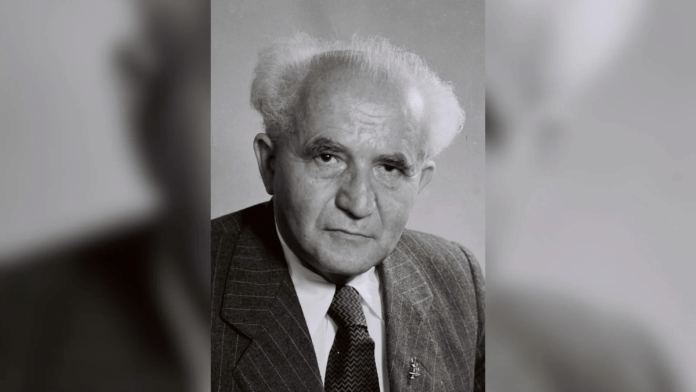
New Delhi: More than 70 years ago, as Israel prepared to invade Egypt during the 1956 Suez Crisis, its founding prime minister, Labour Zionist David Ben-Gurion, wished the Gaza Strip would “sink into the sea”. His comments came at a Cabinet meeting on 28 October 1956, on the eve of the 1956 Sinai Campaign. Seven decades later, his comments have resurfaced after the Israeli Defence Forces (IDF) released documents on the war to mark the 70th anniversary of the campaign, also known as Operation Kadesh.
“The Gaza Strip is an ‘embarrassing’ objective […] We have to take it. It stands in our way. If I believed in miracles, I would wish it would sink into the sea,” he said. And not once, but twice, the new documents reveal.
Ben-Gurion reportedly repeated the sentiment at a conference of senior military officers on 4 April 1957, several months after Israeli forces withdrew from Gaza and the Sinai peninsula.
In another newly released document, Ben-Gurion cautioned IDF commanders against treating the success of Operation Kadesh as a precedent for future wars. While the Israeli military had managed to keep casualties relatively low during the Sinai Campaign, he warned that there was no guarantee this would be possible in another conflict.
He stressed that a future war could cause extensive damage to Israel’s civilian home front, urging commanders not to draw parallels between the Sinai Campaign and the wars to come. The documents also cover lesser-known aspects of the 1956 campaign, including Operation Honio, in which an Israeli team rescued 65 Jews from Port Said, Egypt, in November that year.
Among the documents released is a handwritten account by Shimon Peres, who was serving as director-general of Israel’s Defence Ministry during the campaign. Peres described what appeared to be two contradictory decisions by Ben-Gurion: his decision to go to war and his subsequent decision to withdraw. In his account, Ben-Gurion had explained that military victories could not resolve the underlying conflict between Israel and the Arab world.
“He also explained to us that wars would not solve the problem of Arab-Israeli relations, since our victory in battle does not necessarily mean the last battle, but an Arab victory could be the final victory,” Peres wrote.
Also Read: 3 years since 7 October: How Hamas attack impacted Israel, Gaza, and reshaped geopolitics
What was the Sinai war?
The IDF launched the 1956 Sinai Campaign with the stated objective of stopping feda’yun raids originating from bases in the Egyptian-administered Gaza Strip and Sinai Peninsula. The cross-border incursions, which had intensified over the preceding two years, targeted largely civilian areas inside Israel, according to research papers.
However, the operation soon revealed a broader military and political agenda. Israel had coordinated its campaign with Britain and France, both of which sought to weaken Egyptian President Gamal Abdel Nasser’s government. Tensions had escalated after Egypt announced a major arms deal with the Soviet Union and Czechoslovakia in September 1955 and nationalised the Suez Canal Company in July 1956, defying British and French interests.
On 29 October 1956, as Israeli forces entered Egypt, former Israeli prime minister and foreign minister Moshe Sharett was in New Delhi, having left government a few months earlier. Sharett, who had served as Israel’s first foreign minister from 1948 to 1956 and its second prime minister from 1953 to 1955, had long worked closely with David Ben-Gurion, though their differences over military policy had grown increasingly pronounced.
During his tenure as prime minister and foreign minister, Sharett had favoured restraint in responding to feda’yun raids, opposing the increasingly popular strategy of military reprisals advocated by defence minister Ben-Gurion, IDF chief Moshe Dayan and other hardliners. Despite these disagreements, he reluctantly agreed to remain foreign minister when Ben-Gurion returned as prime minister in November 1955.
As tensions mounted following the Egypt-Czechoslovakia arms deal, Sharett led diplomatic efforts to secure Western guarantees against an Arab attack on Israel. He also pursued the acquisition of defensive weapons from the United States, Britain, France and Canada, although the parallel efforts by the foreign and defence ministries were often poorly coordinated.
His disagreements with Ben-Gurion deepened through 1955 and 1956. Sharett repeatedly mobilised Cabinet support to block proposals to capture the Gaza Strip and the Straits of Tiran, including Sharm el-Sheikh, and to withdraw Israel from the 1949 General Armistice Agreement in response to alleged Egyptian violations.
The relationship reached a breaking point in December 1955, when Sharett, then in the United States pursuing arms requests, learnt of a major Israeli military assault on Syrian positions near the Sea of Galilee. He felt sidelined by the decision, sarcastically recording in his diary that Defence Minister Ben-Gurion had effectively consulted Foreign Minister Ben-Gurion and secured approval from Prime Minister Ben-Gurion.
The attack, which resulted in a disproportionately high number of Syrian casualties, provoked international criticism. Washington and London subsequently delayed decisions on Israel’s arms requests pending hearings at the UN Security Council.
By the spring of 1956, Sharett’s differences with Ben-Gurion had become irreconcilable. He resigned as foreign minister on 18 June 1956, marking the end of his role in the government he had helped build. His departure also paved the way for Golda Meir to take over the foreign ministry.
The Gaza gamble
But the newly released records also reveal that Ben-Gurion was deeply conscious of the dangers of a future conflict, warning military commanders against assuming that the relative success of the Sinai campaign would be repeated. He also warned that a future war could bring death and destruction to Israeli cities, killing not just soldiers but women and children.
“Tel Aviv will be bombed, Haifa will be bombed, and people will be killed. Not combatants, women, children,” he warned.
Ben-Gurion’s remarks reflected the strategic and political difficulties Israel faced in deciding what to do with Gaza, which had come under Egyptian administration after the 1948 Arab-Israeli war. In his assessment, neither Israeli nor international administration offered an easy solution to the territory’s future.
“We know that the Gaza Strip is a problem under any administration, whatever that administration may be, whether it is an Israeli administration, or an Israeli administration plus the UN, or a UN administration without Israel,” he said.
Ben-Gurion also warned that retaining control of Gaza could come at a political and moral cost for Israel. He argued that continued occupation would invite international isolation and require Israel to suppress Palestinian resistance, a burden he believed the country could not sustain.
“From the very beginning, I strongly opposed those who demanded the annexation of Gaza,” he said, adding that Israel had no need for “another 300,000 Arabs” as citizens.
He cautioned that a prolonged presence in the Strip could ultimately damage Israel not on the battlefield, but in the moral realm. “If, in the eyes of the people and in the eyes of the world, we lose our moral right to exist, Israel cannot exist,” he warned.
Also Read: Palestinians have become a footnote in Middle East politics. It is all about Iran now
Who was David Ben-Gurion?
David Ben-Gurion, Israel’s founding prime minister, was born into a Polish-Jewish family and moved to Ottoman Palestine in 1906, driven by Zionist ideals and the persecution of Jews in eastern Europe. A secular Jewish nationalist with socialist convictions, he became a leading figure in the Zionist movement, combining political ambition with formidable organisational and strategic skills.
After a brief exile in the United States during World War I, he returned to Palestine and emerged as the chief architect of the movement’s political and military institutions. Though he recognised the legitimacy of Arab opposition to Zionism and the competing claims to the same land, he believed an independent Jewish homeland was essential for the survival of a persecuted people. He pursued political compromises while building the foundations of a state and an underground military apparatus.
During the Holocaust, Ben-Gurion helped organise Jewish immigration to Palestine while encouraging Jews to join the British war effort against Nazi Germany. His leadership and diplomacy contributed to the international support that culminated in the UN’s 1947 partition plan.
On 14 May 1948, he proclaimed Israel’s independence despite warnings from Washington and predictions of an Arab invasion. The ensuing war killed thousands, displaced more than half a million Palestinians and cemented his position as the dominant figure in Israel’s founding.
Ben-Gurion later coordinated Israel’s 1956 invasion of the Sinai Peninsula with Britain and France, viewing it as a means of securing the country’s borders. After the 1967 Six-Day War, however, he cautioned against territorial expansion, advocating the return of newly captured territories in exchange for peace, while retaining an undivided Jerusalem.
He died in 1973, weeks after the Yom Kippur War, the 19-day military conflict fought from October 6 to October 25, 1973, between Israel and a coalition of Arab states led by Egypt and Syria.
The 1973 Yom Kippur War began with a surprise Egyptian-Syrian attack on Israel on 6 October, during the Jewish holy day. Although Egyptian forces initially made gains across the Suez Canal, the Israeli military eventually counterattacked. The conflict ended without a decisive Egyptian military victory, but it helped pave the way for renewed diplomacy.
Egyptian President Anwar el-Sadat then pursued a diplomatic opening with Israeli Prime Minister Menachem Begin, with the United States playing a central role. In November 1977, Sadat visited Jerusalem, where he met Israeli leaders and addressed the Knesset. The visit paved the way for negotiations under US President Jimmy Carter at Camp David, the presidential retreat near Washington, DC.
The talks culminated in the Camp David Accords of September 1978, which laid the groundwork for a peace treaty. Under the agreement, Israel committed to withdrawing from the Sinai Peninsula, while Egypt agreed to establish normal relations with Israel and provide security guarantees. Sadat and Begin were jointly awarded the 1978 Nobel Peace Prize for their efforts.
The two countries signed the peace treaty on 26 March 1979 and exchanged ambassadors the following year. Currently, both countries share an uneasy peace. Egyptian president Abdel Fattah El-Sisi has ruled out a full normalisation of ties with Israel until its military campaign in Gaza ends and meaningful progress is made towards Palestinian statehood. Cairo has also firmly opposed the forced displacement of Palestinians into Egypt’s Sinai Peninsula. There were also reports that Egyptian intelligence, under former chief Abbas Kamel, had warned Israel ahead of 7 October 2023 but Netanyahu had not paid heed.
Despite diplomatic strains, economic cooperation continues, especially through multi-billion-dollar natural gas agreements linked to Israel’s Leviathan gas field and export infrastructure. Egypt also remains a key mediator in negotiations between Israel and Hamas over ceasefires and hostage releases.
(Edited by Nardeep Singh Dahiya)