




New Delhi: On 7 October, 2023, Hamas launched a coordinated cross-border assault from the Gaza Strip into southern Israel. The attack resulted in the deaths of approximately 1,200 people, mostly civilians, and the abduction of 251 hostages into Gaza. Israel responded by launching a major military campaign in Gaza, which accounts for over 70,000 deaths in the region according to the Gaza Health Ministry.
Attackers deployed commercial drones armed with small explosives to hit Israeli observation towers, cameras, and remotely operated machine guns to degrade the border surveillance network before and during the attack. Simultaneously, thousands of rockets were launched into southern and central Israel to overwhelm the Iron Dome, Israel’s missile defence system.
Hamas fighters infiltrated at least three military installations, including the Beit Hanoon border crossing, the Zikim Base, and the Gaza Division Headquarters, according to the Israeli military. The fighters raided several towns, including Sderot and Ofakim. As per BBC reports, 260 people died in open fire by Hamas attackers at the Nova music festival site.
The Hamas assault occurred at a moment of profound geopolitical realignment across West Asia. The broader geopolitical landscape in the region was being shaped by the Abraham Accords. The Accords, negotiated by the US, were an attempt to normalize diplomatic ties between Israel and several Arab nations.
In 2020, the UAE, Bahrain, and Morocco were brought on board. By September 2023, a possible Saudi-Israeli normalization agreement was reaching its peak momentum. This diplomatic push could have signalled to Hamas and other Palestinian factions that regional economic and security integration could permanently bypass the Palestinian question.
Coupled with this, in the West Bank region, clashes between Israeli settlers and local Palestinians were rising at the beginning of the year 2023. Reports of escalating clashes and military raids in cities like Jenin and Nablus were routinely seen in international media.
By mid-2023, The Guardian reported, as many as 25 to 26 operational battalions were deployed to the West Bank. The perimeter surrounding the Gaza Strip was left monitored primarily by minimal guards on duty and automated weapons.
The history of Hamas
Hamas was founded in 1987 as a resistance movement with a military wing after the first Intifada. Since its inception, Hamas has separated itself from the Palestine Liberation Organisation (PLO), the umbrella organisation with a more democratic and diplomatic approach toward the Palestinian question.
Reports state that Israel supported Hamas initially, as the Hamas-PLO rift kept the Palestinian question down. The years following show a mix of goodwill gestures and hostility by both parties. Israel has held the Gaza Strip blockade since 2007, sealing off its own and the Egyptian border.
But post-2021, Israel supported the Qatari financial aid and gave out employment contracts for Gazans to work in Israel. Major military escalations by Israel happened mainly in 2008–2009, 2012, 2014, and May 2021.
Over the same time period, Hamas routinely launched rocket salvos into Israel in 2008, 2012, 2014, and 2021, forcing civilians into bomb shelters. Hamas held hostage Israeli soldier Gilad Shalit for 5 years, exchanging him for 1,027 Palestinian prisoners in 2011. Low-intensity violence frequently targeted Israeli military personnel throughout the period.
Also Read: 3 reports highlight multiple warnings Netanyahu received and ignored before 7 Oct 2023 Hamas attack
Why border apparatus failed
Israel’s perimeter defence breakdown can be understood by four analytical failures. Foremost was an intelligence failure. Israeli military and intelligence agencies had detailed threat information.
But senior analysts assessed the plan as aspirational rather than an operational reality, even after warnings from surveillance personnel. This intelligence lapse was strengthened by a wider conceptual failure.
October 7, 2023 happened house by house. Road by road. Community by community.
This interactive map documents the atrocities committed by Palestinian Hamas against Israelis and foreign nationals.
See where it happened. See what they did.#UNFORGO7TEN https://t.co/sMo6JLogdf
— Israel Foreign Ministry (@IsraelMFA) October 7, 2026
The Israeli strategic leadership assumed Hamas to be economically weak. The Qatari financial support for Gaza’s civil administration and over 18,000 Gazan work permits were seen as incentives for Hamas to focus on governance instead of conflict.
At the same time, a critical technology failure resulted from excessive dependence on automated sensors, remote-controlled weapons, and the Iron Dome. The incident demonstrated that inexpensive countermeasures and robust planning can nullify expensive electronic defences.
Finally, a response failure or force-disposition compounded these problems. Rising tensions between the Israeli settlers and Palestinians in the West Bank resulted in the redeployment of many Israel Defense Forces (IDF) battalions. This left the Gaza perimeter covered by minimal guard shifts which failed to respond when the surveillance and communication systems were deterred early in the attacks.
The regional escalation
The Hamas attack and the Israeli retaliatory campaign activated existing regional fault lines. On 8 October 2023, Hezbollah initiated cross-border rocket and drone attacks from southern Lebanon in solidarity with Gaza. This led to an Israeli ground invasion in Lebanon, displacing thousands across northern Israel and southern Lebanon.
Concurrently, in late 2023, Iran-aligned Iraqi and Syrian groups attacked US-and Israeli-linked targets, prompting direct American retaliatory attacks inside Iraq and Syria, drawing the US deeper into the regional conflict.
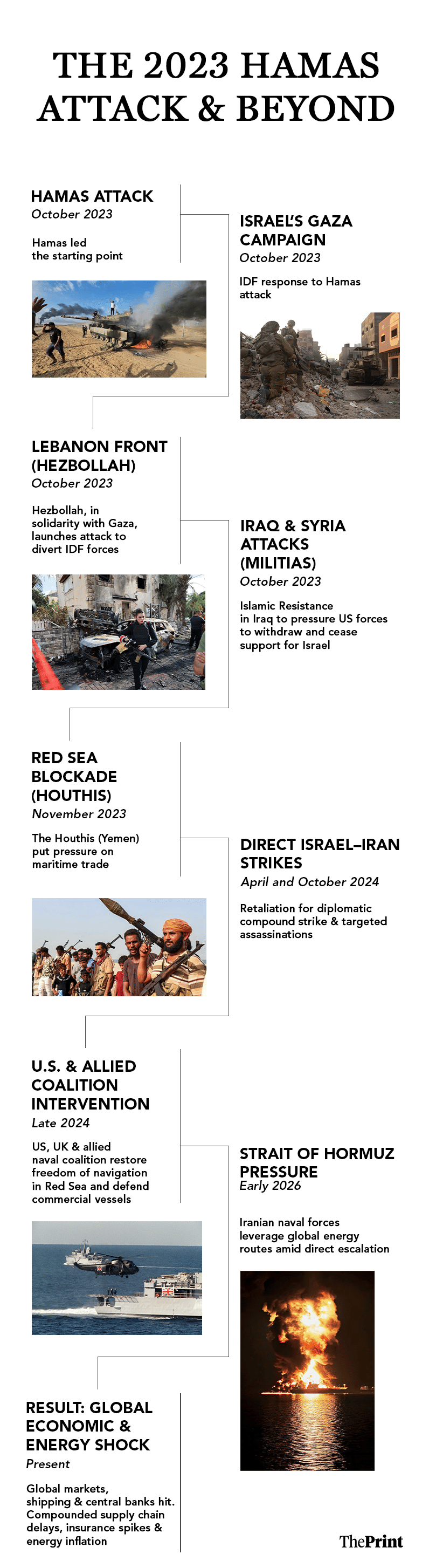
That year saw the Houthis of Yemen blockade the Red Sea region to enforce a limit on Israel and allies shipping until the war on Gaza ended. The blockade put severe restrictions on the world’s shipping routes by limiting traffic across the shortest maritime route via the Suez Canal.
In April 2024, Iran and Israel were in open confrontation. Iran launched direct strikes following Israel’s targeted strike on its embassy compound in Damascus, leaving in tatters the facade of shadow war.
To protect commercial shipping lanes in the Red Sea, US and other regional powers have become increasingly involved. The Western allies conduct targeted strikes to disable Houthi, Iraqi, and Syrian launching capabilities. This Western power projection has been transforming local conflicts into an internationalised defensive campaign.
In February 2026, the US directly attacked Iran, and in retaliation, Iran blockaded the Strait of Hormuz, the world’s most critical maritime energy chokepoint. This earned Tehran some bargaining chips in its war with the global superpower. Over the years, negotiations and attacks have been ongoing, only resulting in the strengthening of the blockade, pushing uncertainty around global crude prices only higher.
Driven by severe logistics disruptions, war-risk insurance premiums, uncertain crude oil prices, Global trade networks, insurance underwriters, major international shipping lines, and central banks are strongly feeling the worldwide inflationary pressures, lengthened maritime supply chains, forced permanent trade realignments, and impacted global fuel prices.
The repercussions
Three into the war, Israel remains institutionally intact and militarily dominant. Tel Aviv doesn’t solely rely on its domestic defence system for security, but on an integrated effort from American allies. When Iran launched a direct barrage of over 300 drones and missiles on Israel in 2024, it was neutralised by a multilateral U.S. Central Command (CENTCOM) network alongside British and French bases spread across the region.
Gaza is undergoing peace deal negotiations. Funding offers to rebuild Gaza facilitated by US President Donald Trump are arriving. However, the strikes have not stopped yet, and the death tolls are rising as reported daily by Al Jazeera.
For India, the Gaza war and its spillover directly impacted key national security, trade, and diplomatic commitments. The India-Middle East-Europe Economic Corridor (IMEC), announced in the 2023 G20 New Delhi summit as a trade route connecting Indian ports to Europe via the Gulf and Israel, was paused abruptly.
Economically, the maritime insecurity in the Red Sea and Strait of Hormuz inflated import costs for crude oil, over 88 percent of which India imports through these vulnerable chokepoints. The blockades also resulted in necessitating the Indian Navy to deploy guided-missile destroyers under Operation Sankalp to escort merchant vessels through turbulent Arabian Sea lanes.
From the larger perspective, the foundational political and security questions of the conflict remain largely unanswered. It remains uncertain how Gaza will be governed in the long term. Questions on whether a two-state solution is possible or if Gaza is to return to Hamas rule or is to be governed by Israel, remain unanswered.
On the broader international stage, the conflict leaves major uncertainties. Questions over whether Arab-Israeli normalization can ever resume, and whether the West Asia region is going to be locked into a no-war, no-peace state, remain unanswered. But it’s clear that what began as a border breach has permanently reordered global trade and international diplomacy.
Moumita Das is a TPSJ alum and currently interning with ThePrint.
(Edited by Tony Rai)