



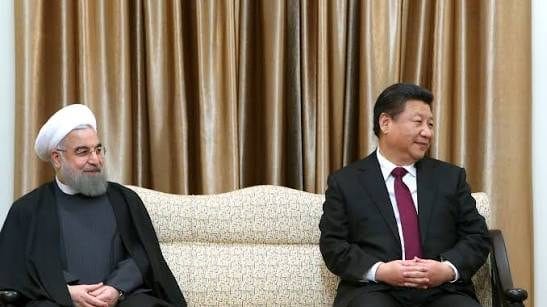
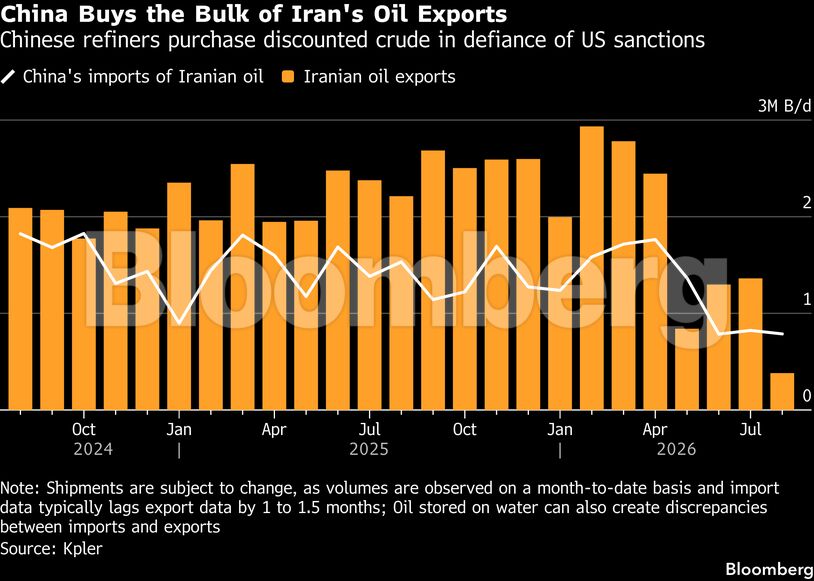
China is Iran’s most important economic partner, buying some 90% of its oil exports and providing a financial lifeline to the heavily sanctioned regime. But since the US and Israel began their war with Iran six months ago, Beijing has offered little visible support to Tehran beyond criticizing the attacks.
In late August, Treasury Secretary Scott Bessent threatened economic punishment against any country doing business with Iran as Washington sought to further isolate the Islamic Republic and end the war. His threats put China’s relationship with Iran under fresh scrutiny — and raised the prospect of another clash between Washington and Beijing ahead of a Trump-Xi summit in September.
However, China’s exposure to Bessent’s threatened measures may be more limited than it would appear. The relationship between China and Iran is far more lopsided and less strategic than commonly assumed. Beijing’s investment in Iran has fallen dramatically short of headline agreements, its military ties are limited and its broader Middle East strategy depends on balancing relations with Iran’s regional rivals.
How important is Iran to China diplomatically?
Ties with Tehran matter to Beijing, but far less than those with Russia. China’s relationship with Iran appears grounded in pragmatism rather than deep strategic alignment.
Iran’s membership in China-led groupings such as BRICS and the Shanghai Cooperation Organization supports Beijing’s effort to dilute US influence and bolster its credentials as a leading voice of the Global South. Beijing’s widely touted role in facilitating a 2023 Iran-Saudi rapprochement enhanced its diplomatic credibility, even as some Western diplomats questioned how central it really was. Beijing hopes to win favor with smaller nations alarmed at Trump’s readiness to intervene militarily in other countries without first seeking an international consensus.
But China has long pursued what analysts describe as a dual-track approach in the Middle East, balancing ties with Iran against its relationships with the US and its regional allies. She Gangzheng, a professor of international relations at Tsinghua University in Beijing, said military support for Iran is “not the way that China does things in the region.”
Beijing’s relationship with Moscow is on a different level entirely. Russia is central to China’s pushback against US dominance, is a critical energy supplier and a partner across multilateral forums. Close personal ties between Chinese leader Xi Jinping and Russia’s Vladimir Putin reinforce that bond.
What is China’s economic relationship with Iran?
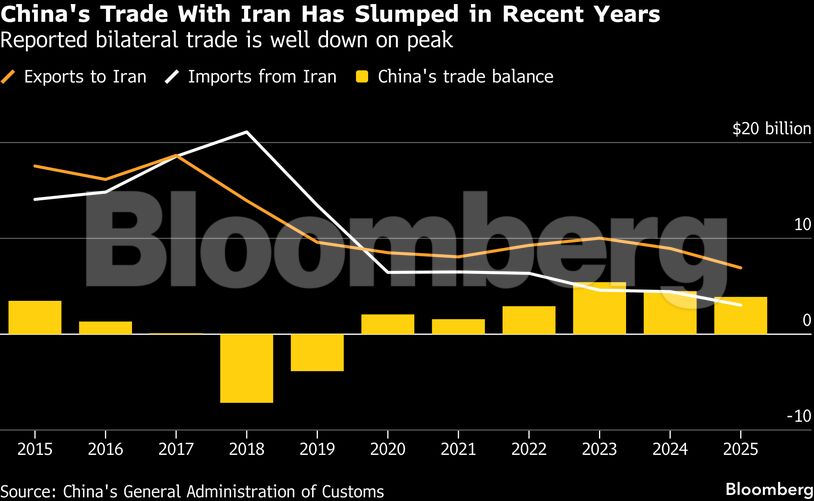
China is Iran’s dominant trade partner, but the relationship is asymmetric. China absorbs roughly a third of Iran’s trade, while the Islamic Republic accounts for less than 1% of commerce for the world’s second-largest economy, according to the Center for Strategic and International Studies.
Iran’s discounted crude makes up roughly a tenth of China’s seaborne oil intake. That helps Beijing to diversify its energy supply from countries such as Russia and Saudi Arabia, but is ultimately replaceable.
Despite headline deals suggesting otherwise, Chinese investment in Iran has been modest. In 2021, Chinese Foreign Minister Wang Yi signed a 25-year strategic cooperation agreement during a visit to Tehran that reportedly envisioned up to $400 billion in Chinese investment. In practice, only $2 billion to $3 billion has been confirmed since then, a figure that pales next to China’s commitments in the United Arab Emirates or Saudi Arabia, according to Alicia Garcia Herrero, chief Asia Pacific economist at Natixis.
Iranian officials have not hidden their frustration. In 2023, two years after the deal was inked, Iran’s then-president, Ebrahim Raisi, said before departing for Beijing that there had been a “serious regression” in the bilateral relationship and that economic ties had been unsatisfactory. Weeks earlier, an Iranian trade official said Russia had overtaken China as Iran’s biggest foreign investor.
China’s official data show its foreign direct investment stock in Iran totaled $4.5 billion by the end of 2024, compared with $9.5 billion in the UAE. The American Enterprise Institute’s China Global Investment Tracker, which monitors transactions of at least $100 million since 2005, puts cumulative Chinese investment in Iran at about $4.7 billion, concentrated primarily in energy and metals. By contrast, it places Chinese investment in Saudi Arabia at about $16 billion across energy, technology, metals and entertainment.
“Chinese companies have a very limited footprint in Iran relative to other countries in the region,” said Esfandyar Batmanghelidj, chief executive of the Bourse & Bazaar Foundation, a London think tank. “Major Chinese firms have steered clear of Iran due to secondary sanctions risks.”
Iran is formally part of China’s Belt and Road Initiative. In 2016, China launched its first cargo train linking Yiwu in eastern China with Tehran via Kazakhstan and Turkmenistan, though the service was suspended during the Covid pandemic before resuming in 2024.
What about China’s military ties with Iran?
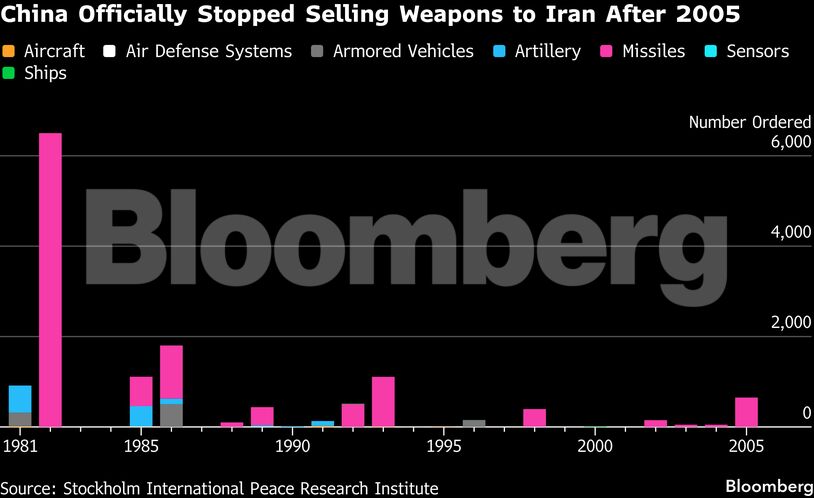
China officially stopped selling weapons to Iran in 2005, when the International Atomic Energy Agency declared Tehran was not complying with the Non-Proliferation Treaty, prompting the UN Security Council — including China — to impose a de facto embargo on nuclear-related exports to Iran. Before that, China supplied a range of missiles, aircraft and artillery, according to the Stockholm International Peace Research Institute.
There have been reports of Chinese air-defense systems reaching Iran and shipments of missile propellant ingredients, but neither China nor Iran has publicly confirmed them. After Trump’s strike, China’s Foreign Ministry dismissed a separate account that Beijing was poised to arm Iran with supersonic anti-ship missiles as “not true.”
More plausible would be the supply of “dual-use” items that are designed for civilian use but can also be employed for military purposes. These would offer China a degree of deniability consistent with its broader playbook. In the last eight years, over 100 Chinese and Hong Kong entities have been added to a US Entity List for assisting Iran’s export control evasion efforts, according to a report by the US-China Economic and Security Review Commission.
But the extent of Chinese support reflects a relationship that is more limited than with Russia, which China has supplied with drones and other dual-use items for the war in Ukraine.
Where does the relationship go from here?
Beijing has limited its support for Iran to trade and diplomacy, stopping short of providing security guarantees like those the US offers some of its partners. China has also maintained productive relationships with Iran’s regional rivals, including Saudi Arabia and the UAE, while keeping its investment commitments in Iran relatively modest.
The balancing act has occasionally caused friction with Tehran. When Xi visited Saudi Arabia in 2022, he did not travel on to Iran, as he had during his 2016 Middle East tour. Several Iranian lawmakers and officials heavily criticized the trip after Xi released a joint statement with Saudi Arabia that referred to Tehran’s “destabilizing regional activities” and its “support for terrorist and sectarian groups.”
Beijing is also pragmatic when it comes to protecting its economic interests with the US. While it does not recognize unilateral sanctions, its state-owned entities generally avoid blacklisted oil. China’s biggest state banks also have a history of complying with US sanctions on Iran, North Korea and even top officials in Hong Kong to avoid losing access to the US dollar-clearing system.
Still, China appears intent on maintaining close ties with Tehran. On Aug. 17, Vice Foreign Minister Miao Deyu held talks in Beijing with Iran’s Deputy Foreign Minister Kazem Gharibabadi, according to a statement published just before Bessent’s comments.
“Iran looks forward to deepening cooperation with China in various fields and advancing bilateral relations,” the statement cited Gharibabadi as saying. “Iran appreciates China’s upholding of justice and fairness and looks forward to China playing a greater role in maintaining regional peace and stability.”
Disclaimer: This report is auto generated from the Bloombergnews service. ThePrint holds no responsibility for its content.