





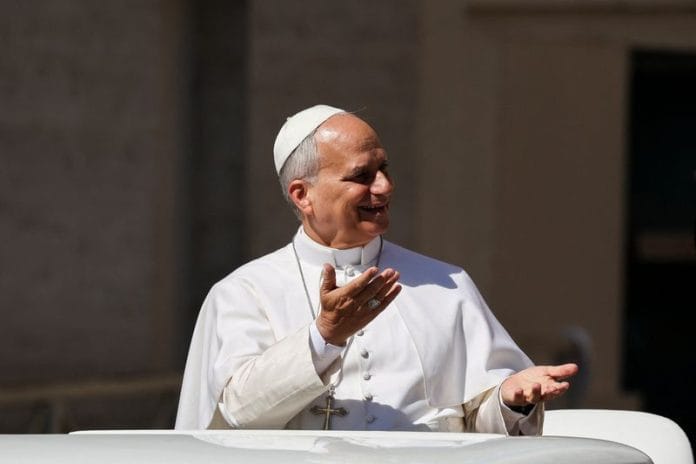


Many, even some Catholics, find the doctrine of papal infallibility hard to swallow. But papal encyclicals — the theological essays that pontiffs issue to guide bishops “in their relations with their flocks” — are almost infallible indicators of social and economic confidence. They must not be ignored.
The mere fact that Pope Leo XIV chose to publish a 40,000-word essay this week arguing that artificial intelligence must “serve humanity, not concentrate power,” shows that the issue has grown salient in society, and signals an approaching turning point.
The Roman Catholic Church isn’t known for its adaptability, but when it attempts to reform, its timing is spectacular. The Vatican II council is a glorious example. Called by Pope John XXIII in 1959, a time of stable prosperity, it marked the beginning of a period of convulsive change. Its first session, starting in October 1962, overlapped with the Cuban Missile Crisis. The second, amid Beatlemania, was interrupted by the Kennedy assassination. By its close in 1965, under Paul VI, the revolutionary 1960s were well underway. Somehow, John had spotted the turning point coming.
The church attempts to follow the guidance of the Holy Spirit. Its timing might be driven by the priorities of an omniscient God. But it’s not necessary to invoke the supernatural. For all its faults, the church has maintained its scale and role by operating as a uniquely powerful gauge of opinion. Priests act as agents throughout the population, gain an intimate understanding of their parishioners and communities, and feed their views into a hierarchy that ends with the pope.
Papal encyclicals, the conclusion of the process, respond to society’s greatest concerns. Everyone should heed Leo’s Magnifica Humanitas (On Safeguarding the Human Person in the Time of Artificial Intelligence).
Encyclicals in History
With intentional symbolism, this encyclical appeared on the anniversary of Leo XIII’s 1891 Rerum Novarum (On Capital and Labor), which addressed the “spirit of revolutionary change” provoked by the Gilded Age and proposed righting the balance in favor of workers. It presaged the growth of organized labor movements.
Peter Atwater, an economist at William & Mary University who charts the impact of social mood on markets and the economy, points to a thesis by his student Francesca Pereira demonstrating that “high-profile papal encyclicals often coincide with highs and lows in global confidence.” They appear when the ratio of the Dow Industrials (which rises when people are optimistic) to gold (chosen when they’re pessimistic) is at or near major highs and lows. “While the Dow to gold ratio demonstrates public pessimism and optimism in markets, papal encyclicals represent the moral response to social mood,” says Pereira. The nine highest-profile encyclicals since 1925 all came at moments of high uncertainty or confidence.
Thus Casti Connubii (On Christian Marriage) doubled down on opposition to all birth control and eugenics in 1930 as a high point in confidence was turning into global depression. Humanae Vitae (On the Regulation of Birth) in 1968 repeated that message in the midst of the sexual revolution (and at a bull market peak). The church had lost this argument in society, but needed to register dissent.
In Caritas in Veritate in June 2009, Benedict XVI pleaded to hold on to objective truth at the darkest moments of the Great Recession, when conspiracy theories were running riot. Francis’ Fratelli Tutti in 2020 pleaded for brotherhood and tolerance for immigrants in the gloomiest days of the pandemic. Fides et Ratio, John Paul II’s plea for self-knowledge, came in late 1998 just as the End of History optimism of the 1990s was about to explode.
Pontiffs don’t alter the public mood, or even alter doctrine. Rather, they change tone to address issues of the moment. “Instead of being a vessel for change in the Church,” Pereira found, “peaks and troughs in confidence often inspire Church leaders to stand their ground on key doctrinal teachings.” By putting pen to paper, a pope sends a clear signal that mood in society is extreme and will demand a response.
Magnifica Humanitas should be viewed in the context where Luigi Mangione, whose trial on charges of murdering the CEO of United Healthcare progressed last week, is lionized; students at elite universities boo any mention of AI at their graduation ceremonies, and the popularity of big business, even in the US, is at an all-time low. Small wonder the pope felt obliged to say something.
AI and Society
Leo has two broad issues with AI — the unaccountable way it’s being run, and the technology’s impact on individuals and their sense of identity. Both concerns mirror widespread worries.
His arguments put the church into direct conflict with Silicon Valley libertarians. The Tech-Optimist’s Manifesto, an aggressive screed by the powerful venture capitalist Marc Andreessen, attacked any government attempt to slow down AI’s development. He argued:
Artificial Intelligence is our alchemy, our Philosopher’s Stone — we are literally making sand think. We believe Artificial Intelligence is best thought of as a universal problem solver. And we have a lot of problems to solve. We believe Artificial Intelligence can save lives — if we let it. Deceleration of AI will cost lives… Deaths that were preventable by the AI that was prevented from existing is a form of murder.
Leo counters that uncontrolled technological development may result in “an increase in means without a growth in humanity: having more without being more.” Rather than accept AI as a Philosopher’s Stone, he argues:
Technology is not simply a tool. When it becomes the standard by which everything is judged, it begins to dictate what matters and what can be discarded, reducing creation to an object of exploitation and human beings to mere cogs in a system driven towards ever greater efficiency.
Leo also sounds the alarm over concentration of power in a few dominant AI companies. Governments’ laisser-faire approach to regulating the early days of the internet and social media, and relaxed attitude toward antitrust, have left a few companies that can “set the conditions for access” and “shape the very possibilities for participation.” Such concentrated power, he argues:
Tends to become opaque and evade public oversight, increasing the risk of distorted forms of development that give rise to new dependencies, exclusions, manipulations and inequalities.
His intervention is timely, as plans for IPOs this year by SpaceX (which owns xAI), the ChatGPT developer OpenAI, and Anthropic, which controls the Claude chatbot, would leave even shareholders with no practical ability to rein in or direct their own companies.
Learning from the mistakes made with social media, the pope says that society must assess “whether the power of digital infrastructures and algorithms truly fosters participation and responsibility, protects the vulnerable, ensures fair access to opportunities and remains directed toward the good of all.” Facebook and Twitter didn’t live up to this. And Leo, like others, wants to protect the vulnerable from AI chatbots.
AI and the Individual
Leo’s other great concern is AI’s effect on, as he puts it in his title, the Magnificence of Humanity. People now treat AI chatbots as people with all the attributes of humans, even though AIs:
Do not undergo experiences, do not possess a body, do not feel joy or pain, do not mature through relationships and do not know from within what love, work, friendship or responsibility mean. Nor do they have a moral conscience.
AI isn’t morally neutral, he says, and its use can never be purely a technical matter — and yet it’s presented as objective, and simulates human communication. It can weaken personal creativity and judgment, and create the illusion of a relationship with a real personal subject. And it runs the danger that its apparently neutral and objective advice will “end up reflecting and reinforcing the stereotype or ideological bias of their designers.”
In making these arguments, Leo is responding to some of the terrifying stories that have already surfaced, of how AI-chatbots can reinforce what their user wants to hear to the point that they goad teens into suicide. He’s also continuing the eternal moral debate that pits the church and the followers of the philosopher Immanuel Kant (who held as a categorical imperative that no person should ever be treated merely as a means to an end) against utilitarianism — the philosophy of doing the greatest good for the greatest number — rather than worrying about each individual.
“If the human being is treated as something to be perfected or surpassed, it becomes easier to accept that some lives are less useful, less desirable or less worthy,” he says, in a classic rehearsal of Kant’s argument against utilitarians. In the name of progress, he warns:
‘Necessary sacrifices’ may begin to be justified, placing the burden on the most vulnerable in pursuit of a supposed optimization of the species.
It’s not necessary to be a Catholic, or even to believe in God, to find that argument intensely persuasive. As for the pope, there are libertarian and utilitarian arguments against what he’s saying, while some Catholics complain that in calling to regulate AI more carefully rather than ban it, he hasn’t gone far enough.
But by making this argument now, the pontiff is expressing a concern that has become overwhelming in society, and he’s done his job as a religious leader by driving the moral debate. That debate now needs to intensify.
Disclaimer: This report is auto generated from the Bloomberg news service. ThePrint holds no responsibility for its content.