







The ceasefire between Iran and the United States remains fragile after the peace talks between the two countries in Islamabad this weekend, with Pakistan mediating, ended in a stalemate.
On Saturday, the two sides held separate meetings with Pakistan Prime Minister Shehbaz Sharif after landing in Islamabad, and then Iran and the US delegations spoke to each other directly, seeking to end their six-week-old war, which has plunged West Asia into chaos and upended the global economy. However, the 21-hour marathon negotiations yielded no fruit, with US Vice President J.D. Vance saying it was “bad news for Iran”.
US has initiated its blockade of all maritime traffic entering and exiting Iranian ports and coastal areas. Meanwhile, Iran has said that any military vessels approaching the Strait of Hormuz will be considered a ceasefire breach.
The developments threaten to prolong and widen a war that has led to thousands of deaths and roiled global energy markets, with higher oil and gas prices threatening to stoke inflation while slowing economic growth. Refiners and traders are desperately trying to secure immediately available crude cargoes as physical supplies tighten.
US-Iran conflict | HIGHLIGHTS
11.15 pm: Amphibious assault ship USS Tripoli conducts night flight operations in Arabian Sea
CENTCOM Monday posted images of the USS Tripoli (LHA 7) conducting night flight operations in Arabian Sea. According to its X post, the Tripoli is designed without a traditional well deck, which allows for more F-35B Lightning II stealth fighters, MV-22 Ospreys, helicopters, and extra maintenance space. During peak operations, the ship can surge to support up to 20+ F-35Bs.
USS Tripoli (LHA 7) conducts night flight operations while sailing in the Arabian Sea. Tripoli is designed without a traditional well deck, which allows for more F-35B Lightning II stealth fighters, MV-22 Ospreys, helicopters, and extra maintenance space. During peak operations,… pic.twitter.com/zjQO1nOcmK
— U.S. Central Command (@CENTCOM) April 13, 2026
10.56 pm: Iran will never have a nuclear weapon, declares Trump
Soon after the US blockade of Iranian ports came into effect, US President Donald Trump told reporters: “We have been called by the other side and they’d like to make a deal very badly, very badly.”
He added: “Iran will never have a nuclear weapon…we agreed to a lot of things but they didn’t agree to that. I think they will agree to it I’m almost sure…in fact I am sure that if they don’t agree there’s no deal, there will never be a deal…we’re going to get the (nuclear) dust back…we’re going to get it back from them or we’ll take it.’
Asked what the “endgame” was as far as the naval blockade is concerned, he said: “We can’t let a country blackmail or extort the world…We don’t need the strait, we have our own oil, gas.” Watch:
Q: "As far as the naval blockade is concerned, what's the endgame?"
President Trump: "We can't let a country blackmail or extort the world…We don't need the strait, we have our own oil, gas." pic.twitter.com/491bLD5OmF
— CSPAN (@cspan) April 13, 2026
A reporter asked: “If a deal is not reached by the end of the ceasefire, does your threat from before still stand?”
To this, Trump said: “It won’t be pleasant for them.”
He also spoke about his Truth Social post depicting himself as Jesus Christ, and his criticism of Pope Leo.
Asked about his ‘Jesus Christ’ post, he said: “I did post it, and I thought it was me as a doctor.” Watch:
Q: "Did you post that picture of yourself depicted as Jesus Christ?"
President Trump: "I did post it, and I thought it was me as a doctor." pic.twitter.com/1kwM0Ac8C4
— CSPAN (@cspan) April 13, 2026
8.30 pm: If Iran’s ‘attack ships’ come anywhere near US blockade, they will be eliminated, Trump warns
Minutes after the US naval blockade of Iran’s ports came into force, US President Donald Trump fired off a major warning to Tehran. In a Truth Social post, he wrote: “Iran’s Navy is laying at the bottom of the sea, completely obliterated – 158 ships. What we have not hit are their small number of, what they call, ‘fast attack ships’, because we did not consider them much of a threat.”
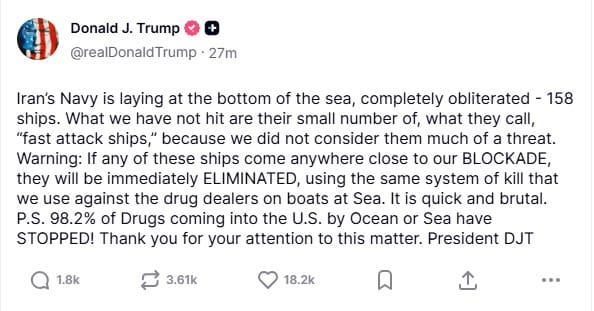
He added: “If any of these ships come anywhere close to our BLOCKADE, they will be immediately ELIMINATED, using the same system of kill that we use against the drug dealers on boats at Sea. It is quick and brutal. P.S. 98.2% of Drugs coming into the U.S. by Ocean or Sea have STOPPED!”
7.55 pm: India-Iran have common fate, says Iranian envoy
India and Iran share a “common fate” in the West Asia region, declared Iranian Ambassador Mohammed Fathali Monday, while clarifying that Tehran is keen to work with New Delhi on the issue of the Strait of Hormuz, moments before US President Donald Trump’s blockade of Iran’s ports came into effect.
“We have good contact with the Indian government. You know that I believe that Iran and India have common interests. As an ambassador I believe that India and Iran have a common fate in the region,” Fathali said at a press briefing in the national capital.
5.50 pm: Saudi Arabia summons Iraq envoy over drone threats
Saudi Arabian Foreign Minister Faisal bin Farhan summoned Iraq’s ambassador Safia AlSouhail Sunday (local time) to talk about continued attacks and blatant threats originating from Iraqi territory against the nation.
During the meeting, Deputy Minister for Political Affairs, Ambassador Dr Saud Al-Sati, delivered a formal note of protest to the Iraqi envoy, stressing the Kingdom’s strong condemnation and denunciation of the attacks originating from Iraqi territory against Saudi Arabia and Gulf countries, a statement said.
5.45 pm: Over 9 lakh Indians brought back from West Asia—MEA
Aseem R. Mahajan, Joint Secretary (Gulf) at MEA, said that wide-scale efforts are underway to ensure the safety and movement of the Indian community in West Asia, with over 9 lakh people having been brought back to the country since the beginning of the present conflict.
Dedicated special control room in the ministry remains operational, and is working in coordination with the Indian missions. “Our missions and posts are operating round-the-clock helplines and pro-actively assisting our citizens. They remain in close contact with the local governments,” the officer said.
Since 28 February, around 9 lakh 27 thousand people have returned to India.
“Around 100 flights are expected to operate from the UAE to India today. Flights are operating from various airports in Saudi Arabia and Oman to different destinations in India. With the Qatar airspace partially open, Qatar Airways is expected to operate around eight to 10 flights to India today”, he added.
5.35 pm: LPG supply ‘stable despite pressure’
On the energy front, Sujata Sharma, Joint Secretary at Ministry of Petroleum and Natural Gas, said that India’s crude sourcing remains diversified.
India sources crude oil from more than 40 countries, while LNG supplies remain stable. LPG cargoes have been secured in advance, pushing commercial LPG supply to 70 percent.
“But there is pressure on LPG, hence repeated requests have been made to consumers to shift to other energy sources, like PNG and electric cook stoves,” Sharma said at the inter-ministerial briefing.
On temporary shutdown of Nayara Energy from 9 April for scheduled maintenance, Sharma said domestic LPG production remains steady at around 45,000 metric tonnes per day.
Commercial LPG supply continues at 70 percent of pre-crisis levels, with 1,82,900 tonnes sold since 14 March. Additionally, 21 states are now receiving an extra 10 percent commercial LPG supply which was contingent to promote PNG connectivity.
In a separate move to safeguard domestic fuel availability, the government Saturday raised export taxes on diesel to Rs 55.5 per litre from Rs 21.5 per litre, and on aviation turbine fuel to Rs 42 per litre from Rs 29.5 per litre. The move is aimed at curbing exports and redirecting fuel supplies to meet domestic demand.
5.30 pm: Subsidies for electric 2-wheelers & 3-wheelers extended amid supply chain concerns
The Centre has extended subsidies for electric two-wheelers and three-wheelers, aiming to boost domestic adoption and manufacturing amid supply chain concerns linked to West Asia conflict.
“The terminal date for subsidies on electric three-wheelers has now been extended by two years till March 2028, while terminal date for electric two-wheelers has also been extended till July 2026,” Hanif Qureshi, Additional Secretary at Ministry of Heavy Industries, told reporters at an inter-ministerial briefing on the conflict Monday. Both subsidies were earlier scheduled to end on 31 March this year.
5.15 pm: 15 Indian-flagged & owned vessels currently in Strait of Hormuz
At a press conference, Mukesh Mangal, Additional Secretary at Ministry of Ports, Shipping and Waterways, says that Indian govt is working to bring its vessels back.
“…As soon as it is possible for our vessels to sail from the Strait of Hormuz, those vessels will come back. At present, a total of 15 Indian-flagged and Indian-owned vessels are there…” he adds.
#WATCH | Delhi: Mukesh Mangal, Additional Secretary, Ministry of Ports, Shipping and Waterways, says, "We, in coordination with MEA, are trying, putting our efforts to bring our vessels back. And as soon as it is possible for our vessels to sail from the Strait of Hormuz, those… pic.twitter.com/HrQGJbQ6Ew
— ANI (@ANI) April 13, 2026
5.05 pm: ‘Ceasefire depends on US’ approach to negotiations’—Iranian ambassador to India
On negotiations with the US, the Iranian envoy to India says, “Our delegation attended the negotiations with experience and expertise. We believe that if they avoid unlawful demands and recognise our legitimate right and interests, I think the negotiations would be successful. The ceasefire depends on their approach to these negotiations.”
Asked if Iran would agree to a second round of talks, he adds, “We have formally and officially announced that if they (US) accept our conditions, it is predictable that we will have another negotiation.”
4.50 pm: ‘We have good relations with Indian govt,’ says Iranian envoy
Dr Mohammad Fathali, Iranian Ambassador to India, thanks the Indian government for “facilitating all the necessary arrangements in this difficult time” and for being a “reliable and compassionate” partner.
On passage to Indian ships through the Strait of Hormuz, he says, “For Indian ships, you know that we have a good relation with the Indian government…We want good preparation for Indian ships… You know our Foreign Minister has described India as one of the five countries as a friend.”
#WATCH | Delhi: On Indian Ships passing through the Straits of Hormuz, Dr Mohammad Fathali, Ambassador of the Islamic Republic of Iran to India, says, "For Indian ships, you know that we have a good relation with the Indian government…We want good preparation for Indian… https://t.co/ErGCNEjXK9 pic.twitter.com/owDObXVpCe
— ANI (@ANI) April 13, 2026
4.40 pm: ‘Strengthening outreach to Gulf countries’—MEA
Ministry of External Affairs spokesperson Randhir Jaiswal says in a press conference that India is strengthening its outreach to Gulf countries amid the conflict. As part of this, EAM S. Jaishankar visited UAE this weekend.
#WATCH | Delhi | MEA Official Spokesperson Randhir Jaiswal says, "Following the directions of the Prime Minister, we are strengthening our outreach to Gulf countries. Accordingly, the External Affairs Minister visited the UAE from 11th to 12th April, 2026…" pic.twitter.com/rQbmdhfn6i
— ANI (@ANI) April 13, 2026
3.50 pm: ‘Will continue to speak out loudly against war,’ says Pope Leo, after Trump calls him ‘terrible’
Pope Leo tells Reuters that he plans to continue speaking out against war after Trump’s direct attack on the leader of the 1.4-billion-member Church.
“I don’t want to get into a debate with him,” Leo told Reuters aboard the papal flight to Algiers. “I don’t think that the message of the Gospel is meant to be abused in the way that some people are doing.”
He added, “I will continue to speak out loudly against war, looking to promote peace, promoting dialogue and multilateral relationships among the states to look for just solutions to problems.”
Pope Leo, originally from Chicago, has emerged as an outspoken critic of the US-Israeli war on Iran in recent weeks, and decried the “madness of war” on in a peace appeal Saturday.
In response, Trump wrote in a post on Truth Social late Sunday, “Pope Leo is WEAK on Crime, and terrible for Foreign Policy.”
3.40 pm: Israel, Hezbollah continue to strike each other
Israel & Hezbollah continue to trade strikes, with IDF declaring expansion of targeted ground operations against the Iran-backed outfit’s military infrastructure “to strengthen the forward defence posture in the Bint Jbeil area in southern Lebanon”.
⭕️IDF troops are expanding targeted ground operations against Hezbollah military infrastructure to strengthen the forward defense posture in the Bint Jbeil area in southern Lebanon.
Our troops struck and eliminated 100+ Hezbollah terrorists, dismantled dozens of terrorist…
— Israel Defense Forces (@IDF) April 13, 2026
Hezbollah has said that it has attacked Israeli soldiers in Shlomi in Israel. using drones.
3.20 pm: France-UK to hold conference on ‘restoring freedom of navigation’ in Strait of Hormuz
France, along with the UK, is planning to hold a conference with countries “prepared to contribute” to a “peaceful multinational mission aimed at restoring freedom of navigation” in the Strait of Hormuz.
In a statement on X, French President Emmanuel Macron wrote, “This strictly defensive mission, separate from the warring parties to the conflict, is intended to be deployed as soon as circumstances permit.”
“No effort must be spared to swiftly reach, through diplomatic means, a strong and lasting settlement to the conflict in the Middle East. Such a settlement must provide the region with a robust framework enabling all to live in peace and security,” the post read.
2.45 pm: Why Trump has threatened a blockade of Iran ports & what are the risks of such a move
The Strait of Hormuz is the world’s most important energy chokepoint, accounting for about a fifth of the world’s oil and liquefied natural gas. A full blockade would further pressure global oil markets by squelching the remaining trickle of shipments that have continued to move through the waterway.
Oil and natural gas surged Monday morning, with Brent rallying as much as 9.1 percent to near $104 a barrel while European gas futures spiked up to 18 percent.
Bloomberg quotes Euan Graham, senior fellow at Australian Strategic Policy Institute, as saying, “The blockade is meant to increase economic pressure on Iran, but blockades are rarely quick in their effects though they can be decisive in the long run. And what Washington prizes above anything else is a quick result.”
While the US is capable of enforcing a blockade, it would entail substantial costs and risks, Bloomberg Economics’ analysts, including Jennifer Welch, wrote in a note. US warships would be closer to Iranian drone and missile threats, leading to a dangerous escalation cycle if any of them are hit. The Houthis, who are allied with Iran, may also look to disrupt oil and gas flows in the Red Sea, the Bloomberg Economics’ analysts wrote.
Eric Martin reports for Bloomberg.
2.30 pm: ‘If Iran’s ports threatened, no port in region will be safe’: Iran military
Meanwhile, Iran’s Armed Forces Central HQ has said in response to US’ announcement of blockade, “Security in the Persian Gulf and the Sea of Oman is either for everyone or for NO ONE.”
Statement reported by Iranian state broadcaster IRIB reads, “If Iran’s ports are threatened, NO PORT in the region will be safe.”
2.15 pm: UK to not back Trump’s blockade of Iranian ports, says Starmer
British PM Keir Starmer has said that whatever the pressure, Britain would not be dragged into the Iran war nor be involved in a blockade of Strait of Hormuz.
“We’re not supporting the blockade,” he told BBC Radio 5 Live. “It is, in my view, vital that we get the Strait open and fully open, and that’s where we’ve put all of our efforts in the last few and we’ll continue to do so.”
1.45 pm: US to block ships entering or exiting Iranian ports, starting Monday
The US military will begin a “blockade of all maritime traffic entering and exiting Iranian ports” Monday at 10 am ET (or 7.30 pm IST) in accordance with President Donald Trump’s proclamation Sunday, the US Central Command has said.
The blockade will be enforced “impartially against vessels of all nations entering or departing Iranian ports and coastal areas, including all Iranian ports on the Arabian Gulf and Gulf of Oman”, a CENTCOM statement said. However, vessels transiting the Strait of Hormuz to and from non-Iranian ports will not be blocked.
— U.S. Central Command (@CENTCOM) April 12, 2026