







New Delhi: The US is moving forward with an equity investment of $50 million in South Africa for a mining project, despite political differences between President Donald Trump and the South African government.
The move to invest the sum in the Phalaborwa mining project comes as Washington seeks to re-engage Africa, where China dominates trade and investment in mining activities.Patience Mususa, a mining specialist at Sweden’s Nordic Africa Institute, told news channel PBS that the US was “trying to catch up in terms of investment in mining” on the African continent, where China is the dominant player in mining.
The investment announced last month, comes despite a major diplomatic rift between Washington and Pretoria. President Trump and his South African counterpart Cyril Ramaphosa had a tense meeting in the Oval Office last year. Trump had accused the South African government of committing genocide against whites (Afrikaners) in the country, a charge denied by Ramaphosa.
The US had boycotted the G20 summit in Johannesburg in 2025 as well as excluded South Africa from the same event this year to be held in Florida. Last February, Trump had halted all financial assistance to the country.
In a conversation with South China Morning Post, Alvin Camba, a non-resident fellow in the Indo-Pacific Security Initiative at the Washington-based Atlantic Council’s Scowcroft Centre for Strategy and Security, said the Phalaborwa project highlighted the strategic interests behind America’s latest push to reduce Beijing’s dominance over the rare earths sector.
The international arm of the US Development Finance Corporation (DFC) will be making the investment in Phalaborwa, which is primarily an industrial waste processing or an ‘urban mining’ project. The investment was committed in 2023 during the erstwhile Biden administration. The South Africa government doesn’t have a direct stake in the project.
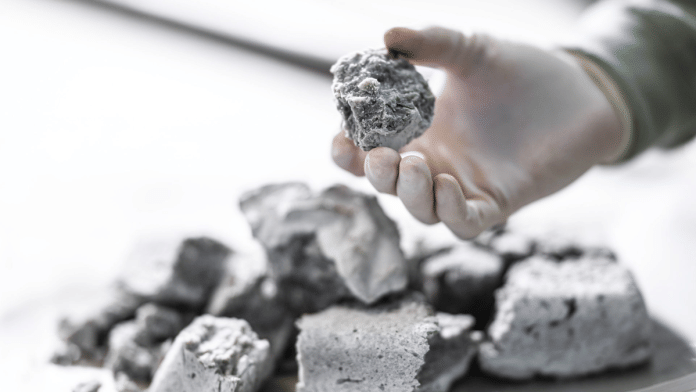
The huge dunes at the South African site consist of 35 million tons of phosphogypsum, a byproduct of mining waste. Rare Earth Elements (REE) like neodymium, praseodymium, dysprosium, terbium and others, used in construction of high-performance permanent magnets in wind turbines, electric vehicles, defence and other applications are expected to be extracted.
Earlier this year, the US Trade and Development Agency (USTDA), signed an agreement to fund a pre-feasibility study for Mozambican mining company Monte Muambe Mining Ltda (MMM). Last year, the DFC announced a $4.6 million reimbursable funding as part of its project development strategy for a project in Songwe Hill in Malawi, to be developed by Mkango Rare Earths Ltd.
While the Trump administration dismantled the USAID, scaling down development assistance to the African continent, it has continued extending financial support in strategic sectors such as infrastructure development.
The Trump administration is continuing financial support to Lobito Corridor, a Biden administration initiative to build a 1,290 km railway linking mineral rich regions of Congo and Zambia to Africa’s Atlantic coast.
Also Read: No country built rare earths resilience alone. India must take lessons from Japan, Taiwan
Competition with China
According to an International Energy Agency (IEA) study, China accounts for 60 percent of global mining output of Rare Earth Elements (REEs) and 91 percent of global production at the separation and refining stages for production of Permanent Magnets. These have come along with increasing forays into diverse regions, including those in Africa.
The Africa Center for Strategic Studies points out that Beijing has diversified upstream by acquiring African mining assets such as Botswana’s Khoemacau copper mine (2023), Mali’s Goulamina lithium mine (2024), and Tanzania’s Ngualla rare earth mine (2025). World’s largest EV maker BYD has essentially secured six African lithium mines to ensure sufficient raw material stock through 2032.
However, the main strength of China lies in the mid-stream process of refining the ore consisting of these REEs. The Phalaborwa project is unique in a sense that, beyond extraction, it addresses the processing part of development of REEs, a section dominated by Chinese companies. The process will deliver separated neodymium and praseodymium oxide along with highly valuable REEs like dysprosium and terbium.
Given that Phalaborwa is a chemical processing operation, with its resource sitting at the surface, it has a much lower operating costs than other REE projects and is one of the highest margin projects outside China according to the company website of Rainbow Rare Earths, a London listed company, entrusted with the development of the project.
The US is developing many other mechanisms globally to challenge the dominance of China in the REE sector. Last year at the QUAD foreign ministers’ meeting in Washington DC, a ‘QUAD critical minerals initiative’ was launched to secure and diversify critical mineral supply chains.
Washington DC also launched the ‘Pax Silica’ coalition of which India became the 12th member in February. The framework is aimed at forming a secure global supply chain primarily for semiconductors, AI and critical minerals in order to reduce reliance on China.
Along with that America has announced ‘Project Vault’ to stockpile 60 critical minerals listed by US Geological Survey, with a $10 billion funding from the EXIM bank and $2 billion in private funding. When Beijing started to impose curbs on rare earths exports, the Pentagon announced a deal to buy $400 million stock in MP materials, a Las Vegas-based mining company.
Jaydeep Gadhavi is an alum of ThePrint School of Journalism and an intern with ThePrint.
(Edited by Tony Rai)
Also Read: America gifted China its rare-earth monopoly — and India helped too