


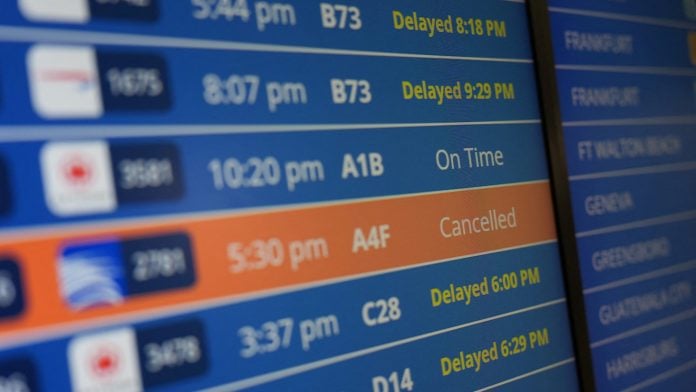
US air travel struggled to recover Saturday from the longest nationwide flight suspension since the September 2001 terrorist attacks, with thousands of cancellations following an outage that laid bare the fragility of America’s aviation infrastructure.
Airlines are rushing to restore regular schedules, leaving more than 6,100 flights into, out of, and especially within the US canceled and another 7,400 trips delayed Saturday as of 7 p.m. New York time, according to aviation data firm FlightAware.
FAA Administrator Bryan Bedford apologized for the disruption and said that between 4,000 and 5,000 flights will likely be canceled on Saturday, adding that airlines expect to be able to return to their normal flight schedules by the end of business on Sunday.
“I do think the worst is behind us,” he said Saturday in a news conference. “But we still do have a significant amount of recovery work to do with our airline stakeholder group.”
The disruption followed a nationwide halt to flight movements on Friday — only the third in US history — after the Federal Aviation Administration imposed a ground stop that lasted for more than four hours. Some 3,500 aircraft in the sky dwindled to less than 400 as authorities blamed a data overload for crippling air traffic control communications and radar.
“Operations are slowly returning to normal this morning,” Transportation Secretary Sean Duffy said in a post on X. “You will continue to see some delays and cancellations as carriers reschedule flights and reposition aircraft/crews where they are needed most.” 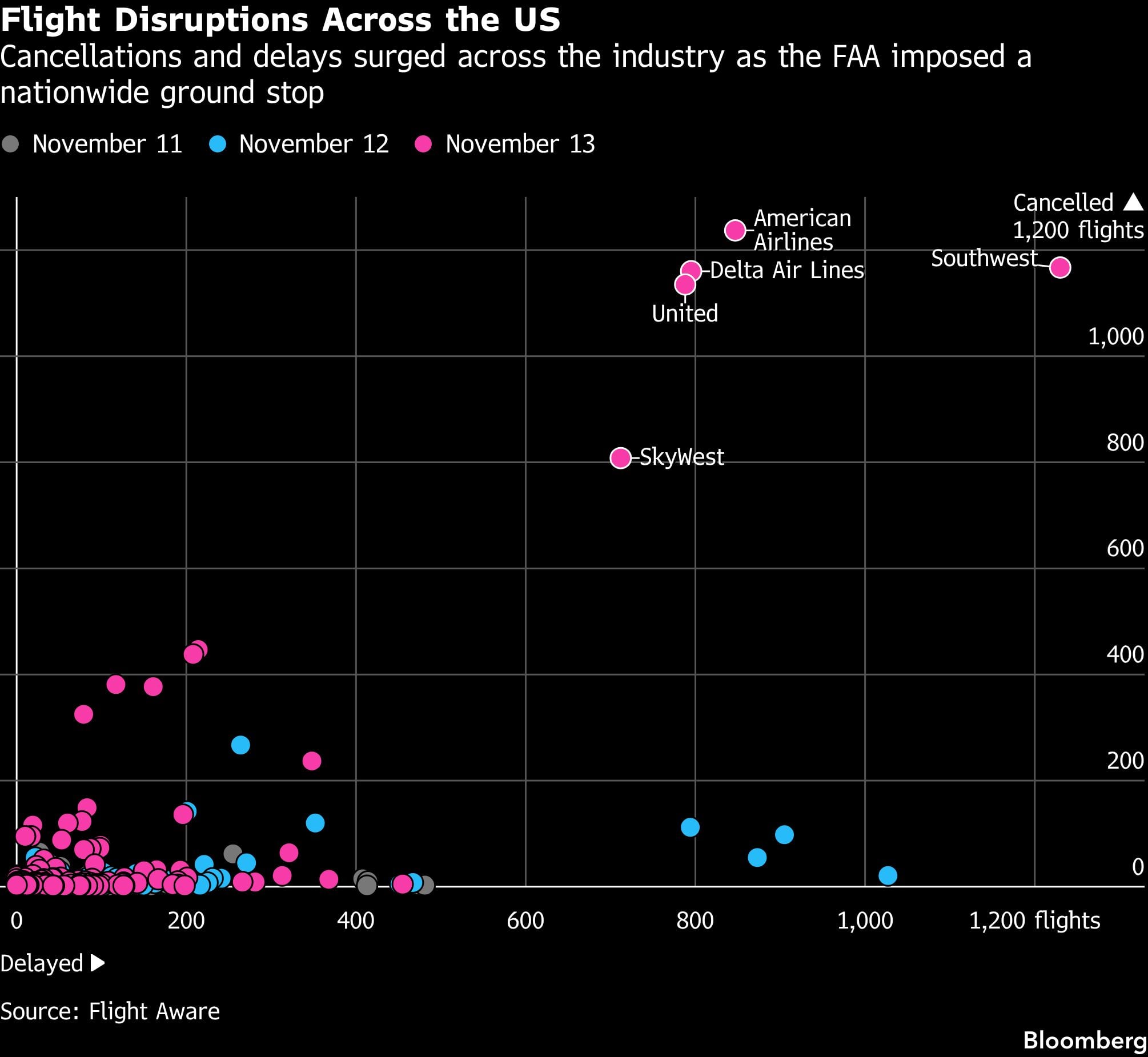
Duffy said that the issue was traced to replacement of outdated copper wire at a remote location by L3Harris Technologies Inc., and that a router there started flooding the air-traffic control system with connection attempts.
“This was an FAA system that didn’t meet the moment,” Duffy said. “Our contractor didn’t meet the moment, or the equipment didn’t meet the moment and caused the outages.”
L3Harris said in a statement that it’s cooperating with the FAA in its investigation.
The failure left airlines trying to rebuild schedules with aircraft and crew scattered and out of position after take-offs were suspended Friday afternoon, while also dealing with hundreds of thousands of passengers who’d been stranded on tarmacs and stuck in terminals.
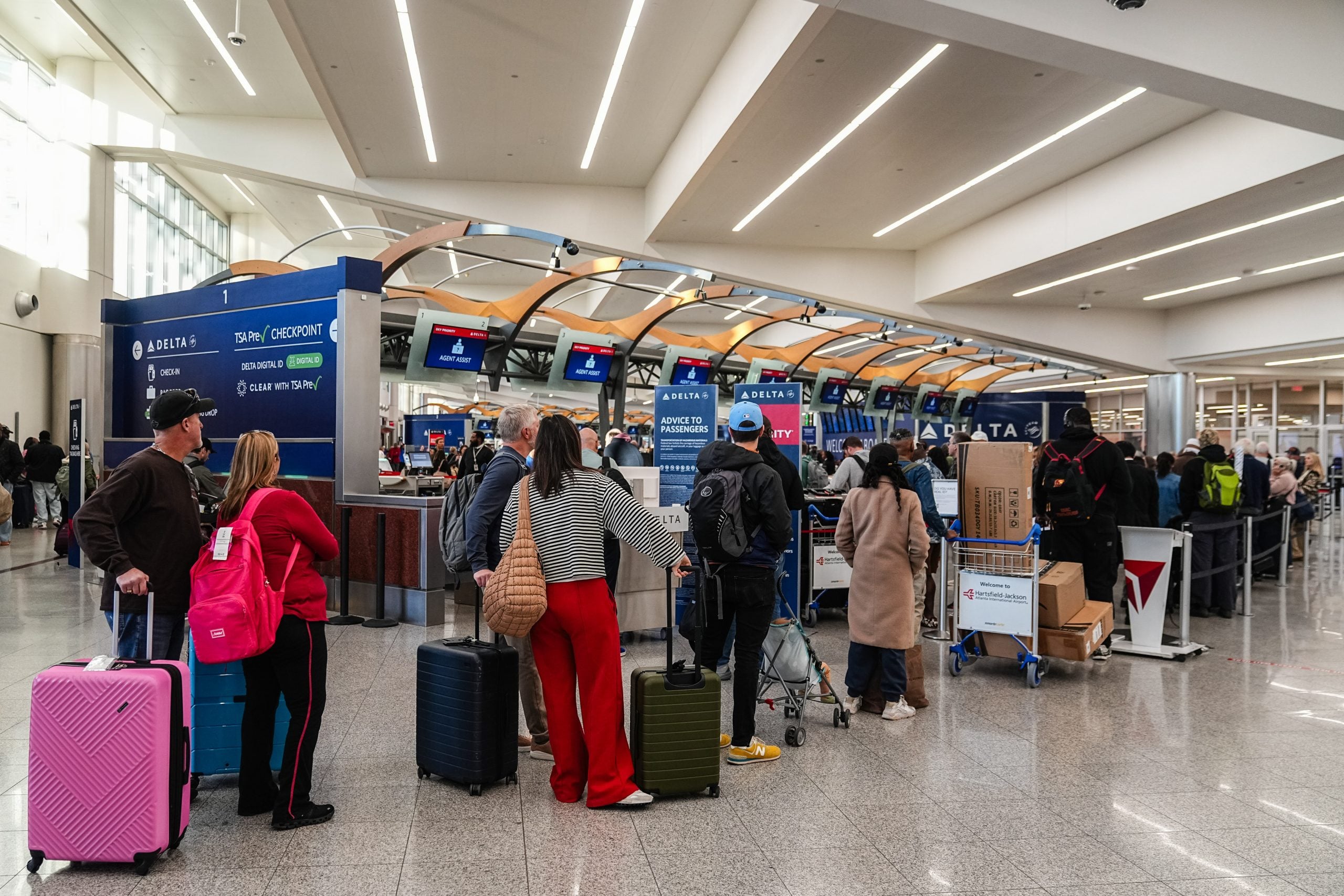
American Airlines Group Inc. warned of residual delays and cancellations as it worked to get aircraft and crew to the right locations. The Dallas-based carrier said it was “positioning the airline for the strongest possible recovery” on Saturday and in the days ahead.
Delta Air Lines Inc. said “it will take time to reset our operation, including the positioning of aircraft and crews.”
Other US carriers, including JetBlue Airways Corp. and United Airlines Holding Inc., warned of similar ongoing disruptions to schedules into Saturday, and encouraged passengers who didn’t urgently need to travel to consider rescheduling.
American scrapped 1,380 trips, more than 40% of its daily schedule, and United canceled 793 flights, which is more than a quarter of its planned service, according to FlightAware data. Delta’s mainline services saw 799 cancellations, or 25% of its daily schedule, while JetBlue has seen 423 flights culled, nearly half of its departures.
Duffy told reporters Friday night that it would “take time” to unwind the impact from Friday, but expected the system to “be back up and operational as we come into the heat of travel during Thanksgiving” later this month.
Aviation officials and airlines were confronted with a cocktail of failing technology and an aging system. The breakdown comes amid a politically charged effort to overhaul and modernize, at high cost, the ailing infrastructure that underpins the communications and tracking system of aircraft in the US.
Last year, Congress provided the FAA with $12.5 billion to carry out the modernization effort, but Duffy has said more money is needed. He initially requested an additional $30 billion but upped that ask to $50 billion after Friday’s breakdown.
A prior modernization effort, known as NextGen, was panned for cost overruns and underdelivering on stated objectives. Overhauling the air traffic system is a challenging task because the upgrades are occurring at the same time controllers are managing thousands of flights per day.
The Trump administration has emphasized the need for speed with its initiative, which has raised concerns among some who say moving too quickly puts the system at risk. Proponents, however, argue that fast improvements are needed because continuing to rely on decades-old equipment increases the likelihood of outages. The FAA and Transportation Department have said they’re aiming to complete major updates stemming from the first tranche of congressional funding by 2028.
The transport chief stood side-by-side with Homeland Security Secretary Markwayne Mullin at the White House Friday night to spell out how outdated equipment, running over capacity and already not coping well, had been pushed to breaking point.
Mullin told reporters that the FAA was “putting patches into the system” and the new technology was “overwhelming the older system.”
Key pieces of equipment, already running over capacity and struggling to cope, were overwhelmed Friday, according to an FAA briefing to the industry that was described to Bloomberg by people familiar with the matter. The failure cascaded and impacted the backbone of the FAA’s old telecoms system that handles voice and data information that is used by air traffic controllers and pilots, the people said.
Specific locations were affected, however, and L3Harris, which operates and helps maintains the older telecommunications network, is being tasked to diagnose the cause of the data overload, the people said. The US aerospace and defense firm did not respond to a request for comment outside of regular business hours.
Duffy sought to reassure air travelers it’s safe to fly — insisting the US has “the safest system in the world” — even as he couldn’t rule out a similar air traffic control outage happening in the future.
“Is this exact thing going to happen again? I don’t know that this exact scenario will happen,” he said.
–With assistance from Sri Taylor, Aidan Williams, Cam Kettles, Anand Katakam, Ed Ludlow, Jeff Mason, Courtney Subramanian and Will Guisbond.
Disclaimer: This report is auto generated from the Bloomberg news service. ThePrint holds no responsibility for its content.