




From the start of his second term, US President Donald Trump made clear he would put tariffs at the center of US economic policy. When the Supreme Court invalidated sweeping import duties he’d imposed citing emergency powers, he used a different provision, Section 122 of the Trade Act of 1974, to set a flat 10% levy on imports. Such tariffs are time-limited, however, and Trump’s expire on July 24.
As the deadline approaches, the Trump administration has indicated that it plans to use Section 301 of the same act to replace those tariffs with more durable and roughly equivalent ones based on accusations concerning forced labor. Imports from Brazil have been singled out for 301 tariffs amounting to 25%, though many consumer goods such as coffee and beef are exempted. The administration is also laying the groundwork for possible additional Section 301 levies with an investigation into concerns that 16 major trading partners maintain excess manufacturing capacity. And it plans to expand so-called sectoral tariffs, which are imposed on specific product categories.
What are the expected tariffs related to forced labor?
The Office of the US Trade Representative (USTR) is proposing to impose either a 10% or a 12.5% tariff on imports from 60 nations that supply almost all US imports, accusing them of failing to enforce bans on foreign goods made with forced labor and therefore enjoying an unfair competitive advantage. Section 301 allows the USTR, under the direction of the president, to impose tariffs in response to other nations’ trade measures it deems discriminatory to American businesses or in violation of US rights under international trade agreements.
Proposed New US Tariffs Related to Forced Labor Accusations | Rate by source
After conducting an investigation into the matter as required under Section 301, the USTR released its report on June 2. The report doesn’t attempt to say whether specific nations are actually importing goods made with forced labor, nor does it look at whether products are being made in those countries using forced labor. Rather, the USTR assessed whether a country has a formal ban in place on goods imported using forced labor and if it is enforcing a prohibition or otherwise attempting to block such imports.
Under the USTR’s plan, the tariff rate for imports would depend on various criteria including whether the source country has struck a trade deal with the Trump administration. There is also a special mechanism to “allow for a certain volume of apparel and textile imports from certain economies” to enter the US at a reduced rate.
What’s the US argument for these tariffs?
The USTR is arguing that a nation failing to enforce a ban on forced labor “burdens or restricts US commerce by subjecting US producers to unfair competition from forced labor goods in both export markets and the US market, and by displacing foreign goods produced without forced labor or forced labor inputs from their domestic market to the United States and other markets.”
For example, it argues that although Canada prohibited imports made with forced labor almost six years ago, the fact that it doesn’t appear to have published any official statistics or information on enforcing that means that there is a “low level of enforcement.”
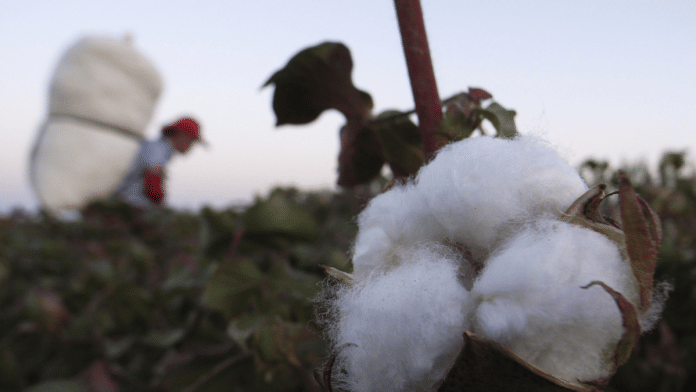
The report also argues that a loss of US market share in exports such as tobacco, rice, beef, and cotton to nations where there are concerns or evidence of forced labor suggests “that US exports have possibly been adversely impacted by competition from forced labor goods” or that forced labor goods have possibly entered the US and undermined US businesses.
A range of countries including India and Canada have pushed back against the US allegations that they have lax or no enforcement of exploited-labor rules and said there’s no basis for the proposed 301 tariffs.
What is forced labor?
The International Labour Organization defines it as all work or service that is exacted from a person under the threat of a penalty and for which the person has not offered himself or herself voluntarily.
The US has prohibited the import of goods made with forced labor since 1930. It has also targeted goods from specific places. A 2021 law bans all imports from the Xinjiang region of China on the presumption that they are made with forced labor. The imposition of the ban, unlike the proposed new tariffs, is based on an assessment of labor conditions in the country.
What would be the impact of the new tariffs?
The 60 nations investigated cover 99.4% of all US imports. Maeva Cousin of Bloomberg Economics said the new levies, if implemented once the time-limited Section 122 tariffs expire, would increase the effective US tariff rate by just 0.5 percentage point from its current level of 10.7%.
Bloomberg Economics expects the tariff on goods from China to be 12.5% and the rate on imports from Canada and Mexico, the other top sources of US imports, to be 10%. However, in the USTR’s plan, goods that comply with the US-Mexico-Canada Agreement are exempt. There are also significant carveouts for electronic goods.
How has the administration laid the groundwork for additional Section 301 tariffs?
The USTR has launched a separate investigation into whether 15 countries and the European Union have “structural excess capacity and production” in their manufacturing sectors such that it produces an “unreasonable or discriminatory” burden on US commerce. The countries are China, Bangladesh, Cambodia, India, Indonesia, Japan, Malaysia, Mexico, Norway, Singapore, South Korea, Switzerland, Taiwan, Thailand and Vietnam. The results of the probe are pending.
USTR Jamieson Greer said in an interview recently that the overcapacity case is “quite an intense project” that may take more time to complete. “I have dozens and dozens of attorneys and policymakers working on this to really examine all of these practices,” he told Bloomberg Television in mid-July. “So it takes a little longer time than doing this forced-labor one.”
How is the administration expanding sectoral tariffs?
Adding to tariffs it has already implemented on imports of aluminum and derivative products, autos and auto parts, copper and lumber, the administration has announced a plan to begin imposing levies as high as 100% on certain pharmaceutical products as of July 31, albeit with significant exceptions.
The levies won’t apply to products made by companies that have struck agreements with the Trump administration to lower some US drug prices, as most of the world’s biggest drugmakers, including Merck & Co. and Eli Lilly & Co., have. Nor will they apply to patented drugs made in countries that have trade deals with the US.
That means the tariffs will mainly hit smaller pharmaceutical companies and ingredient manufacturers. Veda Partners analyst Spencer Perlman estimated that the full 100% tariff would apply to only around $12 billion worth of goods annually. Total US pharmaceutical imports were worth $274 billion in 2025.
Disclaimer: This report is auto generated from the Bloomberg news service. ThePrint holds no responsibility for its content.