





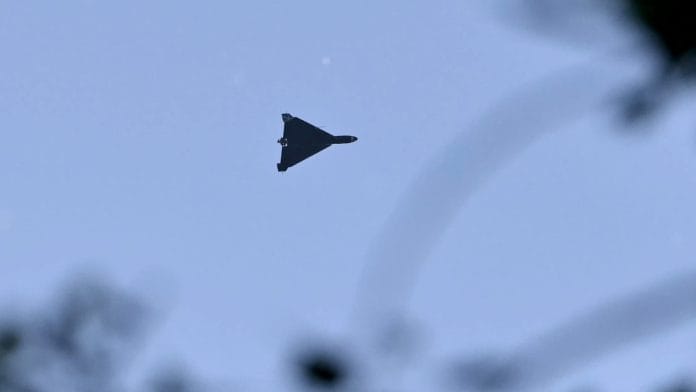


Russia most likely used its fleet of banned oil tankers to help conduct a drone campaign over sensitive sites in Europe to map out weaknesses in air defenses, according to a report from the International Institute for Strategic Studies.
The incidents were part of a broader drone campaign over Europe, particularly in Germany, Denmark, Belgium and the Netherlands, according to the report published Thursday.
IISS researchers examined 144 drone incursions into a dozen NATO countries and Ireland between August 2024 and February 2026 that occasionally caused major disruptions such as airport shutdowns. They also entered sensitive defense installations including sites hosting US nuclear bombs and a French ballistic missile submarine base.
About half of the reported drone sightings occurred over military facilities, the researchers found. The campaign was designed to map out and test Europe’s air defenses, which are meant to stop higher-end threats such as missiles, bombers and fighters, according to the report. The systems have a harder time tracking low, slow and small threats such as drones.
The European countries involved have largely avoided attributing the incursions to Russia, although the report’s authors say the links are clear. The Russian defense ministry didn’t respond to a request for comment.
“We think it is likely that Russia-linked vessels and their shadow fleet were used as maritime launch or recovery or a signal relay platforms,” report co-author Charlie Edwards told reporters.
He said the lack of similar activity in the Mediterranean was largely because the capabilities there were more robust, particularly in maritime surveillance and US submarines. Getting around undetected, let alone launching drones, is much harder, he said.
Several governments have active investigations into the incidents, co-author Louis Bearn said, adding that when European countries started boarding and searching shadow fleet vessels earlier this year, the drone incidents all but vanished.
The report’s assessment of Europe’s response is scathing: “uneven” and “fragmented,” with exceedingly slow attribution and “often disproportionate” response options.
NATO has been criticized over the past year for using sophisticated fighter jets to shoot down cheap drones, and European Commission President Ursula von der Leyen said in late 2025 that a “drone wall” was needed to stop them.
“The UK takes the security of military bases seriously and works closely with allies, law enforcement partners and other authorities to protect people, sites and capabilities,” a spokesperson for the UK’s Ministry of Defense told Bloomberg.
Spokespeople from the governments of Denmark, Estonia and Ireland didn’t immediately respond to requests for comment and Germany declined to comment. The French defense ministry said it couldn’t confirm the report’s conclusions. The Dutch defense ministry said it had “taken measures” to protect military sites.
–With assistance from Ellen Milligan, Ania Nussbaum, Olivia Fletcher, Michael Nienaber, Charlotte Hughes-Morgan, Sara Sjolin and Ott Tammik.
Disclaimer: This report is auto generated from the Bloomberg news service. ThePrint holds no responsibility for its content.