



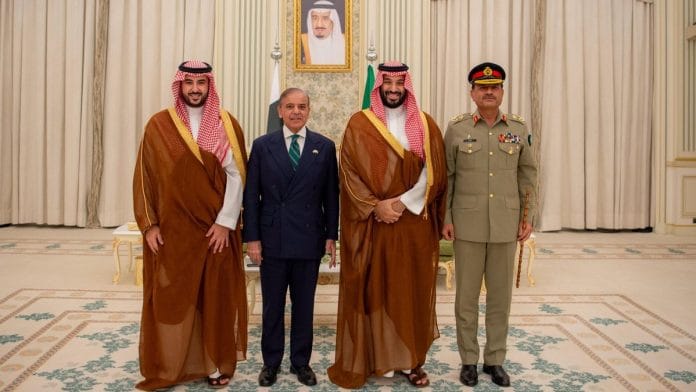
New Delhi: Pakistani jets were used in Yemen by Saudi Arabia against an offensive launched against Iran-backed Houthis, a report by The New York Times said Thursday. Within hours, Pakistan’s information and broadcasting ministry rejected the claim, calling it ‘fake and fabricated’.
Yemen’s government, supported by Saudi airpower, launched a military offensive this week aimed at reclaiming territory along the Red Sea from the Houthis. This also led to the subsequent activation of the Mecca pact, a trilateral mutual defence agreement between Saudi Arabia, Pakistan and Turkey. Both Turkey and Pakistan pledged ‘rapid deployment’ in Riyadh for self-defence and protection of sovereignty.
A senior Pakistani military official, speaking anonymously, told NYT Wednesday that Pakistan Air Force fighter jets were being used in strikes against the Houthis.
Col. David O. Smith, a former US Army attaché in Pakistan and former senior analyst at the Defense Intelligence Agency, also said that although he did not have access to classified information, analysts generally believed that approximately 8,000 Pakistani troops had been deployed to Saudi Arabia.
According to Colonel Smith, the contingent includes Pakistan Air Force personnel and Army air-defence units. He said the troops would probably be tasked with protecting oil infrastructure rather than taking part in direct combat with the Houthis. Such a deployment, he said, would allow Islamabad to support Saudi Arabia while maintaining its relationship with neighboring Iran, which backs the Houthis.
A second Pakistani official, also on condition of anonymity, was quoted as saying Pakistan’s expected role would centre on reducing the Houthi drone and missile threat through air support rather than participating in a ground offensive inside Yemen.
This came a few hours after Lt. Gen. Ahmed Sharif Chaudhry, the head of Pakistan’s military media wing, told CNN Wednesday that Pakistani forces were already in Saudi Arabia. He did not disclose their numbers or capabilities, saying those details were classified.
Chaudhry said Pakistan’s deployment in Saudi Arabia was not a new development and had “not come out of a vacuum”. Pakistan, he said, has maintained a military presence in Saudi Arabia for decades.
He described Pakistan’s commitment to Saudi security as “absolute” and said the new agreement establishes collective defence, under which an attack against one member would be regarded as an attack against all.
Chaudhry declined to say whether Pakistani forces would conduct operations across the border in Yemen. He said that when countries are involved in a military conflict, they do not normally disclose in advance how or where their forces will be employed.
Any Pakistani involvement, he said, would be “defensive in nature”.
In a joint statement issued after an emergency meeting in Riyadh on Monday, the three countries said they would immediately begin implementing their collective-defence commitments and ensure the rapid deployment of military forces and capabilities to Saudi Arabia.
Chaudhry said the security agreement was also intended to deter potential attacks. “Anyone having some funny ideas against another will hopefully think twice, thrice, or multiple times before doing that,” he said. “That stops something terrible from happening.”
For Pakistan, however, supporting Saudi Arabia presents a complicated strategic calculation. Islamabad has played an important role in efforts to mediate between Iran and the United States. Iran is Pakistan’s neighbour and supports the Houthi movement.
Pakistan’s position is also shaped by its previous experience with the Yemen conflict. In 2015, Pakistan’s Parliament voted against sending troops to Saudi Arabia to assist in the kingdom’s military campaign against the Houthis.
Chaudhry said Pakistan remained committed to seeking an end to the wider US-Iran conflict. Subsequently, the I&B ministry rejected the NYT report that its fighter jets were conducting strikes against Houthi targets. The ministry then asked media organisations to “avoid speculative reporting with regard to employment of Pakistan’s Military Forces under the Makkah Joint Defence Agreement”.
Details of any employment, if necessary, will be given by concerned authorities, it added.
(Edited by Nardeep Singh Dahiya)