





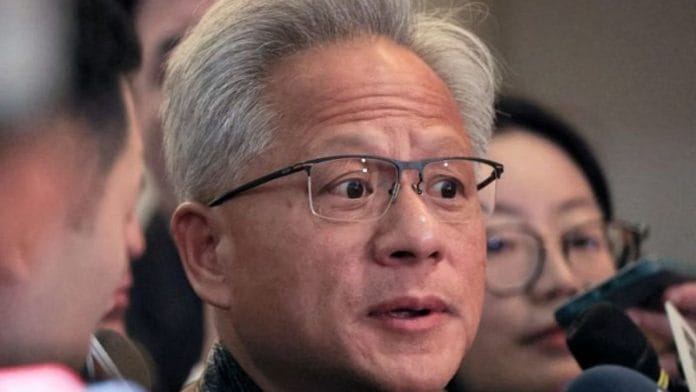


Washington: The roster of business leaders invited to join President Donald Trump on his trip to China this week left off one notable, and surprising, name: Nvidia Corp. Chief Executive Officer Jensen Huang.
While more than a dozen other top executives including Apple Inc. CEO Tim Cook and Tesla Inc.’s Elon Musk made the cut for the business delegation, according to a White House official, Huang was not among those invited. A person familiar with the matter confirmed that Huang — whose company makes the world’s most sought-after AI chips — would not be accompanying the president on the China trip.
The executives joining Trump are all from companies with significant existing China exposure and represent sectors expected to be part of the trip’s commercial agenda, according to another person familiar with the matter. All of the people, including the White House official, spoke on condition of anonymity to discuss confidential travel plans.
Huang’s absence stands out given his role as head of the world’s most valuable company and maker of semiconductors powering the artificial intelligence boom — not to mention his proximity to Trump since the president’s return to office. It represents a potential setback for Huang in his bid to sell Nvidia’s AI chips to China, a market he’s identified as a $50 billion opportunity.
Representatives for Nvidia declined to comment, while a White House spokesperson didn’t respond to requests for comment.
Just last Thursday, Huang had expressed his willingness to join Trump on the highly anticipated trip to China, where the president is scheduled to meet his Chinese counterpart, Xi Jinping. “If invited, it would be a privilege — it would be a great honor to represent the United States and to go to China with President Trump,” Huang told CNBC.
Last year, Huang emerged as a fixture in Washington with frequent visits to the White House and Capitol Hill to make his case for clearing a path for AI development, including by relaxing US export controls. He formed a bond with the president after being introduced to Trump in early 2025, and Huang said in an interview with Time that the two men spoke regularly by phone, often late at night.
Huang’s presence in Trump’s orbit extended to official White House visits last year to the Middle East and the UK, where the president called out Huang in the audience and praised the CEO’s work with Nvidia. “You’re taking over the world, Jensen,” Trump joked in September during an event in London.
The Nvidia chief has continued to communicate directly with Trump this year through multiple channels, according to a person familiar with the matter. Huang saw Trump in Washington as recently as last month, while attending events during King Charles III’s stay in Washington. A senior White House official personally texted Huang to invite him to a state dinner tied to the royal visit, the person added.
Nvidia scored a major lobbying win in December when Trump agreed to allow shipments of the company’s H200 AI chips to China, a decision that marked a significant easing of US restrictions aimed at keeping Beijing and its military from accessing the most powerful US technologies. Nvidia that month also succeeded in killing a chip-export provision in must-pass defense legislation.
Huang said in March that Nvidia was firing up its H200 production, a move the company is unlikely to take without confidence that sales of those chips could be completed. At the time, Huang emphasized that Nvidia had been licensed by the US Commerce Department to sell H200s to “many customers” in China, without offering specifics. The US is set to receive a 25% fee from Nvidia for any H200s sold to China.
Muddying the waters, however, Commerce Secretary Howard Lutnick told lawmakers last month that while some H200s have been licensed for sale to China, none had been exported yet since the Chinese government hasn’t allowed its tech companies to purchase the chips. Huang has supported keeping US restrictions in place for the company’s more advanced AI chips, such as its Blackwell processors and the upcoming Vera Rubin line set to be rolled out later this year.
US export controls have long been a sticking point in trade discussions between Washington and Beijing. Limits on China’s ability to acquire American technology fueled a standoff last year between the world’s largest economies that saw Beijing impose curbs on shipments of rare earths to US customers.
The two sides unveiled a truce in October after Trump’s last meeting with Xi where the US agreed to pause for a year some of its tech-related restrictions in exchange for renewed access to rare earth elements. Those measures will likely be up for discussion later this week.
In the meantime, members of Congress have mounted a renewed push to restrict the flow of AI technology to China. Last month, House lawmakers advanced a slate of bipartisan export control bills including the AI Overwatch Act, which would block the administration from allowing Nvidia to sell its Blackwell chips to Chinese customers. The measure would also give Congress the power to oversee license applications for shipments of the company’s H200 processors to China.
Keeping Huang off the official delegation list sends a strong signal to the government in Beijing that Chinese AI labs won’t have much success in obtaining top-performing chips like those made by Nvidia, according to Ryan Fedasiuk, a fellow at the American Enterprise Institute.
“The Trump administration understands how important computing power is to winning the AI race with China,” Fedasiuk said. “There just isn’t much for American chip companies to talk about with the Chinese government.”
This report is auto-generated from Bloomberg news service. ThePrint holds no responsibility for its content.