


New Delhi: Russia has built a satellite designed to carry a nuclear warhead and could launch it as soon as next month, Bloomberg has reported.
Citing sources familiar with the matter, the report claims that internal intelligence assessments of North Atlantic Treaty Organisation (NATO) countries in early November point to Russia developing a satellite—reportedly named Sputnik-S and designed to carry a nuclear weapon—which has been stored in the Moscow region for many years.
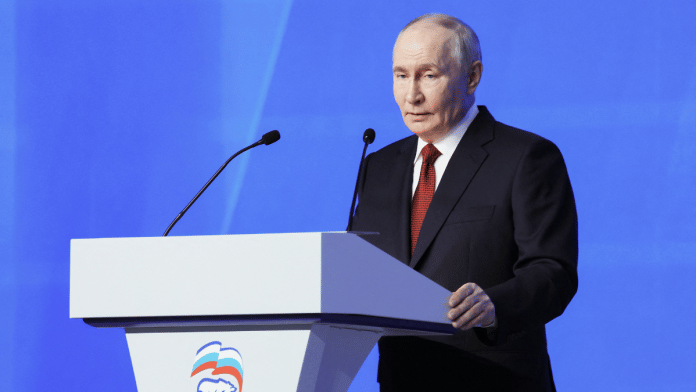
Kremlin spokesperson Dmitry Peskov has, however, rejected the claims. Notably, Russian President Vladimir Putin had said in 2024 that Moscow opposes launching nuclear weapons in space.
The 1967 Outer Space Treaty, drafted and signed at the height of the Cold War, prohibits states from placing nuclear weapons or other Weapons of Mass Destruction (WMDs) in orbit, or on celestial bodies and in outer space.
Germany’s Armed Forces Space Command has assessed that the satellite could be launched as early as December. German media outlets Süddeutsche Zeitung, NDR and WDR have also reported on this. German Chancellor Friedrich Merz described the reports as shocking, saying they demonstrate the extent to which Russia is willing to escalate. The reported launch is unconfirmed, however.
In October, the US Defense Intelligence Agency (DIA) said that Russia was developing a satellite designed to carry a nuclear weapon.
The reports show that this programme may be more advanced than previously understood, and that Moscow could soon move from building the technology to launching it into space.
What a nuclear detonation in orbit could mean
Why would a December launch matter? A nuclear weapon in space would become dangerous beyond the sudden outbreak of war between Russia and Western powers, or direct military engagement between Russian and Western forces.
A nuclear explosion in earth orbit would not be a traditional strike against a single satellite; it could destroy several, hitting key systems for communications, the Global Positioning System (GPS), weather forecasting, scientific research, commercial activity and national security. The consequences would extend into civilian life.
The US Defense Intelligence Agency’s (DIA) October 2026 report, Challenges to Security in Space, says Russia is building a satellite designed to carry a nuclear weapon, despite its responsibilities under the 1967 Outer Space Treaty. The DIA says that a space-based nuclear capability could cause the rapid loss or damage of thousands of satellites. A damage could also create radiation belts that persists for years, damaging satellites not immediately destroyed in a nuclear explosion.
The report links the Russian programme to the launch of Cosmos 2553 in February 2022, a satellite Moscow said was designed to test the effects of space radiation on electronic systems. The DIA notes that it was placed in an unusual, isolated orbit. The report does not mention that Cosmos 2553 carried a nuclear weapon.
Also Read: Trump claims Pakistan, Russia & China testing nuclear weapons secretly. ‘If they test, we have to’
The counterspace threat continuum
The danger sits at the most destructive end of what the DIA calls the ‘counterspace threat continuum’. Space attacks need not involve missiles or explosions. Some methods are reversible: denial and deception, electronic jamming and cyberattacks can temporarily disrupt services, spoof signals or interfere with the data and systems used to operate satellites.
Jamming and spoofing can affect communications and positioning, navigation and timing signals, including GPS, with consequences for civilian users and military forces. Public and commercial services also become vulnerable when linked directly to military space capabilities.
Other tactics can cause permanent or irreversible damage. Anti-satellite missiles can shatter spacecraft into debris fields that remain in orbit for almost centuries, while physical or cyber strikes on ground stations can disrupt the infrastructure needed to control them.
Directed-energy weapons can blind satellite imagery sensors or affect infrared and weather-monitoring systems. Meanwhile, a nuclear blast in or near space could unleash widespread electromagnetic interference, crippling satellites and critical systems on Earth alike.
China’s growing orbital capabilities
China’s space programme adds another layer to the developing situation. The DIA, however, draws a clear line: it says there is no indication that Beijing plans to actively test or develop a nuclear space-based weapon. The report cites Chinese development of space technologies that is capable of inspecting, servicing, or potentially interfering with other satellites.
These include Shijian-17, built with a robotic arm, and Shijian-21, which moved a defunct BeiDou navigation satellite to a graveyard orbit in January 2022. China launched Shijian-25 in January 2025, stating that it would test in-orbit refueling and satellite-servicing technologies.
The report also suggests close approaches by satellites in China’s Tongxin Jishu Shiyan, or TJS, series. According to the DIA, the TJS-3 satellite came within 10 kilometres of foreign spacecraft in geostationary orbit many times in 2023. It says these approaches were greatly inconsistent with stated missions, raising concerns about their purpose. By July 2026, China had launched 27 satellites in the TJS series.
The concern extends beyond one Russian launch. Space is increasingly becoming competitive, and systems that can disable, deceive, approach or destroy satellites are becoming part of a military race. A nuclear weapon in space would become a danger because its effects could be indiscriminate, long-lasting and difficult to contain — potentially damaging the outer space infrastructure on which the world, including Russia and China, depend.
(Edited by Nardeep Singh Dahiya)
Also Read: Ahead of nuclear non-proliferation treaty meet, China & NATO train guns on each other