



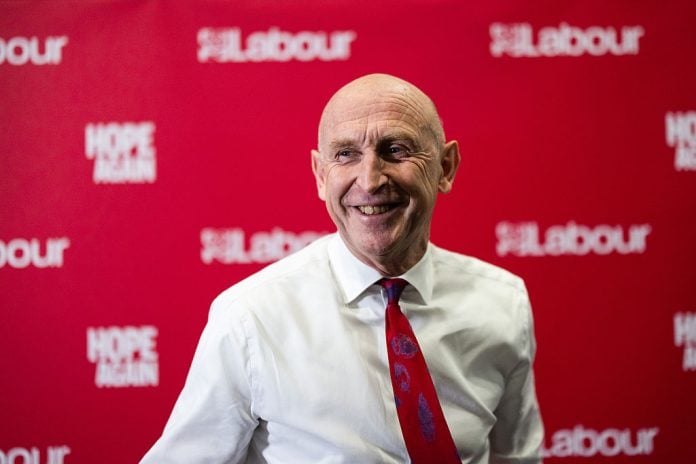
John Healey’s job of presenting his first budget as chancellor of the Exchequer may not be enviable, but the one person he cannot blame is his predecessor. In terms of growth, fiscal consolidation and market sentiment, Rachel Reeves and former Prime Minister Keir Starmer left him a decent hand to play. The International Monetary Fund expects the British economy to expand by 1.3% this year, the second-fastest rate in the Group of Seven.
On fiscal management, there’s broad agreement that the UK is something of a standout. The IMF predicts its borrowing will be the lowest in the G7 by 2031; it is, according to the fund’s Managing Director Kristalina Georgieva, the “one country where action to reduce debt and deficit has been taken decisively.”
Yields are hitting highs they haven’t seen since 1998 — but there’s still appetite for UK debt. When the Debt Management Office sold 10-year gilts in August, bids were more than 3.6 times the amount on offer, the strongest demand since April 2020.
In this budget, therefore, Healey’s task is not repair but reassurance. So far, the main difference between Prime Minister Andy Burnham’s government and Keir Starmer’s has been in the tone of optimism it projects. The chancellor must not give in to the temptation – urged on him, I’m sure, by his cabinet colleagues – to burn the credibility accumulated through two years of dour fiscal responsibility to further fuel optimism. Markets will see through that and, in the end, so will voters. Instead, he should use the tone set by Burnham to show this government is confident of its ability to preserve, and even enhance, growth.
Much rides on him getting it right. A Barclays Plc survey found that 64% of UK companies are waiting to see what Healey says next week before making investment decisions; if they believe he provides a decent long-term framework, more than eight in ten say they are likely to invest more. Already, there’s a nascent revival in business investment that needs to be protected: It grew by an average of 2.4% a quarter in the first half of 2026, compared with a quarterly average of 0.6% over the decade to 2025, according to economics research group the Institute for Fiscal Studies.
Nothing need change in the commitment Labour has shown to fiscal consolidation. In fact, nothing can be changed, since it alone provides the space for everything else the government might want to do.
What should be adjusted is the message about the purpose of that commitment: Fiscal policy, and this budget specifically, should be presented as a way to extend an economic recovery, rather than as another dreary instalment in the management of national decline.
Healey’s speech will need three things to make that hopeful message persuasive.
First, a reiteration that growth is the government’s main aim, and a real vision for how — whether through industrial strategy, an investment revival or better regulation — it will be achieved. On this, he must do better than his prime minister has so far.
Second, a Burnhamite commitment to making people’s lives tangibly better in ways that don’t panic the bond markets. Short-term energy support for households, which Healey reportedly intends to announce, meets the IMF’s criteria for relief. It’s targeted and temporary — if announced with a clear and credible end date. Also, as I have argued before, cutting red tape for small business costs the Exchequer nothing. People will be willing to believe things will get better if they see a few positive changes in their daily life, however small.
And finally, Healey should promise that, even if insecurity is imported into Britain by distant wars, the government will not make things worse through hesitation, delays or infighting. Ever since Brexit, this country has been crippled by uncertainty about where its governments want to take it — and it is that unpredictability, more than anything else, that keeps investment lower than it could be.
The IMF’s chief economist has told Healey that he must “stay the course.” In other words, he doesn’t need to set out a radical new direction for Labour and Britain; the data says the path it’s been on for the past two years is the right one. What his speech needs to do is reassure Parliament, party and people of that truth. But then again, Britain has grown so addicted to doomerism that perhaps that task is even tougher than the one Reeves inherited.
This report is auto generated from the Bloomberg news service. ThePrint holds no responsibility for its content.