




New Delhi: Referendums are back in UK national politics, threatening to further strain the union and posing a challenge to the country’s seventh prime minister in a decade, Andy Burnham, who has struggled to contain the issue. It’s the first time all three out of the four UK countries have come together to take a united stand like this against London.
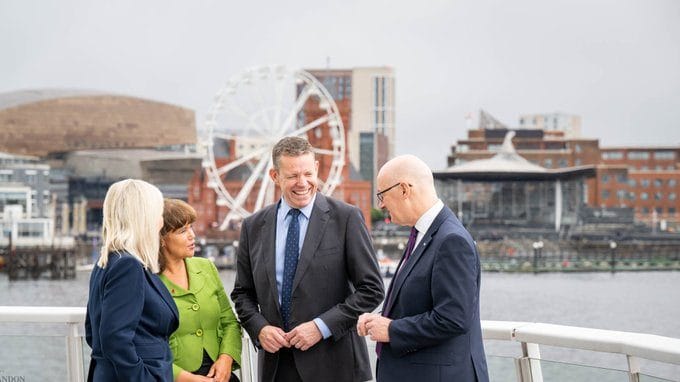
Scotland, Wales and Northern Ireland signed a memorandum of understanding (MoU) in Cardiff on Monday, calling for the UK government to “prepare, plan and facilitate” constitutional change in the three nations.
It all began with a question in Parliament. Scottish National Party (SNP) MP Chris Law last week asked Burnham whether there was scope for a referendum on Scotland’s constitutional future.
Burnham said, he would 100% adhere to the Good Friday agreement, the 1998 peace accord that ended sectarian conflict in Northern Ireland.
What followed over the next week has now led to a landmark summit, where the three first ministers are discussing how to push for constitutional change.
Burnham was quick to make a U turn on his statement but the wheels were in motion by then. Scotland’s first minister John Swinney wrote to him asking for a meeting to proceed with making the constitutional change a law. Burnham said since no such consensus exists, a second referendum is “off limits.”
The last referendum on Scotland was held in 2014 where Scots voted 55% No to 45% Yes to staying integrated with the UK. Northern Ireland has not had a referendum since the Good Friday agreement.
He also stressed that Scotland and Northern Ireland have different constitutional arrangements and histories.
“In my remarks I was simply highlighting that there is no consensus for an independence referendum in Scotland and nor is there a clear basis to suggest that a majority of people in Northern Ireland presently wish to separate from the United Kingdom”, he said in response to Swinney’s letter.
“The issue received further international attention after US President Donald Trump, during a visit to Dublin on Saturday, said he would welcome Irish reunification and called it “a great thing.” Amid a backlash from the UK government, Trump said Sunday: “I love my comments” and that he would save his opinion on Scottish independence for another day.
‘For the first time ever, people across these islands have First Ministers in Scotland, in Wales and in the North of Ireland who are all committed to independence from the United Kingdom. For people watching across these islands – for people watching around the world – there could be no clearer sign that Westminster’s time is coming to an end,’ the MoU read.
Who are the ministers?
First ministers are heads of state for devolved regional administrations in the UK. John Swinney, Scotland’s first minister and leader of the Scottish National Party, Rhun ap Iowerth, Wales’s first minister and leader of Plaid Cymru, and Michelle O’Neill, Northern Ireland’s first minister and vice president of Sinn Féin is the largest party in the Northern Ireland Assembly, signed the joint agreement to pressure UK to hold constitutional referendums.
Plaid Cymru emerged as the largest party in the Welsh Senedd after May’s elections, while the Scottish National Party remains the dominant political force in Scotland despite losing seats. In Northern Ireland, Sinn Fein became the largest party at Stormont in the 2022 elections and is widely expected to remain a major force when voters return to the polls next year. They are all parties who advocate for a breakaway from the UK.
The parties also support closer ties with the European Union and want different routes to membership. While Scotland and Wales want it as independent states, Northern Ireland aims for an Irish reunification.
History of referendums in UK
Three referendums have so far been held across the entire United Kingdom. The first, in 1975, asked whether Britain should remain a member of the European Communities, which it had joined two years earlier. The European Communities were a precursor to the European Union.
The UK subsequently left the EU in 2020 following the 2016 referendum. Brexit negotiations also gave significant attention to Northern Ireland, while Scotland’s distinct preferences received far less consideration. According to experts, it also weakened the balance between UK-wide sovereignty and devolved self-government, challenging Scotland’s and Wales’s political autonomy.
The second, in 2011, concerned whether parliamentary elections should use the Alternative Vote system. The third, in 2016, asked whether the UK should remain in the European Union.
The 1975 referendum was post-legislative: Britain had already joined the European Communities when voters were asked whether to remain. The 2011 and 2016 votes were pre-legislative, taking place before the proposed changes were implemented.
There is also no requirement for a British government to remain neutral during a referendum campaign.
In 1975, then Labour Party Prime Minister Harold Wilson’s government officially recommended voting to remain in the European Community, despite internal party divisions.
The referendum was held on June 5, 1975, with voters asking whether Britain should remain in the European Community, then commonly referred to as the Common Market. The official campaign in favour of remaining was led by Britain in Europe, while the National Referendum Campaign advocated withdrawal.
In 2016, Prime Minister David Cameron’s government officially backed remaining in the European Union. The electorate instead voted to leave. The result set in motion the political process that ultimately led to Britain’s withdrawal from the European Union and contributed directly to Cameron’s resignation as prime minister.
Moreover, before 2000, Britain had no independent national institution specifically responsible for overseeing referendums. That changed under Tony Blair’s Labour government with the passage of the Political Parties, Elections and Referendums Act 2000, known as PPERA.
The legislation established the Electoral Commission and created a framework for regulating elections and future referendums. It also provided for a chief counting officer to oversee the conduct and declaration of results in nationwide referendums.
But PPERA did not create a standing mechanism through which a referendum could automatically be called. Parliament must still authorise each United Kingdom-wide vote through separate primary legislation.
Three Acts have so far provided the legal basis for the three national referendums: The Referendum Act 1975, for the European Communities membership referendum, the Parliamentary Voting System and Constituencies Act 2011, for the Alternative Vote referendum and the European Union Referendum Act 2015, for the 2016 vote on EU membership.
The same principle applied to referendums on devolution.
In 1997, Parliament passed the Referendums (Scotland and Wales) Act, enabling votes on the creation of a Scottish Parliament and a Welsh Assembly. The Labour government elected that year went on to hold five major devolution referendums, four of which produced a majority in favour of a greater devolved government.
What happens next?
Throughout British history, referendums have been complicated. The UK does not have a standing constitutional framework or a permanent procedure to hold a nationwide referendum. Votes are based on a question, the electorate, the campaigning rules and the ballot counts that Parliament must pass.
British referendums are, however, advisory and not legally binding. So while a government is politically compelled to respond to it, Parliament remains sovereign and even if voters reject a constitutional change, Parliament has the authority to implement it. Legislation approved as part of a referendum can later be amended or repealed in the future.
With a joint statement, if the UK agrees to a referendum it will create political and public pressure. After the 2016 EU membership referendum passed, the government invoked Article 50 and Parliament passed acts to leave the European Union, following the public’s choice.
Britain’s referendum history extends to its domestic issues. The governments of England, Scotland, Wales and Northern Ireland have held referendums on questions of devolution, sovereignty and constitutional status. The first was Northern Ireland’s 1973 border poll, in which voters were asked whether Northern Ireland should remain part of the United Kingdom or become part of a united Ireland.
Northern Ireland held another major referendum in 1998, when voters were asked to approve the Good Friday Agreement.
Scotland has held three referendums: two on devolution and one on independence. The independence referendum, held in 2014, produced the highest turnout of any referendum in British history.
In 2017, the Scottish Parliament authorised the Scottish Government to seek another referendum. But in 2022, Britain’s Supreme Court ruled that the Scottish Parliament did not have the authority to hold such a vote without the consent of the United Kingdom Parliament.
Wales has held three referendums, all concerning devolution. The Government of Wales Act 2006 created a mechanism for further referendums on expanding the law-making powers of the Welsh legislature.
Edited by Prakhar Agrawal
Also Read: India should watch Mecca Pact, but not panic, says former ambassador to Turkey Sanjay Bhattacharya