



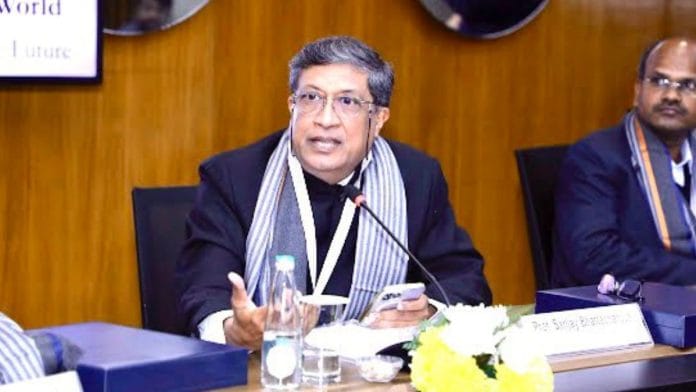

New Delhi: The deliberate withholding of details of the Mecca Pact should give India reason to watch closely, not panic, said Sanjay Bhattacharya, India’s former ambassador to Turkey, Egypt and Arab nations.
He was speaking on the implications of the defence agreement between Pakistan, Saudi Arabia and Turkey at a discussion in New Delhi Tuesday. Bhattacharya said that Pakistan has used the agreement to build greater leverage in the region, and its strategic intentions are well known to New Delhi.
“But India should avoid a reactionary response or feel compelled to take sides in a rapidly shifting West Asia,” he said, noting that none of the countries involved is currently taking a position against India.
The full text of the pact signed in Mecca has not been made public, and there is still no clear operating mechanism, command structure or chain of command for how its mutual-defence provisions would work in practice. Until those details emerge, India should resist the temptation to draw conclusions, he added.
“India is not Pakistan,” Bhattacharya said. “India has significantly deeper strategic depth and ability and capability. India does not need alliances. India can take care of itself.”
The pact has been described by its signatories as a collective mutual-defence and security arrangement, potentially resembling, at least in concept, the Article 5 principle of NATO, under which an armed attack on one member is treated as an attack on all.
Turkey Foreign Minister Hakan Fidan has already indicated that coordination will be necessary to determine how the agreement is implemented. “At the moment I really have an idea of the mission objectives. The final thing is that many of them have talked about a regional role. They have not talked about an extra regional role. Unless there is a mechanism and a structure and a chain of command, how do you actually do a military action?” Bhattacharya said.
The agreement does not publicly identify an adversary, leaving open the question of whether its strategic purpose is directed primarily at Iran, Israel or a broader conception of regional security.
Saudi Arabia has long relied on Pakistani military personnel, advisers and security expertise. Pakistan’s military relationship with the kingdom has therefore not emerged overnight, he added. What is new is the possibility of bringing together three different forms of strategic capital: Saudi financial resources, Turkish military technology and hardware, including drones, and Pakistani military manpower.
But the lead protagonist, in author Raj Shukla’s view, has been Turkey, which has been working toward such an arrangement for nearly three years.
Ankara’s ambitions include expanding its leadership role in West Asia, rebuilding influence in Syria and Iraq and responding to what it sees as Israeli assertiveness. The Israeli attack on Qatar, for instance, during negotiations involving Hamas in September 2025, reinforced those concerns.
More broadly, Erdogan’s pan-Islamist and neo-Ottoman vision appears to be unfolding across a wide geographical arc, from the eastern Mediterranean and Aegean to Somalia and Libya, and through active military assistance and cooperation with countries including Bangladesh, Malaysia and Indonesia.
“To me, it appears to be more like a drawing room artifact seeking to endear, dazzle those that are willing to be dazzled, and to scare those that are willing to be scared,” Bhattacharya said.
The problem is that deterrence ultimately depends on operational capability. The MDA may have a geographically ambitious profile stretching from the edge of Europe to the Indian subcontinent, but its military component does not yet appear to possess the expeditionary capacity required to conduct sustained operations across such a vast area.
The pact’s potential expansion is another unanswered question. Egypt had participated in discussions but did not sign, citing constitutional requirements. Qatar also remained outside the agreement, while the United Arab Emirates has maintained a notably quiet position. Bangladesh, meanwhile, has expressed an interest in joining.
Pakistan’s growing relationship with Saudi Arabia and Turkey deserves close attention because its consequences could extend beyond West Asia. Saudi financial support could give Islamabad additional room for manoeuvre, while Turkish military technology could reinforce a relationship between Ankara and Islamabad that New Delhi has watched with concern, the former ambassador explained.
“The Turkey-Pakistan axis, the technology axis, which we’ve seen come into play in the past as well, in the last instance,” Bhattacharya said, “is something that is going to have a cumulative effect over time because Pakistan is likely to be more emboldened with more financial resources that they will get from the Saudis.”
But he cautioned against assuming that Saudi Arabia would automatically align itself with Pakistan on every strategic issue. The more important question for India, he suggested, may be what the new alignment means for the political currents shaping the region, including the future role of the Muslim Brotherhood.
And India should remember that it is operating from a fundamentally different position than Pakistan. “The pact can be understood as more like a political security alignment, and less of a military alliance at this point in time,” Shalini Chawla, Distinguished Fellow, CAPSS said.
India, Bhattacharya argued, has neither the strategic necessity nor the structural constraints that would make a formal alliance the natural response. It should instead strengthen its own capabilities while maintaining relationships across the region.
“To get into this particular situation, at a time when we are in transition, in a very fluid situation in that particular part of the world, would be extremely foolhardy in my mind,” he said. “We should buttress ourselves, strengthen our resources, maintain good traditional relations with all sides and work out this transition period,” he added.
(Edited by Nardeep Singh Dahiya)
Also Read: On Mecca Pact, Putin’s press secy Peskov to India: ‘Be patient, it’s new, yet to be developed’