



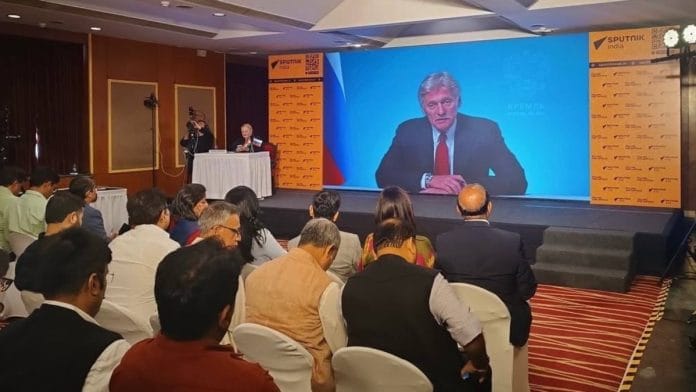
New Delhi: The Mecca Pact could be a “key pillar of regional stability,” Dmitry Peskov, press secretary to the President of Russia, said Tuesday. Addressing Indian media virtually at an event organised here by Sputnik, Peskov requested India to wait and watch before being “concerned” about the newly-formed grouping.
The Mecca Pact was announced by Pakistan, Türkiye and Saudi Arabia on 7 August. Russian Foreign Minister Sergey Lavrov indicated earlier this week that Iran could potentially join the pact, as the situation in West Asia continues to evolve.
“We hope that the (Mecca) pact will be another pillar of regional stability. If it is a real contribution for regional security, we would welcome the participation of important regional players (including Iran) in the process. It is new and yet to be developed. There have been no statements on the regional situation. Let’s be patient,” Peskov told the Indian media, just ahead of Russian President Vladimir V. Putin’s visit to New Delhi for the 18th BRICS Summit.
Apart from the Mecca Pact, Peskov highlighted areas on the agenda in the upcoming bilateral meeting between Russian President Vladimir V. Putin and Indian Prime Minister Narendra Modi, including potential sales of Su-57 fighter jets, new nuclear power projects, and further production of BrahMos missiles.
🇷🇺🇮🇳 On September 8, in New Delhi, Russian Presidential Press Secretary Dmitry Peskov held an online briefing organized by the Sputnik India ahead of President Vladimir Putin’s visit to India to participate in the 18th BRICS Summit on September 11-13.
👉 https://t.co/7WYE6CuzLb pic.twitter.com/7jfPMIH8FA
— Russia in India 🇷🇺 (@RusEmbIndia) September 8, 2026
Peskov also said that internal discussions have begun on sensitive matters such as potential transfer of technology for Russia’s Su-57 project to India.
“We are satisfied in our cooperation in the military field with India. This cooperation has very rich traditions. It is a rooted cooperation…We have very good military equipment. Some of those are the best in the world and we are ready to share those equipment with our Indian partners,” he said.
The Press Secretary to the Russian President added: “We want to go further in this field of cooperation. We are producing jointly the BrahMos missile. It is time to think about improving these missiles to make them more competitive in the market…We are willing to sell the Su 57, but the Indian side also wants transfer of the technologies…Discussions have begun, it is also on the agenda (of Putin’s meeting with Modi). ”
Putin is expected to arrive in the national capital Friday, and hold a bilateral meeting with Modi, his second in as many weeks, before attending the BRICS summit Saturday. The Russian President is expected to depart India the next day.
Peskov was categorical that Russia will “fulfill its obligations” on the sale of S400 missile systems, despite the delay in delivery. At least one platform has not yet been transferred to India.
Also Read: Oppn ridicules BJP as Nitin Nabin welcomes Russian envoy Alipov with Rasputin playing in background
Nuclear cooperation & trading in local currencies
Apart from the traditional military relationship, Peskov highlighted the expanding cooperation between the two countries across different sectors, including nuclear energy.
“Russia is a global leader in the nuclear sphere. We are involved in nuclear units across the world. We are constructing more nuclear units currently than any other country in the world. We are introducing a new field of economy in India, peaceful nuclear energy. Our cooperation is going on very well with Kudankulam. We are expecting further development in this sphere and waiting on new negotiations for a new nuclear plant that will be built in India,” said Peskov.
The growth of nuclear power cooperation would expand the strong energy relationship between the two countries. India’s imports of Russian oil have grown in the first months of the current fiscal, with Peskov highlighting that the imports are hitting a “new record” month-on-month.
India’s imports of Russian oil have grown since the war with Ukraine began in February 2022. The conflict has seen Russia’s access to the global economy severely curtailed as a result of sanctions imposed by the US and the European Union (EU).
Trade between the two countries has consistently crossed the $50 billion-mark due to India’s energy imports. Peskov highlighted that, for the most part, the two countries have been carrying out trade mostly in local currencies.
“Russia was deprived of the right to use the USD and the EUR. The US Dollar is the reserve currency of the whole world. We do not want to claim any de-dollarisation policy. We are simply doing what better corresponds with our national interest. If you want to ensure that your money continues to remain the reserve currency, then you would never do the steps I mentioned. The US is ruining the trust in its dollar,” said Peskov.
He added that Russia’s push for trading in local currencies is a direct response to the US’ bid to cut the country off from the global economy. Over 90 percent of Russia’s trade with BRICS members is now conducted in local currencies.
Peskov underlined that issues between India and Russia over the Rupee-Rouble trading system were “gradually” resolved over the last four years. He also welcomed any efforts by India to mediate the war in Ukraine, but highlighted that the issue remains Kyiv’s lack of interest in ending the conflict peacefully.
(Edited by Amrtansh Arora)
Also Read: Jaishankar underlines ‘resilient’ India-Russia ties amid US pressure over energy imports from Moscow