







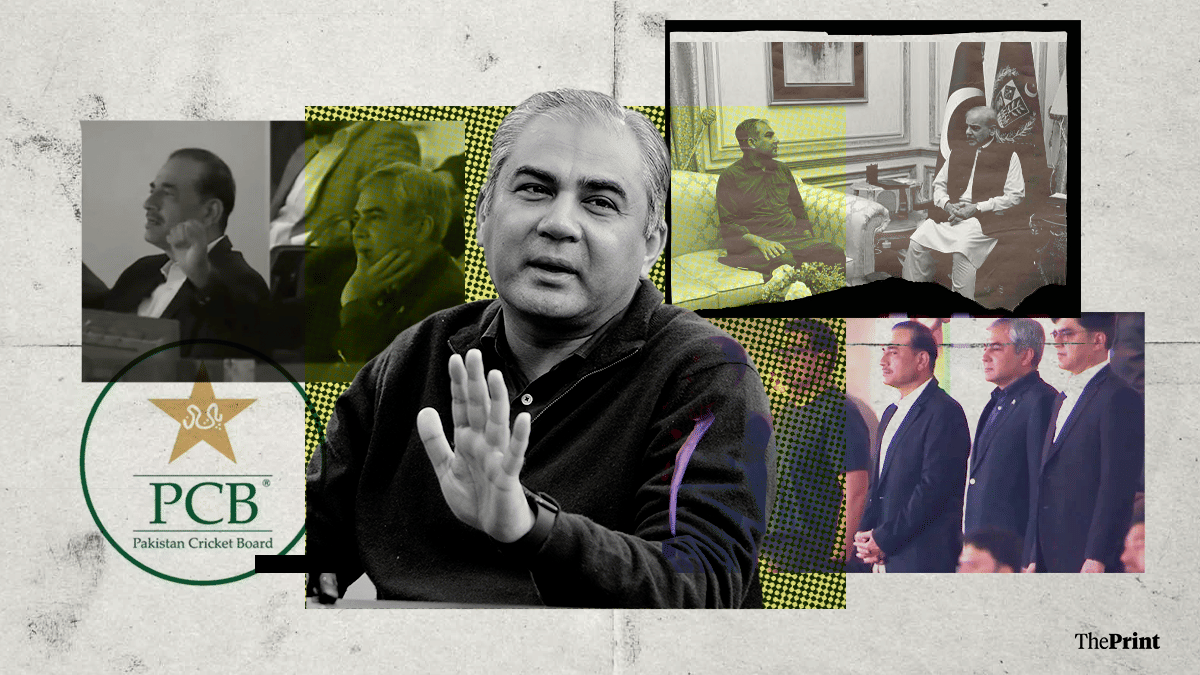
If you are back to talking about Pakistan yet again this week, thank a man called Mohsin Naqvi for it. Remember him? Many of us remember him from the Asia Cup trophy episode, when the Indian team refused to accept the trophy from him, and he took it home. It’s still with him. He can declare himself the winner of the Asia Cup.
That aside, Naqvi is a serious figure, powerful not because of anything that he has done in politics or public life but because he is seen to be the factotum of Field Marshal Asim Munir. He is handpicked, almost a political son of Asim Munir. He used to be a journalist, in fact a CNN correspondent. (The link of an earlier episode featuring him is in the description)
Selection grade: The army picked him up; that’s how talent hunt takes place in Pakistan. You pick up somebody and install them in politics. That’s what the army does, because the army ultimately decides who rules, who doesn’t rule, who stays free, who goes to jail, who gets rich, who gets pauperised — all of that. So he was made chief minister of the state of Punjab. Punjab in Pakistan is almost 60 per cent of Pakistan.
Naqvi was also made Chairman of the Pakistan Cricket Board. That is almost like the second most important job for a civilian in Pakistan — unless, of course, a general decides to take over the PCB, because it is a very important job. And then he was inserted into national politics as Minister for the Interior.
He did not belong to the Pakistan People’s Party (PPP). He did not belong to the Pakistan Muslim League-Nawaz (PML-N), Nawaz Sharif’s party. That ‘N’ doesn’t stand for Nawaz. That stands for Noon — that is Sir Malik Feroz Khan Noon, one of the many prime ministers of Pakistan.
Prime ministership in Pakistan has also had a chequered history. Mohsin Naqvi was inserted as a senator and given this key position. If you draw an equivalence with the Indian system, then he would be a member of the Pakistani Cabinet Committee of Security. Not that it matters very much, because all that stuff is done by the General Headquarters (GHQ) there, not the Cabinet. But he got to the Cabinet at the same level as, say, External Affairs Minister Ishaq Dar—also Deputy Prime Minister and a relation of Nawaz Sharif—and Defence Minister Khawaja Asif.
Cat among the pigeons: Now what has he done? On 31 July, he walked into the chambers of commerce and industry, the Pakistan equivalent of our Federation of Indian Chambers of Commerce and Industry and Confederation of Indian Industry (CII). He walked into one of their meetings, and addressed them for about 20 minutes or a little more than that, and it became a condemnation of the entire government and the system of which he is a part. He said a bunch of things, and I will list those. But basically, that made headlines all over Pakistan. It drew a lot of interest in India as well, and in all those countries that have an interest or stakes in Pakistan.
That’s because the effect of what he said puts the elected government of Pakistan on notice. It puts them on notice by saying: you failed, you are good for nothing. And even if you try much harder, you cannot get any better for Pakistan. So something has to change, something’s got to give. And in Pakistan, when the factotum — the chief factotum or the spokesman of the Field Marshal — puts his own government on notice, it means only one thing. It means that the Field Marshal or the powers that be, the GHQ, want the elected government out, and to take over. That may be a hasty conclusion now.
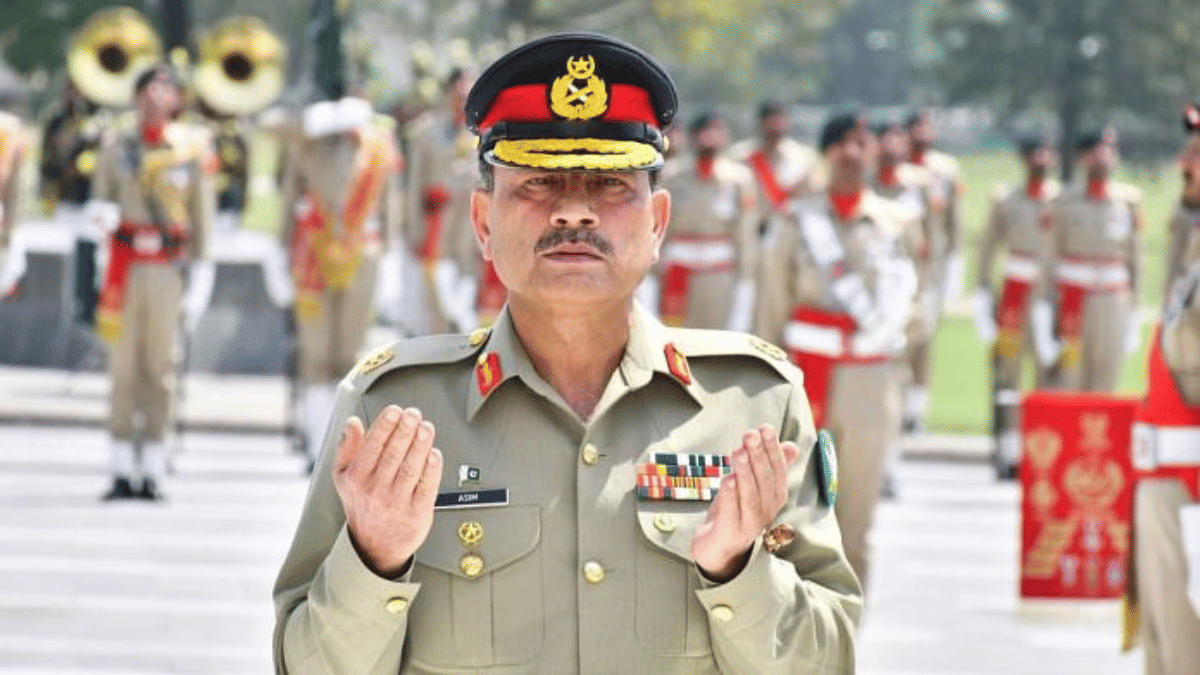
Setting the field? Or they want certain concessions from the elected government, and thereby this message. At the extreme end, if I read the Pakistani media, the interpretation is that basically the Field Marshal is getting impatient and he’s saying: look, I’m the Field Marshal, all right, I’ve got immunity for life, but I’ve still got tenure that ends in 2030. Just think about it. In 2030, Munir would have been chief of everything he can survey in Pakistan for eight years. Even then, he’ll be 62. But in his tenure, he’s already seen the third Indian Army Chief. And even if he goes home on 29 November 2030 —most unlikely; it will not happen—dictators in Pakistan cannot have a retirement plan. And Munir doesn’t have one. Even if he goes home, he’d then have seen the fifth Indian Army Chief by then. And he’ll be thinking now: why would I go home at 62 and what will I do when I go home? So he’s also planning his future now.
So, at the extreme end of the interpretation, in Pakistani circles, it’s being seen as a message to President Asif Ali Zardari and to Prime Minisiter Shehbaz Sharif that the political class should get together and invite Asim Munir to become the President of Pakistan. So he can be President; he can be Field Marshal for life, with immunity for life, etc., running the Army, Navy, Air Force and Strategic Forces Command at the same time being the President. That’s at the extreme end.
Also Read: Munir’s messenger & ‘one-man army’, the rise of Mohsin Naqvi in Pakistan’s ‘hybrid system’
Funds and games: At the most forgiving extreme — the other extreme — it is just that the army wants more money. They are not happy with the budget they have, and they know that the federal government, what we call Central government in India, doesn’t have enough money, at least not enough surplus money. That’s because in 2008, after Benazir Bhutto’s assassination, when the PPP and PML-N came together, the army was very weak. That’s the reason they carried out the 26/11 attacks in India so that they could talk about, and build up paranoia over a threat of war from India and thereby again regain their prestige. It was in that period that PML-N and PPP got together.
Asif Zardari became the President, and that is when they together passed the 18th Amendment to the Pakistani Constitution. The 18th Amendment greatly devolved powers to the provinces, to the states. Pakistan has four provinces: Punjab, Sindh, Khyber Pakhtunkhwa and Balochistan. They devolved a lot of the finances to the states, which was to be done through the National Finance Commission, just as we have the Finance Commission. And all the central revenues would then go to the federal government in a divisible pool from where it would be devolved to the states.
There was also some funny stuff there: that states will get money depending on the population they have. So in his speech, Mohsin Naqvi now says that the system is also broken because the states are not curbing their population. They are actually driving up their population because the more population they have, the more money they will get. However, the subtext is that the 18th Amendment also put education, health, etc. fully in control of the states. In India, it is still a concurrent subject, but the Pakistani system for health and education became even more federal than, or even more devolved than, say India’s system.
So the army is impatient, and this is the most liberal interpretation of what’s happening. The army feels that the federal government has nothing to give us. And they need money not just to buy weapons and acquisitions. Their defence budget just went up by almost 20 per cent this year. That is not their issue. They want a lot of money which is not accounted for, and I am using it loosely — that is the money for, for example, their jihadist activities where India is the main target.
Follow the money: Where do they get the money from? The budget gives the Inter-Services Intelligence (ISI) money for its salaries and administrative expenses, but no secret funds for all the mischief that it does. Similarly, they need more money for their own welfare as well, because the Pakistani army is the biggest oligarch. In fact, it’s the only oligarch of Pakistan, because they control almost every area of Pakistan’s economy.
In 2023, we spoke about the Cholistan project. Cholistan is a huge desert area in southern Punjab bordering India and going up to the Indus river system. The Pakistani army planned to acquire more than a million acres of land there, almost 2 or 3 million acres of land by some calculations, under its Green Pakistan Initiative, or GPI. The GPI was to be run by a private company fully owned by the Pakistani army. For all of that, the Pakistani army needs the money. So if the federal government has more money, they can take away more of this. That is the most liberal interpretation of what’s happening.
Again, at this extreme, the interpretation is that this is the first move in a coup through the legislature. That the elected MPs will remain. The elected government will invite the Field Marshal to become President —Aiwan-e-Sadr, which is the presidency there. And he will take over, and the National Assembly will endorse it. It’s all done peacefully. In fact, every coup in Pakistan is bloodless, but done through a democratic institution.
Also Read: Pakistan halts Cholistan canal project amid Indus treaty pause. Why it faces a dual crisis
Coup by invitation: So Munir, as the new President, also has the democratic stamp. The elected leaders of the country say that look here, we are patriotic Pakistanis, we are doing our best for the country. But the country today has multiple threats. It has threats from the eastern borders, that is India — which is fake because India doesn’t pose any threat to Pakistan. India is quite happy if Pakistanis stay out of our way. That I am adding; Pakistani politicians are not saying that—it’s my opinion. On the western front, we have trouble from Afghanistan and the Tehrik-i-Taliban Pakistan (TTP). In this situation, this country needs stronger leadership, and Field Marshal, who better than you to provide that leadership? So we are getting out of your way. And we are requesting you to come for the sake of the glory and survival of our country. Please come and take over the job of the President.
The other extreme is that the extortionist army is now arm-twisting the elected government to say, listen, you guys can’t even fight us because you don’t even deserve to be there. We fixed the election for you. We banned the most popular party in the country, that is Pakistan Tehreek-e-Insaf, from even contesting. We put their leader in jail. He has been in jail for three years and is rotting in there. So thank us and give us a little more money, and you find a way of doing it because what you are doing right now is not working.
Melon-slicing: Then there is an interpretation in the middle. That is just to say that look, you guys are too centralised in the provinces. You are centralised at the federal level — that’s a different thing. But you are too centralised in the provinces. Provinces have too much power. And we have too few provinces. So why can’t we have more provinces? We can have 10 provinces, or six or eight. What happens is if the provinces are then cut to size — say Punjab, which is 60 per cent of Pakistan, if that’s divided into two or three, then the Sharif family may not have so much power.
And then you can deal with each one of these provinces or constituents differently. Similarly, if you carry out this experiment, then you can also divide Sindh. And if you divide Sindh, you can take Karachi out of it. And Karachi then becomes a federally administered territory like Islamabad is.
His master’s voice: Here’s a few highlights of what Mohsin Naqvi has said. Remember, Mohsin Naqvi is only saying this; the voice is his master’s, what Munir wants conveyed to the political class. He said, one, that the system has collapsed fully in the country. It has collapsed so badly that nobody can solve Pakistan’s problem. He says, with a sideways compliment to the prime minister who works 12 hours a day, that he can work 16 hours a day, 18 hours a day, but the country’s problems cannot be solved. After a decade, we will still be dealing with the same problems. The country, what he means, is ungovernable in the current system. That’s my interpretation.
Two, he said, this country can think about having new administrative units, which means abolishing the provinces and having a lot of district-style units or divisions run by the bureaucracy, and maybe elected local bodies. That’s an experiment Pakistan has seen in the past. In 1955, Pakistan had only two provinces. All of West Pakistan was one province — Punjab, Khyber Pakhtunkhwa (which was then Northwest Frontier Province), Balochistan and Sindh. It was made one province, and East Pakistan was one province. That is to say that West Pakistan is the same size as East Pakistan or maybe a little bit bigger. Although that led to the growth of sub-nationalism in Pakistan and ultimately led to the division of the country because the East simply rebelled against this Western domination. So, one option is to have smaller new administrative units. The other is to have more provinces. And he says, look at India. India started with 14 provinces. Now they have 29.
So why can’t they have more provinces? A little problem there is that for any of these changes to take place, a two-thirds majority is needed for a constitutional amendment in the National Assembly, which is easy for the Pakistani army. But they need that in the Senate too. And the Pakistani Senate is structured a little bit like the American Senate in the sense that every province there has the same number of representatives. So tiny Balochistan also has the same number of senators as giant Punjab. And there might be a little problem there. In any case, it’s messy to deal with so much politics.
Sind against: At the same time, there’s a great deal of speculation in Pakistan about what may be the 28th Amendment to the Constitution, which can make Munir the President. I don’t know. You can do anything these days in Pakistan. Or it might break up the provinces. But for that, pushback will come from some parties. The PPP, for example, will really push back. They don’t want Sindh broken up. Because if Sindh is broken up, then they will lose control of Karachi. And if Karachi becomes a small province or a federally administered territory, then PPP cannot win elections there. Because PPP’s vote base is Sindhi. Karachi is now a very cosmopolitan city with a very large number of Muhajirs — that’s the Urdu speakers who have gone from India — and MQM (Muhajir Qaumi Movement). They are very strong there. The Islamic parties are very strong there. PTI also has a support base. So that vote will get divided. PPP can’t win Karachi on its own, and they will resist.
That’s why one of the first pushbacks to Naqvi’s speech has come from a very senior PPP leader, Nisar Khuhro. He says the size of provinces is so large that it leads to centralization, and people feel too far from it. And then he said, all of you go to Islamabad to resolve your problems. Islamabad is a very busy place; it can’t resolve your issues. You need decentralisation, which means breaking things up. Then he said that everybody is increasing population. When Pakistan needs to reduce population or reduce the population growth rate, every province is actually working on increasing their population growth rate.
Numbers game: That’s not quite true, in fact. Since 1990, when Pakistan’s total fertility rate was about 6.5, today it’s at 3.5. It is still by far the highest in this subcontinent. It’s higher than even the fastest-growing state in India, which is Bihar. So Bihar is now about a 2.8 total fertility rate. Pakistan is at 3.5 total fertility rate. Khuhro says the states are doing this because they think by having more people, they will get a larger share of Central revenue. Just for comparison, and because Pakistan has had such a high birth rate, their average age is the lowest in this subcontinent. Pakistan’s average age is just 21, and it’s one of the youngest large states in the world.
India’s average age at this point is 29. Look at other countries in the neighbourhood. Sri Lanka is at 34 because they controlled their population. Bangladesh is at 27. Even Nepal is at 26. Pakistan has a population growing much faster than any other in the subcontinent. Then, Khuhro says, unless you carry out structural governance reforms, which in Pakistan only means handing over power to us from the army, Pakistan’s youth could also become cockroaches. He uses the Indian parallel. Pakistan’s youth could attack the system and destroy it from outside, he says. This has been interpreted by some people to mean that the army or establishment will unleash some cockroach movement on the elected government. I don’t buy that. In fact, I see concern from many apologists for the Pakistani army, saying this should not happen because if it does, once you have the cockroaches out, who knows, they might turn on the institutions as well.
In Pakistan now, people don’t say the army or the GHQ; they say institutions. It’s a bit like in our traditional families, women would not mention their husbands by name. In Pakistani commentary now, people say the institution or institutions — qaumi idare. But when they say institutions, what they mean is the army.
Thin red line: Then Khuhro makes his most interesting statement. You can call it interesting. I would say it’s pregnant with possibilities and probabilities, but probably more mischief than possibilities and probabilities. He says that there is one man who’s going around the world getting fame for Pakistan, getting so much joy for Pakistan and so many favours for Pakistan, so many gains for Pakistan. Remember, he has done it all without crossing any red lines. What is the red line? The red line is just walking up the steps of Aiwan-e-Sadr, the presidency. Then he says, all of you parties should get together. In about six months, you should be able to resolve these issues. Basically, the government in Pakistan has been put on notice for six months. It’s a six-month probation. That is the interpretation that I will buy.
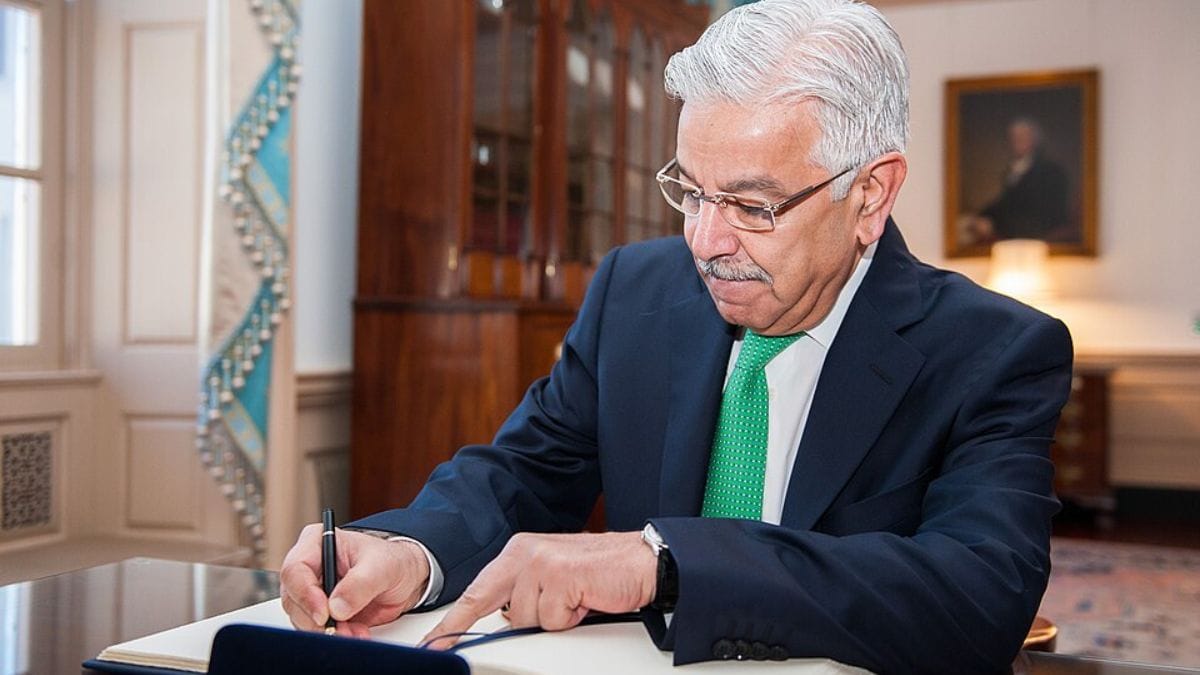
This speech has drawn criticism or pushback from many quarters. Khawaja Asif, the Defence Minister of Pakistan —the one who said before Operation Sindoor, “If you want to shoot, shoot, don’t talk”—is saying: how can Mohsin Naqvi say that? Who’s he? I haven’t even seen him in the National Assembly. He’s hardly come in. First of all, he said he hasn’t come in at all. Then he said, maybe a couple of times. Maybe he’s come a couple of times while I wasn’t there. He doesn’t even come for Cabinet meetings. He’s the Interior Minister. There is so much terrorism. I have not seen this discussed in Cabinet meetings. Maybe he goes and talks to the Prime Minister by himself. That pushback has come from him.
The other pushback has come from Rana Sanaullah. Rana Sanaullah is a colourful character, also a senior leader of PML-N, who’s also pushed back, saying: who’s Naqvi? Maybe what he’s saying is just his personal opinion. We should leave it there. We should not take it more seriously than that. I told you, PPP spoke through Nisar Khuhro — its leader in Sindh, president of the party in Sindh, also a member of the National Senate.
Maulana gauntlet: And then the strongest pushback has come from Maulana Fazlur Rehman. Maulana Fazlur Rehman is the head of Jamiat Ulema-e-Islam, JUI — the pre-eminent Islamist party in Pakistan. And he’s spoken out in a very spirited speech in such chaste Urdu that I had to also use a dictionary to get the meanings of a few words right. I will repeat them to you. He said, first of all, we respect everybody — the establishment, the bureaucracy, the politicians, the parties, and then protectors, and those who are, quote-unquote, protectors of our borders and our politics and our economy. So he means the army. And he says, if those who call themselves protectors of our borders, politics and economy, if they sabotage the Constitution and if they twist the laws of the land like muh ki naak — like, I don’t know how to translate it, like a nose made of wax, right? You can twist it any which way. If they sabotage the country’s Constitution and twist the laws like this, then I will tell them that you are responsible for taking the nation to the verge of destruction. And he says, I respect the forces and the institutions — which means the army, as I told you — but we will fight. We will fight, and when we fight, you will not be able to deal with us because right now, you are used to fighting criminals, because those who are in power right now, that is PML-N and PPP, they are criminals and they know they are criminals. That’s the reason they cannot fight you. We are not like that. If you drag us into the fight, apni halaqat ke aap zimmedaar ho gaye. Halaqat is destruction or death.
If you see some Urdu news bulletins, they say itne log halaq hue, itne terrorist halaq hue, itne fauji halaq hue. So he said, apni halaqat ke aap zimmedaar honge — you will be responsible for your destruction. He says the country is being held hostage, obviously by the army. You’ve also got entangled in this mess. Qaum bhi mehsoor hai, which means the people feel besieged. Awam ro rahe hain. People are crying. And then you have somebody who says that I am so clean — pak, saaf, shafaf. Those are the words he used. I am so clean and so pure that a case cannot be filed against me for my entire life. That’s a reference to Asim Munir. He said, don’t you mess with us. We are loyal to Pakistan’s Constitution and laws. Don’t try to sabotage that because if you do that, you will be taking us on. So there is a pushback from all parties. But each one’s pushback is a little bit limited. Maulana Sahab’s is the most direct. However, what Mohsin Naqvi has said sustains because all of these objections will not matter. What he has done is he’s given you a reading of Asim Munir’s mind. Now this is something that’s open to interpretation by everybody. I’ve given you the interpretations and conclusions from both extremes, as well as the more mainstream view