


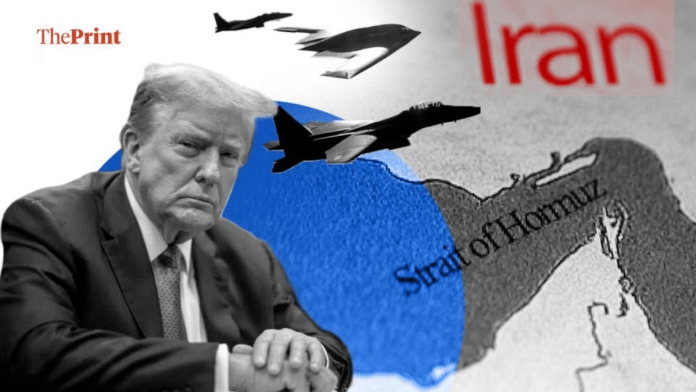
New Delhi: It’s a mid-term hammer, and the failure is epic, but US President Donald Trump prefers to downplay ‘it’. Congress has been flipped, and the legislative brakes are on for the remainder of Trump’s term.
Trump has acknowledged the war in Iran was partly to blame for the Republican rout in the American midterm elections concluded on November 3. “Iran was a piece of it,” he told the Wall Street Journal, adding he did the right thing by launching the war and would do it again.
For weeks, Trump was indicating he would strike Iran after the midterms. But just hours before the polls closed, Trump, in an interview with the Financial Times, said the US has no immediate plans to strike Iran, nor is there any reason for it, though the US forces remain ready to act if necessary.
Democrats swept the Congress, with America’s war on Iran playing a decisive role in the Republican defeat. An exit poll by US-based Responsible Statecraft shows that about 74 per cent of voters said the Iran war was a “crucial” or “major” factor in their vote, with 62 per cent believing that using military force against Iran was the “wrong decision”.
The 2026 midterms show the localisation of foreign policy. The midterms are typically conducted halfway through the incumbent’s presidency, and they are widely regarded as a referendum on the President’s governance.
‘It’s the war, stupid!’
Though Trump did not launch a full-fledged war before voters went to the polls, he carried out a series of smaller-scale military operations a day before the midterms, attacking Iran’s Qeshm island near the Strait of Hormuz. Officials described the action as “defensive” in nature to prevent Tehran from having the freedom to attack commercial ships in the Strait of Hormuz.
The war on Iran, launched jointly with Israel on the last day of February this year, has cost American taxpayers at least $47.1 billion so far, according to the Pentagon’s latest estimates. It has also led to a domestic skyrocketing of energy and fuel prices, which along with the US support for Israel, became among the central issues in the polls, challenging Republicans even in their strongholds.
On the day of the election, Trump’s disapproval rating was at 60 per cent, with his approval standing at 37 per cent, as per The New York Times; many other polls put the disapproval even above 60 per cent. The last time an American President’s approval was at a comparable low this close to midterms was in 1946. This is even considering the party in power typically loses seats in both chambers of the Congress – the Senate and the House. A vast majority of pre-election polls showed the Democrats outpacing the Republicans, even in staunchly red states.
Trump’s approval ratings slumped as an upshot of the Iran war, with the dragging of the war at odds with his 2024 presidential campaign pledge to not start new wars. The US president’s biography on the White House website credits him with “putting a stop to endless wars”. In the war’s initial days, Trump repeatedly said he would finish the war in mere “weeks” – sometimes three, four, five or six.
Far from ending the Iran war, it has only dragged on. Meanwhile, President Trump has repeatedly issued ultimatums, at one point threatening to wipe Iran off the face of earth by stating, “a whole civilization will die tonight, never to be brought back again” unless an agreement is reached. Such comments have undermined his attempt to portray himself as the “President of Peace”.
Also Read: US midterm election results ‘not a hit on me’, says Trump after Republicans lose key seats
More strikes?
Roughly a week before midterms, the Wall Street Journal on 28 October reported that the US had told several Gulf countries to be prepared for a “short, intense military campaign” after the midterms, subsequently reporting that the top US Commander in the Middle East, Admiral Brad Cooper, briefed the White House in person on military options for Iran.
Amid these reports, a US Senator from Connecticut, Chris Murphy, speaking at a Middle East Institute event, described Trump’s plan to attack Iran after midterms as “insane”. Murphy warned that it would lead to devastating escalation and would likely destroy US commitment to the rule of law. He added that some were privy to the plan, which in his view will lead to “prolongment and escalation of this war that will be devastating to our [US] security interests”.
Soon after, on 2 November, a former ally of Trump who broke away from the President in April this year, Tucker Carlson – also a conservative commentator – put out a post on X that sent alarm bells ringing across the world. He said the Trump administration, under pressure from Israel’s Benjamin Netanyahu, may be “within days of launching a nuclear strike on Iran”. The target, according to Carlson, would be Pickaxe Mountain, where Israeli intelligence claims that Iran has restarted its nuclear enrichment program. The catch is that because the supposed site in Pickaxe Mountain is an underground storage facility, no conventional weapons could penetrate through, thus requiring “a nuclear strike”.
“An American nuclear attack on Iran would set a new precedent. The Russians have already told at least two other governments that an American nuclear strike on Iran would free them to use nuclear weapons against Ukraine. Pakistan and India would be tempted to do the same against each other, as would North Korea against Seoul. After the first nuclear strike, World War Three is inevitable. That war would be short and final”, read his X post.
Carlson argued that Netanyahu, who has so far been unable to form a government after Israel’s recent elections, needs the war for political gain and is pressing US officials hard to resume it. Netanyahu reportedly wanted to resume attacks on Iran before Israelis went to the polls, but Trump wanted to wait until after the midterms. Neither Netanyahu’s bloc nor the Opposition has a clear majority, and forming a coalition government could take weeks of wrangling, or even more. Until then, Netanyahu remains caretaker prime minister, a role which would curtail his powers, and by extension, his capabilities to launch strikes against Iran. But experts say that Netanyahu would still retain significant legal powers to wage a war on Iran.
Abdul El-Sayed: The leading Democrat against the Iran war
Abdul El-Sayed, the Democrat candidate from Michigan who defeated Trump’s close ally, Mike Rogers, openly opposed the war on Iran and American support to Israel. El-Sayed, whose wife traces her origin to a town in Karnataka, has become the first Muslim Senator.
El-Sayed’s manifesto under the category of ‘Sensible Foreign Policy’ opposed what he calls the “illegal and unjustifiable war” in Iran. He has spoken of utilising taxpayer dollars at home instead of providing direct blank-check funding to foreign militaries–including Egypt, Israel, Saudi Arabia, the UAE, and others.
“Right now, our tax dollars and American-made weapons are being used to perpetrate a genocide in Gaza, illegal settlements in the West Bank and Jerusalem, and the attempted annexation of Southern Lebanon. That must end… I support an immediate arms embargo on Israel and reject the false differentiation between “offensive” and “defensive” weapons”, it further adds.
El-Sayed’s campaign, coupled with others who have taken a similar stance during electioneering, appears to have resonated with a substantial share of Americans, cutting into Trump’s support. The effect was visible on election day itself, when Trump announced that aid to Israel, amounting to $4 billion, would be cut off at the end of the year. This aid would be replaced with an agreement where Israel would have to pay to purchase weaponry from the United States.
Explaining the U-turn in his decision, Trump said, “They don’t need it”, and, “why should we suffer the slings from lunatics like an El-Sayed when they don’t need it?”.
However, the current memorandum of understanding between the two countries provides Israel $3.8 billion annually through September 2028. Trump’s comments suggested this would be cancelled two years early with Netanyahu’s consent. Trump may also have recognised that winning congressional approval for aid packages would be difficult, particularly if Republicans lose their majority in the midterms, which has now happened.
Netanyahu’s chief opponent, Gadi Eisenkot, swiftly used Trump’s statement to make his case for why the former prime minister cannot be trusted and must be replaced. “The fact that the defence establishment, along with Israeli citizens, is learning through the media about a change in the strategic relationship shows just how much Netanyahu’s conduct poses a real danger,” said Eisenkot.
What now?
Now, with Democrats having captured both chambers of Congress – the Senate and the House – Trump may find it difficult to get approval for fresh strikes on Iran or further military support for Israel. However, presidents often have latitude to chart the course of their foreign policy. Many have thus pointed to how Trump’s loss at home could spur him toward even more aggressive actions globally, including renewing the military campaign against Iran.
Rather than launching a kinetic campaign, the Trump administration is currently pursuing a punitive economic policy, having imposed tighter sanctions and a naval blockade on Iran whilst shutting down much of its air links and cutting into its overland trade routes. The resulting pressure has squeezed Iran’s already suffering economy.
Experts across the board have said officials in the US and Israel still continue to believe, erroneously so, that another round of strikes against Iran, either decapitating senior officials or striking critical infrastructure, will lead Tehran to concede and bring down the regime. In reality, however, this will only harden the Iranian regime, since for the latter it is a question of survival, with fresh strikes perhaps strengthening Iran’s resolve to up its ante on the missile and nuclear programme.
Reports suggest that regional mediators led by Qatar have restarted negotiations between US and Iran to stave off a potential war after midterms. For its part, Iran has threatened massive retaliation not only on American targets, but also in neighbouring countries in the Persian Gulf, should the US and Israel renew their military campaign.
(Edited by Nardeep Singh Dahiya)