





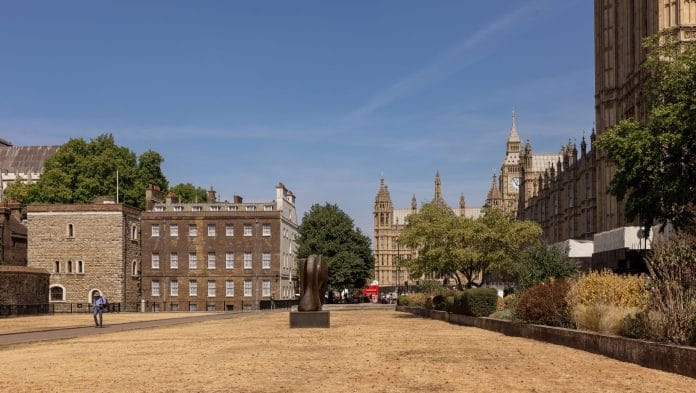

This summer, Europe’s weather has triggered widespread consternation and worry. Weeks without rain, record-breaking temperatures, failed harvests, widespread fires and thousands of heat-related deaths have been difficult to ignore, for the public, for investors — and for politicians.
As the natural weather phenomenon El Niño builds into one of the strongest ever recorded, meteorologists are now looking ahead to next summer. While it’s too early to forecast exactly what will happen, the UK’s Met Office is already saying that 2027 is likely to rival 2024 as Europe’s hottest year on record. Even if that doesn’t come to pass, climate change means future heat waves will be longer, more intense and more frequent than the record-breaking ones we have now.
But for the most part, tangible changes will take longer. Europe’s hospitals are one example. Many are in older buildings in built-up urban areas and don’t have comprehensive air conditioning, leaving them particularly vulnerable to overheating. In the UK, nurses have been fainting at work and medical staff have warned that conditions are unsafe.
“I’m optimistic that we will see adaptation to heat waves being a higher priority in the NHS,” says Chris Naylor, a senior fellow in health policy at the King’s Fund, a research nonprofit. “Whether that will happen in time for summer 2027, I’m less confident.”
Some operations were postponed this summer due to heat. That has focused minds in the health service, he added, since providers are under pressure to clear a significant waiting list. Even so, managers of hospitals and other healthcare facilities have many other demands on their time and budgets.
The NHS said in an August statement that it has implemented “a range of measures to make conditions more comfortable for staff.” Those measures include deploying portable air conditioners and adapting uniforms, the health service said.
Installing air conditioning and better insulation at hundreds of hospitals might not happen in the short term, says Naylor, but measures like solar-control glazing, reflective coatings on building roofs and better ventilation at night would all help and are quicker to implement.
Working against adaptation efforts in various sectors are tight national budgets and the many demands competing for European governments’ attention, including wars in Iran and Ukraine, tense relations with the US and voters frustrated by inflation and political instability.
How to handle the heat is also controversial. Right-wing populist politicians have seized on air conditioning as a political wedge issue, accusing policymakers of putting net-zero priorities ahead of the comfort of their citizens, in some cases while denying, against the scientific consensus, that humans are causing climate change at all.
Adaptation can also bring new challenges. The summer weather has prompted a rush to install air conditioners in Europe, meaning many more people will have access to cooling. But that creates a new vulnerability: European grids now have to contend with summer demand peaks. This summer, the UK’s grid issued multiple warnings about a mismatch in supply and demand.
This wouldn’t be the first crisis to be hailed as a wake-up call for the world that ultimately produces little concrete change.
It could also be the one that’s different, says Emma Howard Boyd, chair of the UK’s independent National Heat Risk Commission, given the persistence of this year’s heat and its effects, including fires, trade disruption, power and water outages and public spaces visibly desiccated by weeks without rain.
On Thursday, the Commission said that the UK had been slow to adapt to heat and called for evidence to help explain why more progress had not been made.
“That knowledge that things are only going to get hotter just needs to be really embraced at all levels of government,” she says. “It’s still incumbent on us all,” as the summer ends and temperatures drop, “that we don’t forget, so that we are better prepared next year.”
Disclaimer: This report is auto generated from the Bloomberg news service. ThePrint holds no responsibility for its content.