





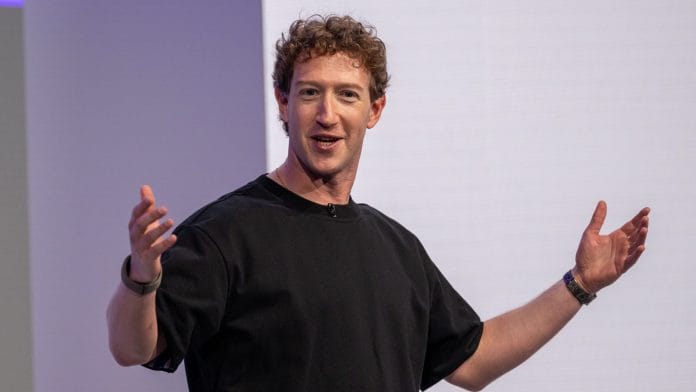


After seeing a video of Mark Zuckerberg sparring with a UFC champion on a barge in the middle of Lake Tahoe, you might be inclined to dismiss his man-of-the-people essay published on Monday morning. In it, he tries to position his company — which is paying out hundreds of millions of dollars in damages for harming children — as the AI company that will fight for you, me and everything society cares about (such as earning a living).
Unlike competitors such as Anthropic and OpenAI, Zuckerberg wrote in more than 6,500 words, Meta Platforms Inc. is building AI “primarily” for people rather than companies, governments and institutions; those other AI labs have compromised incentives and must not amass too much power, or tyranny awaits. He might be right, though to suggest his company’s “personal superintelligence” — whatever it ends up being — will therefore end up any better for humanity than those rivals is a stretch to say the least.
For starters, on the question of building open or closed AI models, he has now flip-flopped twice, which I suppose leaves him back where he started, only now claiming, with a straight (and rather sunburned) face, that his company had never wavered in this belief. In truth, Zuckerberg’s focus on AI, much like his apparent political views, has whipsawed from open to closed depending on Meta’s failings and the trends of the day. The most recent chatter in AI circles has focused on how Chinese open-weight models — which can be more highly customized and run independently of their initial creators — are growing in capability and cost efficiency. To keep up, we should make it easier and cheaper to make and release open-weight models, Zuckerberg argues, by permitting controversial practices like distillation — the process of training one model with another, which some AI labs vehemently oppose.
This attempt to position Meta as a champion of decentralized technology is comical. Zuckerberg must assume that everyone has forgotten that at one point Meta’s strategy in the developing world was to essentially centralize the internet through its thankfully ill-fated Internet.org project. Closed systems and control are in Meta’s DNA. Put it this way: the only reason Meta isn’t talking up an all-powerful closed AI model for businesses, governments institutions is that it has so far failed to build a competitive one.
So, Zuckerberg’s strategy is to use his company’s history of providing a free tool to billions as evidence he can and will do the same with AI. Then, for more proof of the positive impact Meta’s “personal superintelligence” can have on real people, Zuckerberg points to Richland Parish, Louisiana, where teachers received a $50,000 bonus thanks to a tax windfall from a Meta data-center construction project. Not bad in a region where the average teacher pay is $40,920, according to the Shreveport-Bossier City Advocate. Who could be against that?
What Zuckerberg didn’t mention were the state sales tax breaks Meta receives for building the data center. Nor did he talk about how the company managed to reduce its overall effective US federal income tax rate to just 3.5% in 2025, according to the Institute on Taxation and Economic Policy. He also doesn’t mention that teachers must be mindful the golden goose will expire once construction stops — long before the facility stops generating billions of dollars for its operator.
He did, however, announce the creation of a new $1 billion Future Is for Everyone Fund which will go to … it’s not quite clear. Concrete details of this are, naturally, scant — $1 billion doesn’t exactly go far in the AI game — and it doesn’t speak to how that support should adapt, and grow, as the supposed revenues of AI begin to materialize.
We know, of course, why this charm offensive is happening. Across the US, voter sentiment toward AI companies and the data centers they want is in the dirt. Sweeping moratoriums against construction are being laid down, with more planned. Political candidates with a solid stance against the huge, power-hungry facilities are winning across the spectrum, and Zuckerberg — who seemed to at least consider a presidential run, back when he was somewhat popular — knows all too well that the clock is ticking to reverse some of this bitter discourse as the US nears November’s midterms.
For those not convinced by the do-gooder routine, Zuckerberg’s essay offers a predictable stick to go with the carrot: He writes that “any policy” that delayed AI development for “even a month,” whether through regulatory oversight of new models or slowed infrastructure build-out, would see China march ahead. He outlines a way around this through “collaboration” — which, in Silicon Valley speak, is another way of making sure innovations happen on the companies’ terms, nobody else’s.
After the midterms, moratoriums will likely be lifted only after local jurisdictions are satisfied that companies are paying their fair share on a sustainable basis. If Zuckerberg thinks a short-term tax windfall and a loosely defined $1 billion pledge can satisfy this demand, he is wrong. It can come only from new taxation fit for the economics of the AI era, not voluntary handouts whenever companies need a quick PR victory.
Between the lines, Zuckerberg’s meandering essay betrays more than its author probably intended, for what it reveals is a man far removed from what the public wants — or rather, doesn’t want — from his AI efforts. He doesn’t seem to understand the visceral opposition to his intrusive smart (or “pervert”) glasses, for starters, and seems oblivious to how out of touch his suggestion to use AI to pick recipes to bake with his daughter, and then automatically order the ingredients, reads to anyone who knows the fun (and developmental purpose) of achieving those tasks together like human beings.
Even if you don’t care about that touchy-feely stuff and would rather focus on the investment opportunity of Meta’s AI, Zuckerberg’s bloated essay exposes again how his “personal superintelligence” strategy is more buzzword than progress, an ill-defined strategy that seems to change course from one day to the next.
Disclaimer: This report is auto generated from the Bloomberg news service. ThePrint holds no responsibility for its content.