



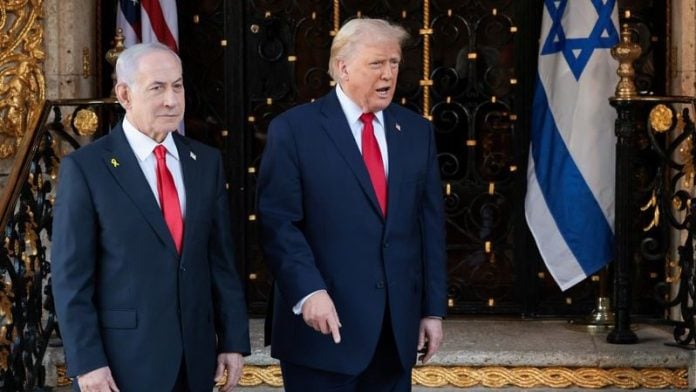
New Delhi: The United States and Israel have drawn up detailed plans for renewed strikes against Iran, including a potential three-day campaign targeting nuclear facilities, energy infrastructure and military assets, according to a New York Times report published Wednesday.
The plans come after the two countries nearly launched strikes against Iran earlier this month, before US President Donald Trump intervened to halt the operation at the last minute, according to American and Israeli officials cited by the NYT. Both air forces had completed extensive preparations and were on peak readiness before the planned operation was called off, the report noted.
Although formal planning focuses on a timeline immediately following the US midterm elections on 3 November, Trump suggested in a phone interview with CBS Monday that military action could come sooner. Meanwhile, Israeli Prime Minister Benjamin Netanyahu has taken an aggressive stance towards Tehran ahead of Israel’s 27 October elections.
According to the New York Times and the Financial Times, the Pentagon and the Israeli Defense Forces (IDF) have developed plans for an intensive 3-day campaign. The two militaries have stepped up joint exercises, including flying warplanes over Iraq to practice strike manoeuvres.
Operational planning draws on fresh intelligence and focuses on three main areas: Iran’s energy infrastructure, including the Kharg Island oil export hub; regime command centres; and deeply buried nuclear facilities, including the heavily fortified Pickaxe Mountain site, known locally as Kooh Kolang.
According to the Financial Times, Netanyahu originally pushed for a major offensive during the weekend of 10 October. Trump reportedly vetoed that timeline to prevent the regional war from reigniting ahead of the US midterm elections.
Also Read: What’s the prognosis of the US-Israel-Iran war? Strategic defeat of the US is ordained
Uncertainty among strategists
The repeated cycle of operational preparations and sudden stand-downs has created uncertainty among defence strategists, according to an anonymous military officer quoted in the NYT report.
Some US military planners argue that an intense three-day air campaign could further fracture Iran’s already weakened economy, forcing Tehran into sweeping diplomatic concessions over its nuclear programme and control of the Strait of Hormuz.
However, other policy experts told the New York Times that eight months of conflict, naval blockades and heavy sanctions have failed to bring Iran back to meaningful negotiations. Previous rounds of fighting between February and April 2026 drove up global energy prices, fuelled inflation and severely depleted US missile interceptor stockpiles.
“At this point in the war, what is clear is that the conventional military campaign waged to date, and the current punishing economic sanctions and American naval blockade, have not brought the regime back to the negotiating table in a meaningful way,” said Dana Stroul, Pentagon’s top Middle East policy official during the Biden administration, according to the New York Times.
Neither Trump nor Netanyahu “has made a compelling case for how more war would change this strategic dilemma in an increasingly unstable and conflict-ridden region”, said Stroul.
MOAB vs FOAB
The heavily fortified Pickaxe Mountain nuclear site is among the potential targets of renewed US-Israeli strikes, according to sources familiar with the planning cited by the New York Times. A CNN report published October 15, 2026, cited sources indicating that a weapon under consideration was likely intended for the facility.
There has been much speculation that the munition being considered is the GBU-43/B Massive Ordnance Air Blast (MOAB), the largest non-nuclear weapon in the US military’s arsenal and unofficially called the ‘Mother of All Bombs’. The discussion came after Trump’s revelation about potential plans to use the munition.
However, arms experts told the New York Times that the MOAB is poorly suited to striking deeply buried facilities. Weighing nearly 10,000 kg, the munition detonates midair to produce a broad surface blast, making it ineffective against subterranean granite formations such as those at Pickaxe Mountain.
Deploying the weapon would also require an MC-130 cargo aircraft, which defence strategists say could be vulnerable to Iranian air defences.
Iran, meanwhile, has threatened retaliation if the US and Israel resume their attacks.
Hossein Mohebi, an official spokesperson for the Islamic Revolutionary Guard Corps (IRGC), warned through state-run news networks Wednesday that retaliation would not be “quick or limited”. He threatened strikes extending beyond commercial shipping lanes to regional data centres and underwater internet cables, alongside concentrated missile attacks against Israel. Mohebi also threatened the use of a weapon dubbed the ‘Father of All Bombs’.
Details about the weapon remain unclear.
Ashwin Shekhar is a TPSJ alum, currently interning with ThePrint.
(Edited by Sunanda Ranjan)