


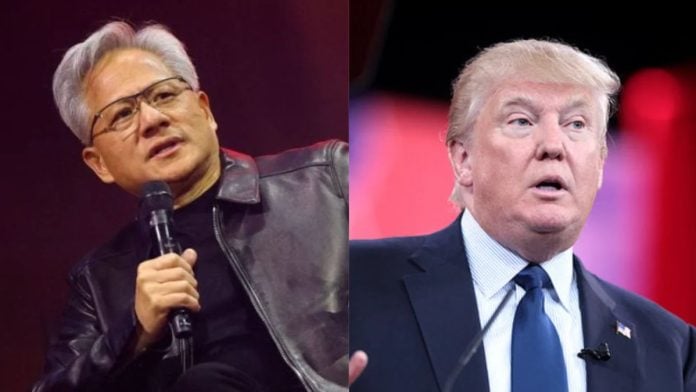
New Delhi: When Jensen Huang returned to Nvidia headquarters in Santa Clara Monday, employees lined the office walkways and balconies, cheering and shouting, “We love you, Jensen!” The Nvidia chief, who resigned less than two weeks ago amid reports of multiple affairs, thanked employees for giving him a second chance, acknowledging he had made “some very terrible mistakes”.
His return, however, was the culmination of an extraordinary political and corporate campaign involving US President Donald Trump, Vice President JD Vance, Silicon Valley executives and senior administration officials. They argued that Huang’s leadership was critical to America’s artificial intelligence ambitions and the stability of its financial markets.
The Wall Street Journal, Financial Times and The New York Times, in separate reports published Monday, detailed how Trump intervened to secure Huang’s reinstatement, reversing an earlier decision by Nvidia’s board to accept his resignation and rule out his return.
The campaign gained momentum as Nvidia’s shares fell sharply, dragging down technology stocks and triggering concerns about a wider market sell-off. According to the WSJ, Trump told associates there was only one solution to the crisis: bringing Huang, whom he considers a “friend and ally”, back to the company.
“The behind-the-scenes lobbying was an unprecedented campaign by the US President to bend a company board to his will,” the WSJ reported.
How Trump intervened
The turning point came over the weekend, when Attorney General Todd Blanche informed Trump and Vance that Huang was neither a target nor a subject of any Justice Department investigation. Blanche also told them the department had “no evidence” to suggest Huang had broken the law or posed a “national security risk,” according to US officials cited by the WSJ.
The assessment provided an opening for the Trump administration to push for Huang’s return, despite intelligence reports that raised concerns about his relationship with Alice Huang, whom US intelligence suspected had links to Chinese intelligence.
The WSJ described the next 48 hours as a “frantic” effort in which Trump, Vance and other senior administration officials relayed the Justice Department’s assessment to the Nvidia board members. Trump said he had spoken to the board “in numerous ways” and “through representatives”.
Trump initially suggested that former Apple CEO Tim Cook could replace Huang, but changed his position as Nvidia’s shares continued to fall and after hearing from other executives, including Elon Musk, who helped lead Silicon Valley’s support for the company’s founder, the WSJ reported.
Trump later said he had called Huang to congratulate him on his reinstatement. During the conversation, Huang spoke about new chips he wanted to develop. “There’s really nobody like him,” Trump said to The WSJ.
Trump began pushing for Huang’s return after being assured there was no evidence of illegal activity, he told The WSJ. He also acknowledged that the falling share price had influenced the timing of his intervention, saying: “The climate became more and more right as the company stock began to tumble.”
According to The Financial Times, the lobbying effort began within hours of Huang’s resignation on 12 November. Members of his inner circle, described as his “kitchen cabinet,” began approaching the White House and influential figures in Washington.
A group of Silicon Valley allies, including Uber founder Travis Kalanick and venture capitalists Gavin Baker, Brad Gerstner and Marc Andreessen, rallied in Huang’s support.
Baker and Gerstner published an open letter urging Nvidia’s board to keep all options open, including Huang’s return. An ally also helped arrange a 45-minute phone call between Huang and Vance, during which the Nvidia chief defended his positions on US chip export controls and the company’s dealings with Megaspeed.
One person familiar with the lobbying effort told the FT: “Everyone important in the tech world was beating his door down.”
The allies argued that Huang was personally integral to the health of the US AI industry and, consequently, the stock market and the wider economy. One of them told the FT: “All the success we’re enjoying, all the tech gains, that’s all down to one guy.”
People familiar with the developments said discussions leading to Huang’s return were so closely held that even Nvidia’s interim chief executive, Colette Kress, was kept out of the loop. The company’s board met on Sunday before unanimously voting to reinstate him.
Vance, a former venture capitalist mentored by Peter Thiel, appeared to be persuaded by Huang and his allies’ appeals. The group could also prove to be an important source of financial backing if Vance decides to run for president.
The ally added that Vance was not acting to raise campaign funds, but understood Nvidia’s importance to the US economy. “He clearly understands that half of US GDP depends on Nvidia right now… the Nasdaq is up 7 per cent. If you think that’s happening without Jensen, you’re crazy,” they said.
Also Read: Jensen Huang’s return added $1 trillion to Nvidia’s value. How can one man do that?
Why Huang’s return matters to Trump
Trump’s intervention came as Nvidia’s falling valuation threatened to undermine a stock-market rally central to his administration’s economic narrative. The company has become one of the biggest beneficiaries of the AI boom, supplying the advanced chips used to develop artificial intelligence systems while also financing parts of the wider industry.
The New York Times reported that the economic losses Trump saw “on the horizon” if Nvidia remained in turmoil appeared to matter more to him than the controversy surrounding its chief executive.
In a social media post, Trump said Huang’s return would “ensure the Success and Prosperity of not only the Company, but the American Economy”. Asked whether the stock market had influenced his decision, Trump told CNBC: “Probably so, but the bigger impact was the long term.”
Nvidia’s shares rose more than 30 percent by Monday’s close, adding roughly $1 trillion to its market value, according to the NYT. The S&P 500 also rose around 4.7 percent. The WSJ reported that Nvidia recorded its largest one-day increase in market capitalisation for a US company.
The NYT reported that Trump’s advocacy for Huang reignited concerns about his “growth-at-all-costs mentality” and the extent to which the US economy was becoming dependent on a single industry.
“There is genuine concern about how heavily everyone is relying on Nvidia,” Nidhi Hegde, executive director of the American Economic Liberties Project, told the newspaper. In the administration’s view, the company had become “too big to fail”, she said.
Trump argued that keeping Huang was necessary to prevent China from gaining an advantage. Speaking to CNBC, he said Chinese President Xi Jinping had praised Huang during a recent trip and suggested Beijing could try to attract the Nvidia chief if the US did not support him.
“If we didn’t do this, I could see China coming in and saying to Jensen, ‘Hey, how would you like to come to China?'” Trump said, according to the WSJ.
National security concerns remain
Huang’s return has not put an end to the scrutiny of Nvidia’s business dealings and its links to China. The Justice Department’s assessment that Huang was neither a target nor a subject of its investigation does not mean that other probes involving Nvidia, its customers or alleged chip smuggling have been closed.
The department has been investigating suspected efforts by customers, including Megaspeed International and server maker Super Micro, to move Nvidia chips into China in violation of US export controls.
The controversy has prompted criticism from lawmakers across party lines.
Some have argued that reinstating Huang could expose the US to national-security risks, particularly if chips made by Nvidia reach Chinese companies that could use them to develop artificial intelligence systems with military applications.
“This looks like a decision to protect the wallets of Wall Street fat cats while putting profits ahead of our national security,” Amy Kremer, chairwoman of Humans First, an organisation that has called for limits on data-centre development, said in a statement to the NYT.
Scott Lincicome, vice-president of general economics at the Cato Institute, said investment decisions should be driven by commercial considerations rather than political support. “We want capital flowing to companies for commercial reasons,” he told the newspaper.
Also read:Why Jensen Huang and Nvidia matter so much to markets
Questions over corporate governance
Huang’s reinstatement has brought Nvidia’s internal governance under scrutiny. He has led the company for more than three decades and owns about 3.5 percent of it, but does not hold super-voting shares that would give him greater control over shareholder decisions.
The FT reported that Huang exercises close control over subordinates, with his daughter and son-in-law also involved in the company’s internal management. Nvidia has no formal succession plan, raising questions about the concentration of decision-making around its founder.
The board considered potential successors, including Arm CEO Rene Haas, but ultimately found few candidates willing or able to replace Huang at a time when Huang’s departure risked unsettling investors and employees, WSJ reported
The decision has drawn criticism from investors and people familiar with Nvidia’s governance. One large investor told the FT: “Corporate governance has gone the way of the dodo.”
Another person who had worked with Huang in Washington wondered whether the episode would push him to seek greater control over Nvidia. “If I’m Jensen Huang, my first question today is, ‘How can I get some of those super-voting shares so I can tell everybody to f*** *** next time’,” the person said.
The FT also compared Huang’s return to one of the most remarkable corporate comebacks in recent history, drawing parallels with Sam Altman’s brief ousting from OpenAI. But it noted that the “semiconductor giant at the heart of the AI boom is in treacherous waters”
The risks surrounding the AI boom
The episode also renewed concerns about the financial risks posed by the AI industry’s rapid expansion.
Companies have committed billions of dollars to building data centres and acquiring computing capacity, with some relying on complex financing arrangements and debt to fund their expansion. The NYT reported that minutes from an October meeting of Federal Reserve officials showed that nearly all 19 participants had raised concerns about the potential fallout if AI investments failed to meet investor expectations.
Policymakers also flagged the growing use of “complex and opaque financing structures” by AI companies to fund their expansion. The Federal Reserve’s latest financial stability report, released earlier this month, identified AI as the biggest threat cited by market participants surveyed by the central bank.
The FT reported that a longtime associate of Nvidia board chair Harvey Jones believed the controversy surrounding Huang had obscured wider concerns about the sustainability of the AI boom. “The Jensen affair masks a growing market consensus that the debt-leveraged speculative data centre build-out is quite fragile,” the person said
Trump, however, has continued to defend the decision to bring Huang back, brushing aside concerns from Republican lawmakers that the move could jeopardise national security. “I think they’ll see the result is so positive because the public has spoken today,” he said, referring to the stock market’s reaction.
Earlier on Monday, Trump shared an AI-generated image on social media depicting Huang in place of the president in the iconic photograph taken after the 2024 assassination attempt at a rally in Butler, Pennsylvania. The image showed Huang clutching a red bra, with an Nvidia flag behind him.
(Edited by Anupama Yadav)
Also Read: Huang’s return boosts stocks, but investors remain wary of AI boom