


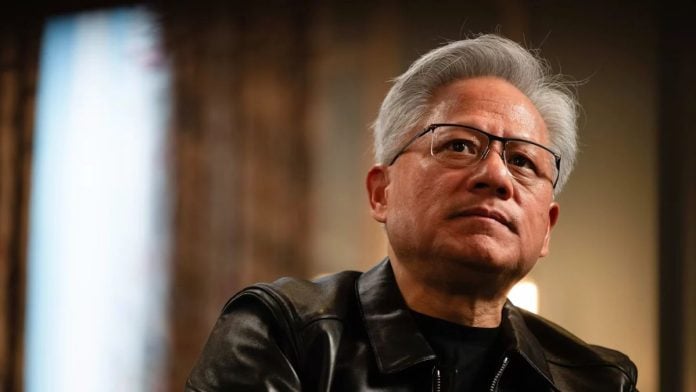
New Delhi: Nvidia did not unveil a revolutionary chip, announce a billion-dollar business deal or make a scientific breakthrough on Monday. All it did was bring back the man who built the company. And that was enough for Wall Street.
On 23 November, Nvidia shares surged 31.5 per cent, their biggest single-day percentage gain in 23 years, adding nearly $1 trillion to the company’s market value after Jensen Huang was reinstated as CEO, Reuters reported.
Huang had resigned on 12 November following revelations of extramarital affairs, including one with a woman US intelligence officials suspected of being a Chinese spy. His departure rattled global markets, wiping out more than $1 trillion from Nvidia’s valuation.
Eleven days later, following mounting pressure from investors, technology industry leaders and US President Donald Trump, Nvidia’s board unanimously voted to bring him back.
But what makes a 63-year-old electrical engineer so valuable that his return can move global markets?
How did Huang build Nvidia’s AI empire?
Long before Huang became the face of the global artificial intelligence boom, he was trying to make video games look more realistic.
In 1993, Huang founded Nvidia with fellow engineers Chris Malachowsky and Curtis Priem. The company’s early years were difficult, with its first commercial chip failing to achieve widespread success.
Its fortunes changed with the launch of the RIVA 128 graphics chip in 1997, followed by the GeForce 256 in 1999, which Nvidia marketed as the world’s first graphics processing unit (GPU).
But Huang’s most consequential decision had little to do with gaming.
GPUs can perform thousands of similar calculations simultaneously, making them particularly useful for rendering complex video game graphics. Huang recognised that the same technology could help scientists solve complicated mathematical problems.
In 2006, Nvidia introduced CUDA, a computing platform that allowed programmers to use its graphics chips for applications beyond gaming, including medical research and weather modelling.
It was an expensive gamble. Artificial intelligence was nowhere near the commercial industry it is today, and the immediate financial benefits of investing in such technology were far from obvious.
Then came a breakthrough in 2012. Researchers at the University of Toronto used two Nvidia gaming graphics cards to train an AI system called AlexNet. It comprehensively outperformed its competitors in an image-recognition competition, demonstrating the potential of GPUs in AI development.
Huang doubled down on AI.
In 2016, he personally delivered Nvidia’s first DGX-1 AI supercomputer to OpenAI, then a relatively young research organisation.
He also looked beyond chips. In 2020, Nvidia completed its $7-billion acquisition of networking company Mellanox, acquiring technology that helped large numbers of processors communicate efficiently inside data centres.
By the time OpenAI launched ChatGPT in November 2022, Nvidia had spent more than a decade building the infrastructure that would power the generative AI boom.
Its competitors were no longer simply competing against a chipmaker. They were competing against an entire computing ecosystem.
Where did the $1 trillion come from?
Nvidia’s market value rising by nearly $1 trillion does not mean that the company earned that amount in a single day.
Market capitalisation is calculated by multiplying a company’s share price by its total number of outstanding shares.
Share prices reflect not just what a company earns today but also what investors expect it to earn in the future.
Huang’s reinstatement appears to have restored some of that confidence. The rally extended beyond Nvidia, with the technology-heavy Nasdaq-100 index adding more than $2 trillion in market value on Monday.
Why are investors so attached to Huang?
Huang’s influence extends beyond technological innovation. According to the Associated Press, he has around 60 people reporting directly to him, an unusual management structure for a corporation of Nvidia’s size.
He has also built personal relationships with chip manufacturers, technology executives and customers, with some major business arrangements relying heavily on his negotiating abilities.
But such dependence comes with its own dangers.
In business, this is known as key-person risk, where the departure of an individual central to a company’s operations can threaten its fortunes.
Huang’s return has not ended the independent investigation into whether he was targeted by a foreign intelligence operation. Questions also remain over Nvidia’s export compliance and the sustainability of the broader AI investment boom.
Nvidia’s success is the work of thousands of engineers. But Huang’s reputation rests on recognising technological opportunities before their commercial potential becomes apparent.
Three decades ago, he bet on making video games look better. He subsequently bet that the same technology could teach machines to recognise images, understand language and solve complex problems.
Today, Wall Street is placing a nearly trillion-dollar bet on his ability to see what comes next.