



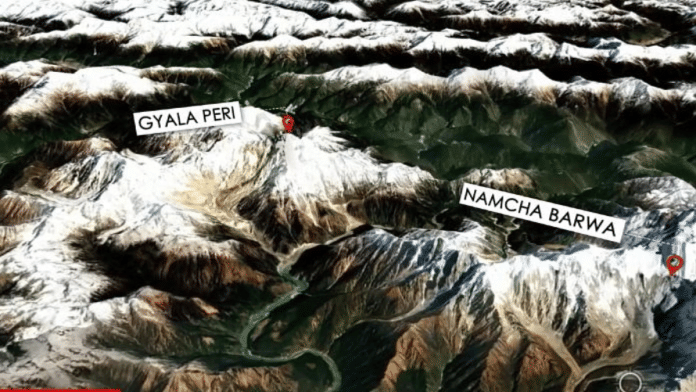

New Delhi: Chinese geologists have warned that an active fault line directly beneath it can threaten China’s Medog Hydropower Project—the world’s largest project of its kind being built on Tibetan plateau’s Yarlung Zangbo (Brahmaputra) river.
A fracture in the Earth’s crust could significantly affect the integrity of the hydropower project’s infrastructure, the geologists have warned, according to a report published Thursday in South China Morning Post.
In a paper published last month in the Chinese-language academic journal Sedimentary Geology and Tethyan Geology, supervised by the state-owned China Geological Survey, the researchers underlined the necessity to put in place measures to buttress slope stability and utilise retaining enforcements to offset potential landslides and collapses.
The Chengdu University of Technology, Civil-Military Integration Centre of the China Geological Survey, and Middle Yarlung Zangbo River Natural Resources Observation and Research Station jointly conducted the research on feasibility of the hydropower project.
The active fault, referred to as the Paizhen Fault, has been fracturing the surrounding rocks of the area, making the foundation-bearing capacity and structural stability of nearby engineering projects more susceptible to damage. “The Paizhen Fault, which has been highly active since the Pleistocene [also known as the Ice Age], will have a major impact on the structural stability and construction of nearby structures, including dams, roads, bridges and tunnels, as well as the reservoir area,” the researchers wrote.
The area is located within the designated reservoir of the hydropower project proposed downstream of the Yarlung Zangbo river.
According to the researchers the terrain has a “loose structure and weak cohesion”.
They also said that “after long-term immersion and under the influence of fault activity and earthquakes, instability of the slopes on both sides of the reservoir area can be extremely easily triggered”.
Construction on the mega-dam, with an estimated annual capacity of 300 billion kilowatt-hours of electricity. It is stated to be three times larger than the world’s largest dam and power station, the Three Gorges Dam, also in China.
Medog Hydropower Project is situated near the “Great Bend” of the Yarlung Tsangpo, where the river plunges into a 2,000-metre gorge. The project is on a strict timeline, projected to be complete by 2033.
According to the paper, Pai village, located close to the construction site, sits on the Himalayan seismic belt. The belt has seen the strongest and most recurrent earthquakes in the region. The paper cited the 6.9-magnitude earthquake that occurred in 2017 on the northern end of Paizhen fault line as evidence of the geostructural fragility of the region.
“Under regional seismic action, landslides and collapses can easily be induced, threatening the safety of engineering facilities and personnel,” the report said.
The Yarlung Zangbo becomes Siang as it flows into India’s Arunachal Pradesh, after egressing the autonomous region of Tibet. It flows further southwards through Assam as the Brahmaputra and enters Bangladesh as Jamuna river.
Construction of the dam had raised concerns about water supply and environmental impact in both India and Bangladesh.
In a written reply to Rajya Sabha in August 2025, Minister of State (MOS) for External Affairs Kirti Vardhan Singh said the Indian government had taken note of the developments and was monitoring the situation through established mechanisms. Earlier in February 2025, the MoS had informed the Rajya Sabha that India had conveyed its concerns regarding the downstream impact of the dam to the Chinese authorities. The issue was also raised by Foreign Secretary Vikram Misri during his visit to Beijing in January 2025.
Shubhanker Tripathi is an alum of ThePrint School of Journalism, currently interning with ThePrint.
(Edited by Amrtansh Arora)
Also Read: China’s Motuo dam is coming. Assam has no buffer and no real-time data