



It was supposed to be a cargo of bananas from Latin America. What Spanish police found on the ship in the Mediterranean port of Algeciras instead were 13 tons of cocaine.
The drug bust in the fall of 2024 became the biggest in Spain’s history at the time. The ensuing investigation has now revealed what authorities allege was a financial network used to launder money running all the way to the founders of a special-purpose acquisition company in Newport Beach, California, that raised $200 million from investors just last year.
The case has all the ingredients of a movie: a drug kingpin, a corrupt senior police officer with millions in cash reportedly stashed in his walls, and links to Spanish royalty. Yet the allegations are also striking in how they link financiers with Wall Street connections, an Irish fintech trading crypto assets, luxury Dubai real estate and multiple offshore lenders.
The details are being revealed in pre-trial documents prepared for court by investigators in Madrid and seen by Bloomberg. The alleged protagonists were formally named as suspects, or investigado in Spanish. None has been charged.
At the center of the network sits a suspected drug lord by the name of Ignacio Torán, according to investigators. Described as a Real Madrid fan with a penchant for luxury watches, at one point he planned to use his wealth to invest in football players from Argentina.
Allegedly working for him was Óscar Sánchez, who at the time of the 2024 cocaine bust was chief of the national police’s money-laundering unit. Sánchez is suspected of using his position to help traffickers. When police raided Sánchez’s home, they found €20 million hidden in the walls of his house, Spanish media reported.
Torán and Sánchez are in Spain and were held on remand in prison. A lawyer for Torán declined to comment. Sánchez’s lawyer didn’t deny that money was found in his client’s home, but questioned the legitimacy and procedure in the allegations against him. Messages used as evidence, for example, were obtained without the necessary court orders, for example, the lawyer told Bloomberg.
According to investigators, Torán also employed Francisco de Borbón, the son of a duke and a distant cousin to Spain’s King Felipe, and Ketan Seth, an American investor based in a mansion in Newport Beach’s upscale Dover Shores neighborhood.
Investigators say that Seth and De Borbón were managing partners at Alpha Trading, a Californian firm that was funneling Torán’s drug money from offshore accounts at a bank in Panama.
It’s unclear how Seth and De Borbón first crossed paths but they founded Alpha Trading in 2012, describing it as a “leading integrated commodity supply and marketing firm” with offices in New York, Madrid and Miami.
Seth had other interests. He operated several UPS shipping outlets in New York during the 2010s but got tied up in disputes with landlords that resulted in judgments for unpaid bills of more than $300,000, according to legal filings.
In 2025, Seth and De Borbón founded Blue Acquisition Corp. as a special-purpose acquisition company, or SPAC, targeting data centers and AI. Wesley Clark, the former four-star US Army general, became Blue’s chairman.
The firm, which lists Seth’s house in Newport Beach as its headquarters, raised about $200 million last June through an initial public offering and forged ahead with a deal to acquire a data center in Niagara Falls.
BTIG, the investment bank that’s being taken over by US Bancorp, helped arrange the IPO while some of Wall Street’s biggest hedge funds, including Sona Asset Management and LMR Partners, are among the firm’s largest shareholders today, Bloomberg data show. Representatives of BTIG, Sona and LMR all declined to comment for this story.
Blue isn’t named by investigators or accused of any wrongdoing. Seth resigned from the company on June 9 for what the firm described as “family reasons,” according to a regulatory filing. Blue’s current CEO, David Bauer, told Bloomberg that Seth is “no longer affiliated” with the company in any capacity. De Borbón served as a special adviser to Blue and the role terminated in February, Bauer said by email.
“We are at that point where you just mention AI and data centers and everyone wants in,” said Matt Tuttle, who oversees $5.3 billion as CEO of Riverside, Connecticut-based Tuttle Capital Management. “I’ve seen some strange stuff in SPAC world but this is a first for me.”
‘Grey Zone’
Seth has been called to testify, though requested a delay through his lawyers and is now scheduled in court in September. He recently also requested that an international arrest warrant against him be lifted. Seth didn’t respond to multiple emails and phone calls requesting comment or to a letter left at his Newport Beach address. His lawyer declined to comment.
De Borbón was being held in Spain and has since been released. His lawyer also declined to comment.
The case is particularly significant not just because of the size of the drugs bust but also because of the seniority of Sánchez along with the alleged role of investment structures, fintech firms, cryptocurrency and international companies, according to Annette Idler, a professor in global security at the University of Oxford who has studied illicit supply chains.
“Successful illicit entrepreneurs depend on legal markets, financial professionals, logistics companies, and corporate structures to conceal illicit proceeds,” she said. “The grey zone between legal and illegal economic activity is precisely where many sophisticated criminal organizations thrive.”
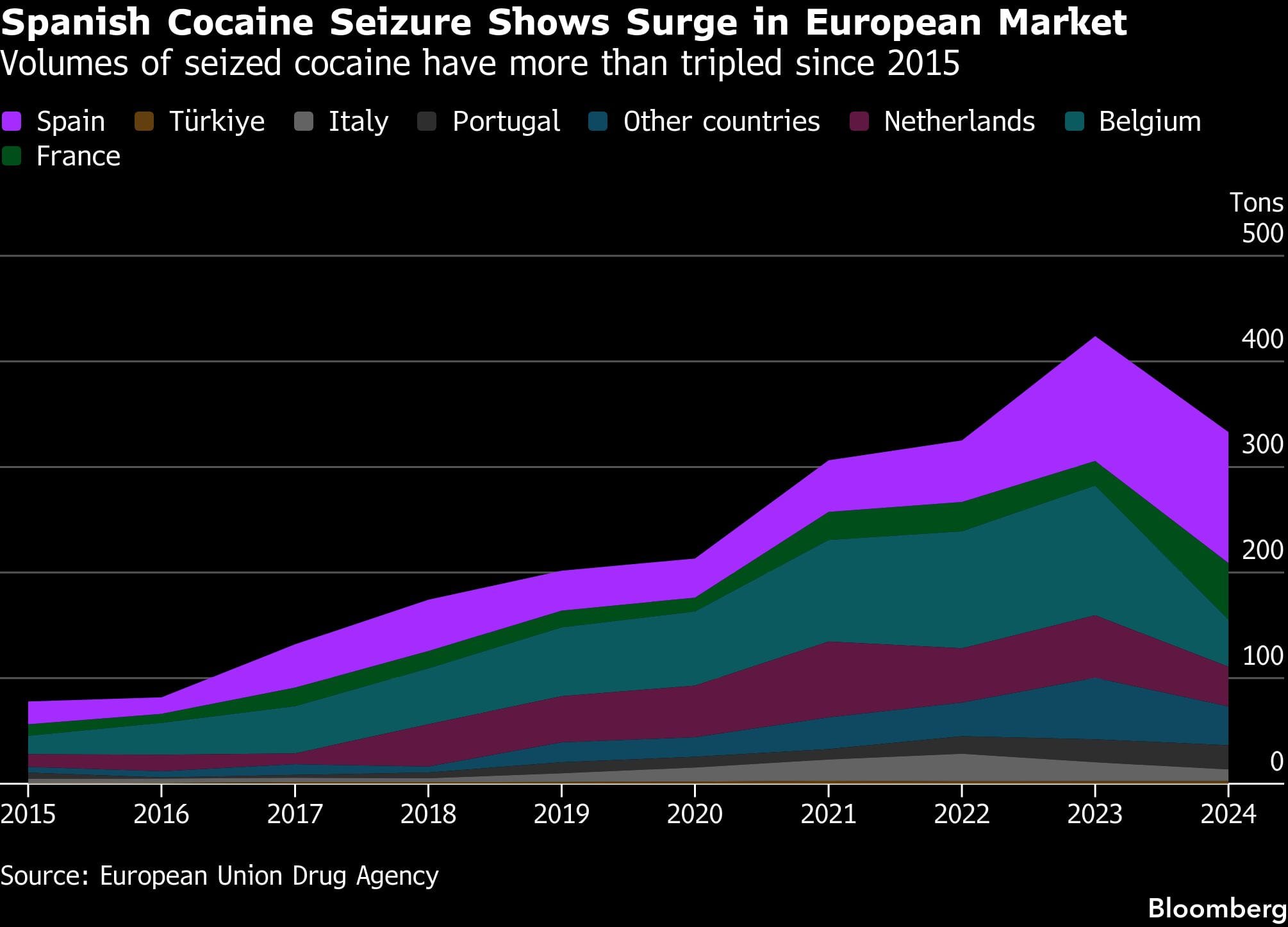
The bust in the Spanish port of Algeciras followed one involving 1.6 tons of cocaine in May 2021. They were both brought into Spain from South America camouflaged among fruit imports and with a combined market value of more than €350 million ($400 million), authorities claim.
Later, when investigators examined Sánchez’s personal phone records, they determined that another 58 tons had been smuggled into Spain between 2020 and 2024. That would amount to a retail value of $3.5 billion, based on an average price of $60 per gram, according to Gabriel Feltran, a professor at Sciences Po university in Paris who studies criminal networks.
Such incidents are no longer rare as an increasingly sophisticated network of middlemen make the drug easier and cheaper to obtain and its proceeds smoother to launder, he said. “Intermediation is driving both increases in production and consumption,” said Feltran.
Investigators believe the head of the gang is Torán. He allegedly set up the web of holding companies in Spain and abroad, mostly formally owned by front men. When he was arrested, he owned two Spanish holding groups and was about to start operating a third.
Police reckon that Torán owned real estate, mostly in Dubai, through those holding companies. This included a €10 million mansion in the W residential compound in Palm Jumeirah and €11 million in other properties in the city. He referred to these in messages as “my houses,” investigators said.
Aside from this, Torán’s gang had two offshore vehicles, including one in Panama where it had an escrow account at Atlas Bank. While investigators couldn’t seize cash or crypto assets, they estimate he had at least €10 million in bitcoin at the time of his arrest.
The gang used both fiat and crypto to move money across the world. It relied on Bitcoin, Tether and VXL dollar, and to launder the money the gang needed banks. That’s where Ireland, Panama and São Tomé and Príncipe came in.
Irish Fintech
There was also an Irish company called ET Fintech Europe Ltd., which was owned by De Borbón and several other suspects, according to the investigators. ET Fintech was “directly controlled by the criminal organization,” they said.
Alina Burnard, a shareholder and director of ET Fintech, denied that the company was involved in money laundering. The Spanish allegations “materially mischaracterize the purpose and activities” of the firm, which was set up to develop a digital banking platform, she said in an emailed statement. Burnard has cooperated fully with the investigation, she said.
There were also two entities in São Tomé that investigators say were presented online as banks, though aren’t registered with the local financial authority. In the money laundering business, such institutions are known as “nested banks,” which conduct transactions for clients using accounts in larger banks. The aim is to shield the real customer’s identity.
All these lenders were central to Torán’s organization. In an instant message in 2023, a close collaborator of Torán and his main financial manager said “it all comes from those banks” and “it goes from there” to other places.
Another step in the financial scheme was the opening of an escrow account at another lender in Panama called Atlas Bank. At least eight people are named in the Spanish court documents as involved in the Panama set-up. The escrow account had Alpha Trading, the firm run by Seth and De Borbón, as the depositary.
Alpha Trading took part in the transfers through a “complex financial instrument,” according to investigators. They don’t identify the instrument.
The “information given by the Panamanian authorities confirms the money laundering operations,” the investigators said. The entire set-up was aimed at “hiding the origin of the funds, as well as the identity of the real beneficiary” and to give “an appearance of legality to the transaction.”
–With assistance from John Gittelsohn and Peter Newcomb.
Disclaimer: This report is auto generated from the Bloomberg news service. ThePrint holds no responsibility for its content.