



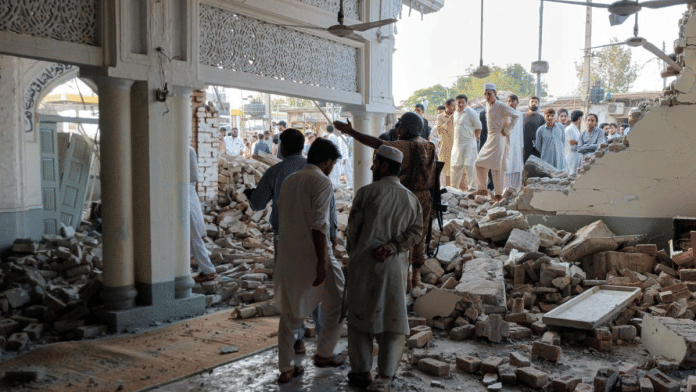
New Delhi: Eight militants were killed by Pakistani forces after a 20-hour standoff in Kohat district, marking an end of the operation that began Friday after twin strikes at a police compound in the restive northwestern Khyber Pakhtunkhwa (KP) province.
The toll stood at 31, including 16 policemen, and more than 100 injured in the attack whose responsibility was claimed by the Hafiz Gul Bahadur-led Ittehad-ul-Mujahideen.
The standoff was preceded by a suicide car bombing and gun assault at a mosque inside the Old Police Lines complex in Kohat, a city in KP province, near the Afghanistan border.
An explosives-laden vehicle rammed into the entrance of the police compound as worshippers gathered for prayers at the mosque. The militants, according to local reports, then engaged in a gun battle with security forces and KP police.
The complex houses district-level police headquarters as well as units including the Counter Terrorism Department and Special Branch. The assault came a day after a roadside bomb struck a security-forces convoy in neighbouring Hangu district, killing six soldiers.
Provincial police chief Zulfikar Hameed confirmed that the attack involved a suicide bomber. After the initial explosion, armed militants attempted to enter the police compound and engaged officers in a prolonged exchange of gunfire, he told Reuters.
On Saturday, the Khyber Pakhtunkhwa posted that the operation ended with the elimination of eight militants.
Following the blast at the Old Police Lines Mosque in Kohat, terrorists attempted to infiltrate; 8 terrorists were killed in retaliatory action by police and security forces.
IG KP Zulfiqar Hameed lauded the officers who took part in the operation and announced rewards. pic.twitter.com/OYvB81LjyF
— KP Police (@KP_Police1) September 19, 2026
In 2010, the police complex had suffered the brunt of a similar suicide car bombing which had then claimed at least 20 lives. Lashkar-e-Jhangvi, another anti-Shia Deobandi group, had claimed responsibility for the attack.
Also Read: Pakistan signs interceptor drone deal with Trump family-backed Powerus
What is Ittehad-ul-Mujahideen Pakistan?
In Khyber Pakhtunkhwa, Tehreek-e-Taliban Pakistan (TTP), or the Pakistani Taliban, remains the militant group operating along the Afghan-Pakistan border.
But competing factions and alliances have increasingly challenged its position. The Ittehad-ul-Mujahideen Pakistan, or IMP, comprises the Hafiz Gul Bahadur Group, or HGBG; Harakat Inqilab-e-Islami Pakistan, or HIIP; and Lashkar-e-Islam, or LeI.
Since its formation in April 2025, IMP has evolved into a militant umbrella alliance rather than functioning as a single, distinct organisation. The alliance has been particularly active in Khyber Pakhtunkhwa. HGBG, the faction associated with Hafiz Gul Bahadur, is regarded as the most experienced and dominant component of the coalition.
A Deobandi militant faction based in North Waziristan and nearby areas of Khyber Pakhtunkhwa, the HGBG is led by Pashtun leader Hafiz Gul Bahadur, who is affiliated with the Afghan Taliban and the Haqqani Network. Estimates put its size at roughly 1,000 to 1,500 fighters.
Bahadur was named the first deputy head of the TTP when it came into being in December 2007. Infighting followed because he insisted on attacking targets in Afghanistan, rather than the Pakistani government. As his group maintained ties with the Pakistani government, media and officials dubbed it the “good Taliban”. A 2009 analysis called Bahadur ‘the survivalist of North Waziristan’.
That peace arrangement ended in 2014, when Pakistan launched Operation Zarb-e-Azb against all militants in North Waziristan, including those of HGB. Bahadur then fully aligned with jihadist elements and relocated to Afghanistan. After the Taliban took over Afghanistan in 2021, HGB shifted its activities against Pakistan and collaborated further with other militant groups.
The Pakistan army claims the group operates from Afghanistan. The Inter-Services Public Relations, the media and public relations wing of the Pakistan armed forces, had blamed the July 2024 Bannu Cantonment attack on it following which Pakistan’s National Counter Terrorism Authority formally designated the group a terrorist organisation in July 2024.
In 2025, Bahadur was reported to be the leader of a new alliance, Ittehad-ul-Mujahideen Pakistan, which carried out ambushes and rocket and grenade attacks in North Waziristan and Tirah.
It reportedly used anti-drone technology together with the TTP. In July that year, IMP claimed that it carried out more than 90 attacks against security forces across Khyber Pakhtunkhwa. Reports indicated that June 2025 had brought a sharp increase in militant attacks and counterterrorism operations.
While some describe HGB as affiliated with or aligned with the TTP, the Pakistan Institute for Conflict and Security Studies emphasizes that the faction maintains an independent command structure and follows its own agenda.
HGB is rooted largely among the Wazir and Dawar tribes of North Waziristan. TTP has historically been dominated by the Mehsud tribal network of South Waziristan. The two groups have consequently been involved in competition over resources, authority and territorial control.
In a paper, Safdar Sial, an expert at the Pakistan Institute for Peace Studies, has described HGB as a growing security threat as it carried out large numbers of attacks against Pakistani forces. The violence in Kohat is part of a broader deterioration in security along Pakistan’s western frontier, according to Sial.
Islamabad has repeatedly accused groups like TTP of using safe havens in Afghanistan to train, organise and plan attacks inside Pakistan. The Taliban government has rejected those accusations, saying that militancy inside Pakistan is a domestic problem.
The dispute has contributed to growing tensions between the two neighbours, which have exchanged cross-border strikes intermittently.
Kohat occupies a strategic position in this region. The city is close to the Afghan border and serves as a major route toward North Waziristan, as well as toward Bannu and Dera Ismail Khan, areas that have experienced repeated militant attacks in recent months.
The district’s population is overwhelmingly Pashtun. According to the 2023 census, Pashto is the dominant mother tongue of more than 85 percent of Kohat District’s residents.
The Kohat terrorist incident, according to Pakistan’s former Special representative to Afghanistan Asif Durrani, again exposes the erosion of the state’s writ in parts of Pakistan.
“Counterterrorism is not merely about force; it requires winning the confidence, cooperation and support of the people. In KP and Balochistan, that vital element appears increasingly weak,” Durrani posted on X.
“This delicate moment once again calls for serious introspection. A more coordinated socio-political response designed to reinforce the state’s narrative is vital for a winning proposition. Pakistan will not be the last to bleed if the Taliban continue to have their way,” Express Tribune wrote in an editorial Saturday.
(Edited by Tony Rai)
Also Read: Khyber Pakhtunkhwa CM alleges ‘abduction’ by Lahore cops as Pakistan’s provincial feud escalates