


Sonia Gandhi, born Edvige Antonia Albina Maino, was a young Italian woman who arrived in India as a bride, little knowing she would become part of one of the country’s most consequential political dynasties. Having met Rajiv Gandhi in Cambridge, where they were both studying, she began a life far removed from the political tumult that would eventually define it. Rajiv entered politics following the death of his younger brother Sanjay Gandhi and went on to become India’s youngest prime minister after the assassination of his mother, Indira Gandhi, in 1984. Seven years later, Sonia was widowed when Rajiv was assassinated in 1991.
In the decades that followed, she emerged from the shadows of the Gandhi legacy to become one of the Congress party’s most influential leaders, eventually taking the helm. Now, with the release of her memoir, Belonging: A Journey of Love, published by HarperCollins India, Sonia Gandhi revisits a life shaped by love, loss and politics.
In a February 2004 episode of Walk the Talk, ThePrint Editor-in-Chief Shekhar Gupta spoke to Sonia Gandhi about her life within the Gandhi family, her relationship with her mother-in-law, Indira Gandhi, and the formidable legacy she inherited.
She also reflected on pivotal moments in India’s history, the personal upheavals that shaped her journey, and her eventual, reluctant entry into politics.
Here is a complete transcript of the interview:
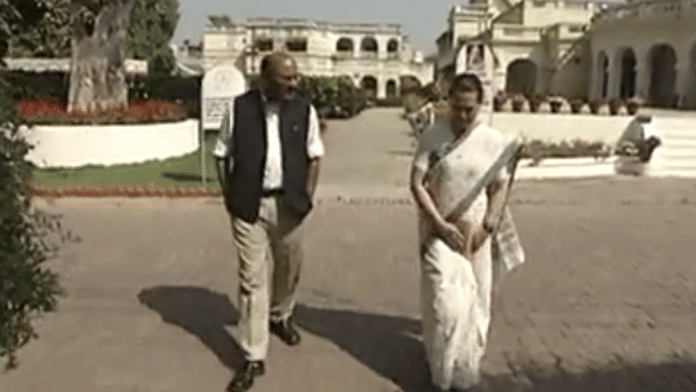
Shekhar Gupta: Hello and welcome to Walk the Talk. I’m Shekhar Gupta, and since you know my guest today so well, let me first tell you about this remarkable setting.
This is Swaraj Bhavan, part of the larger Anand Bhavan complex in Allahabad, the home of the Nehru-Gandhi family. My guest today is somebody who carries that formidable dynasty on her slender shoulders, if I can put it like that.
Mrs Gandhi, welcome to Walk the Talk. I’m so grateful to you for finding so much time.
Sonia Gandhi: Welcome to Swaraj Bhavan.
Shekhar Gupta: Life’s changed a great deal. So let me first go back to where it began. When did you first come to this place, to Anand Bhavan?
Sonia Gandhi: I came to Anand Bhavan in 1970, and that was when Indiraji dedicated Anand Bhavan and Swaraj Bhavan to the nation. In terms that they then became museums and it was open to the public. That was in the 1970s, so I had been married for two years. I was the mother of a young baby child, Rahul. It left a great impression on me because, of course, my mother-in-law, while she was winding up and deciding what things to leave here or to take. There were still some personal items here. She was describing to me and one or two friends who accompanied us what all happened in both these houses.
Shekhar Gupta: You never thought, when you got married to Rajiv, that you were marrying into a political family and that politics was going to be part of your life?
Sonia Gandhi: When I came to this family and got married, I was a complete anari about what was going to come.
Shekhar Gupta: But when you came here in 1970, you were still very much more an Italian than an Indian at that point. You had been here for a very, very short time.
Sonia Gandhi: Yes, at that time… I was adjusting. I had just come. I was adjusting to many things here, to life here, to ways of thinking. Basically, yes, that is something which happens to every young bride. But frankly, I came here because I was madly in love with my husband, and he was with me, and so nothing else mattered. It didn’t matter what I had to face.
Shekhar Gupta: Do you cook?
Sonia Gandhi: No.
Shekhar Gupta: Can you boil some pasta?
Sonia Gandhi (laughs): I used to when my husband wasn’t in politics; I used to look after my family. I used to look after my mother-in-law, and she did occasionally enjoy Western meals. So I used to cook, but when I got married, I didn’t know how to cook, so I had to pick it up from books and recipes.
Shekhar Gupta: What were your mother-in-law’s favourites?
Sonia Gandhi: Well, she did enjoy pasta.
Shekhar Gupta: What else did you learn from your mother-in-law? She was a tough woman.
Sonia Gandhi: Yes, she was a very strong woman. But she had a very, very gentle side to her, a side that very few people know. She had an eye for detail. If someone was unwell or unhappy, she would immediately notice and do something about it, perhaps by jotting down two lines.
For instance, I remember when I got married, my mother came to the wedding. She stayed for about a month, and then when she left, obviously, it was quite a sad moment for me. My mother-in-law sent me a little note: ‘Hi Sonia, this is just to tell you that we all love you.’ That totally melted me and gave me a lot of strength. I knew that I was being loved and cared for.
Shekhar Gupta: Do you recollect any responses from her to things that happened in India politically, which showed her character to you? The Bangladesh war, do you recollect anything?
Sonia Gandhi: Of course, the Bangladesh war was a very exciting moment for all of us because we lived every moment of that crisis in our family. When Mujibur Rahman came to Delhi from London, there was a big reception at the airport. I made it a point, even though I was going to deliver my other child the next day, to be there at the airport. There was such excitement. Yes, that is, I think, one of the triumphs of Mrs Gandhi.
Shekhar Gupta: What was the conversation on the dining table like during the days of that war?
Sonia Gandhi: Well, mostly, we were getting reports of the atrocities of the Pakistani army on the people of Bangladesh, on their intellectuals, and the cruelties they were indulging in. But throughout that period, she was very composed and calm.
Shekhar Gupta: The other turning point in her political career was the Emergency. What side of her did you see then? And how did you and Rajiv respond to the Emergency?
Sonia Gandhi: Well, my mother-in-law herself, after she lost the election, she did say that she had to rethink that. The very fact that she declared the elections means that she had to rethink the Emergency.
Shekhar Gupta: Do you think that she really thought it was a mistake?
Sonia Gandhi: I think she did think that it was a mistake, because don’t forget that at least the Indira Gandhi I knew was a democrat at heart, to the core. And I think circumstances compelled her to take that action, but she was never quite at ease with it.
Shekhar Gupta: What motivated you to come into politics? After your husband’s assassination, you had stayed out for some time. What forced you, inspired you, motivated you or told you there was no choice?
Sonia Gandhi: Well, the Congress party was going through some problems. Many of the leaders, my senior colleagues, came and asked me to come and help the Congress, to participate in Congress activities, because they felt that it would help the party to a certain extent. And I thought hard about it.
There was a conflict within me because I was never keen to join politics. In fact, I didn’t even want my husband to join politics because I had seen my mother-in-law’s life struggle, being rejected and having all sorts of calumnies hurled at her. She led a life of service and a very difficult life, and then she was killed.
Also Read: Sonia and Rajiv Gandhi: The romance India watched, mourned and mythologised
Shekhar Gupta: So you had seen the price you have to pay for it?
Sonia Gandhi: Yes, I’d seen that, and I felt at that time, with my husband, that possibly the same would happen to him. In fact, after my mother-in-law was killed, I knew that he too would be killed.
Shekhar Gupta: You knew? Do you mean there was an inevitability or a premonition?
Sonia Gandhi: No. All of us, my children and I, knew that it was just a question of when my husband would be killed. Anyway, the fear of being killed and all that wasn’t the issue. I thought it was going to be a difficult decision to take, a difficult phase. But eventually, frankly, I have photographs of my husband and my mother-in-law in my drawing room and in my office. Each time I walked past those photographs, I felt that I wasn’t responding to my duty, to the duty to this family and to the country.
Shekhar Gupta: Did you see anything happening in the country that said to you that you should be in politics? Did you see any trends in our politics, or was it just the family and the party?
Sonia Gandhi: No, at that time there was a trend. The BJP was gaining. That was in 1998, and the BJP was gaining somewhat. That was the main reason for me taking that decision.
Shekhar Gupta: So what was it about the BJP that made you think like that vis-à-vis the VJP? Why does the BJP worry you? It’s a political party.
Sonia Gandhi: The BJP is a political party, that may be, but the BJP is a party which believes in a divisive agenda, and we all know what their agenda is. This is an agenda against which my whole family has fought. They lived and died for the country and also to fight this agenda. Because they believed, and I believe, that this agenda, if it is carried out, is going to divide our country and break our country.
Shekhar Gupta: What are the key things that you and your government will do that will be an improvement over the current situation?
Sonia Gandhi: Well, first of all, I know that there are some reservations amongst people about our stand on economic reforms. So I think there should be no worry whatsoever. The policy of continuing with economic reforms will carry on. Nobody should have any doubt.
But our economic reforms are slightly different from the BJP’s. How? For instance, in our economic reforms, there is a very strong component of focus on social welfare programmes, rural development programmes and poverty alleviation programmes. And in the administrative strengthening and the financial strengthening of the Panchayats, which has not taken place. In the case of this government, what they have done is chipped and chopped so many of these poverty alleviation programmes that they have practically become ineffective.
So, while continuing with economic reforms, and by the way let me tell you that we greatly admire our entrepreneurs, our administrators and members of the business class because they have done a great deal for the country.
I believe that both economic reforms as far as you know, business, the business community are going ahead. We are all for it, but at the same time, I believe, we believe that we have to focus. We have to focus on the poor.
Shekhar Gupta: And people from the Congress who authored economic reforms to begin with, particularly Dr Manmohan Singh, will have a key role in this government.
Sonia Gandhi: Certainly, most certainly. The two are not mutually exclusive. I’m talking about, you know, business going ahead, the way they are, and a special focus on poverty alleviation programmes, on social welfare.
Also Read: How Sonia Gandhi stepped into Rajiv’s shoes with 2 speeches. Amethi, then Sriperumbudur
Shekhar Gupta: So there’s no repudiation of Dr Manmohan Singh or his policies?
Sonia Gandhi: Not at all. This is a galatfehmi (misunderstanding). Someone has spread a rumour that we are rethinking, but that is not the case.
Shekhar Gupta: But people from your party frequently say that a mistake was made.
Sonia Gandhi: Let me tell you that during Narasimha Rao’s time, and even during Rajivji’s time, when economic reforms were first introduced, these were the very people who attacked us bitterly, attacked the Congress bitterly, on economic reforms.
Shekhar Gupta: You mean the BJP?
Sonia Gandhi: All the parties which were on the other side, including the BJP. And now, you know. So it’s a bit of a farce.
Shekhar Gupta: But what do you think about the Prime Minister, Mr Vajpayee? As a fellow politician, fellow parliamentarian, and as a rival?
Sonia Gandhi: Well, certainly, he has been there for more than half a century in politics.
Shekhar Gupta: There are those who say that he has acquired a Nehruvian halo, the same kind of credibility that Nehru had, even among those who don’t vote for him.
Sonia Gandhi: I’m sorry, I totally disagree with that. And those who say that do not know about Nehru, have no idea, and have obviously not read anything about what Nehru was and what Nehru did.
Shekhar Gupta: And what’s the reason you think this government must go? Even more important than power for yourself?
Sonia Gandhi: Because they haven’t fulfilled a single promise of theirs. One crore jobs a year. You go anywhere around here, you step out of this house, and you will come across hundreds of thousands of young men and women who don’t know where to go. They have no future because they are jobless. What about the kisan (farmer)? There has been no growth of investment in the agricultural sector or, for that matter, in the industrial sector. Now, if we do not do something to give them security to the kisan
Shekhar Gupta: Where is the feel-good factor coming from?
Sonia Gandhi: The kisan or the naujawan (armyman) are the country’s lives (jaan). If we do not do something to give them that security, to make them feel that they have a life and a future,
Shekhar Gupta: So if all of this has not worked, then where is this feel-good factor coming from?
Sonia Gandhi: I frankly… Search me, I don’t know. I have not seen it anywhere in the places which I have visited. The feel-good factor, I tell you, could be among some cronies of the government or minister or his friends. There is a lot of cronyism going on, even in this investment. That feel-good factor could certainly be in the pockets of those people.
Shekhar Gupta: That’s a serious charge to make.
Sonia Gandhi: Well, I’ve read it in your newspaper.
Shekhar Gupta: You keep blaming my newspaper for everything. I have to go and do a bit of answering after this.
Sonia Gandhi: I think that you are an objective newspaper person. Your newspaper is respected for that.
Shekhar Gupta: For the campaign for this government, apart from the fact that they talk about their performance over the past five years, the second leg of the campaign is your foreign origin. In fact, not just your foreign origin, but also your children’s half-foreign origin.
Sonia Gandhi: That should tell you; that should be a message to all of us, to everyone, that they have totally failed, that they have to pick up this one issue.
Shekhar Gupta: But is there a liability for you or your party? Is it a liability that you originally came from Italy, or isn’t that a liability? Does that work adversely with some voters, or do you think it doesn’t matter?
Sonia Gandhi: It may work adversely with some voters. But frankly, wherever I go, especially in the rural areas, amongst women and less fortunate people, I have never felt, even when I first started working, that I was a foreigner or that they looked at me as a foreigner. Because I am not. I am Indian.
Shekhar Gupta: And do you feel fully Indian?
Sonia Gandhi: Absolutely.
Shekhar Gupta: And when did the transition start, and when was it completed?
Sonia Gandhi: Well, the transition was completed quite long ago. It was a slow transition. After all, marrying into this sort of a family which was part of the freedom movement, which made sacrifices, and which lived a life completely devoted to the service of the people — seva. They had nothing else outside of this life. No life outside this. So you also assimilate and imbibe a certain amount of these feelings.
Shekhar Gupta: So do you resent it when they talk of your foreign origins?
Sonia Gandhi: Not at all. In fact, it makes me laugh. How can I resent it if I feel completely Indian? In fact, if I go abroad, I feel a foreigner there. Truly.
Shekhar Gupta: And you said this has been a slow transition over many years.
Sonia Gandhi: Well, naturally, when I first came as a young woman of 21 into a completely different environment and surroundings, naturally, it took some years.
Shekhar Gupta: But tell me, you talked about life outside this family’s seva. If you were not in politics, what would you be doing? If you had spare time, how would you spend it? Do you watch movies? Do you cook?
Sonia Gandhi: Unfortunately, I don’t have much time to watch movies, though I would like to be able to. But I do relax by reading, for instance. I used to read much, much more. I find I don’t have time to anymore.
Shekhar Gupta: What kind of things did you used to read?
Sonia Gandhi: Autobiographies, books on history and sociology. I’m presently reading Shashi Tharoor’s book The Invention of India. And, of course, I relax most when I have my family with me, my two grandchildren.
Shekhar Gupta: Is there time for family vacations now? Or do you not see that coming?
Sonia Gandhi (laughs): Oh, I don’t see it coming. Not for some months at least.
Shekhar Gupta: But when you had personal space, I presume… before Rajivji became prime minister.
Sonia Gandhi: No, first of all, from the time Rajivji went into politics, I started working and looking after his constituency. I used to regularly go, focusing mostly on work with women in health and education. After that, when he lost the election, I used to go to the museum to do some voluntary restoration work. But when Rajivji was assassinated, we set up the Rajiv Gandhi Foundation. This is, by the way, where Jawaharlal Nehru’s ashes were kept before immersion, and Rajivji’s and Sanjayji’s. And mine will also be kept.
This is a tradition of the family before they were immersed in the holy Sangam.
Shekhar Gupta: We are in a very emotional setting.