


New Delhi: For Sonia Gandhi, the road to politics ran through two places marked by the life and death of her husband, Rajiv Gandhi. In August 1995, four years after the former prime minister’s assassination, she returned to public life with a speech in Amethi, Uttar Pradesh, the constituency he had represented, speaking of the family’s political legacy and the principles for which its members had died.
In January 1998, she stood at Sriperumbudur, Tamil Nadu, where Rajiv had been killed, and formally launched the Congress’s 1999 election campaign. The two appearances, separated by nearly two and a half years, was a marked shift for the reluctant outsider—from a widow to a political heir willing to take responsibility for a party shaped by her husband, her mother-in-law Indira Gandhi, and her father Jawaharlal Nehru.
Sonia had spent years resisting the political inheritance that came with marrying into the Nehru-Gandhi family. She had opposed Rajiv’s entry into politics, fearing that he might meet the fate of his mother, Indira. After his assassination in May 1991, she withdrew from public life, devoting herself to her children and to preserving her husband’s memory. For a time, she appeared determined to remain outside the world that had claimed both her husband and mother-in-law.
But the Congress was in decline, and pressure was building on her to intervene. Party leaders and former colleagues of Rajiv began approaching her, warning that the organisation was losing its political footing. Her first public speech in Amethi was not an announcement of a political career, but it offered an indication of the responsibility she felt towards the party and the family legacy. By the time she returned to Sriperumbudur in 1998, that sense of duty had turned into a decision to campaign.
Her memoir, Belonging: A Journey of Love, due for public release on Tuesday, revisits the personal histories and relationships behind that journey. But the transition from private citizen to political leader was visible well before the book in two speeches that charted her gradual, and deeply personal, entry into politics.
1995 Amethi speech
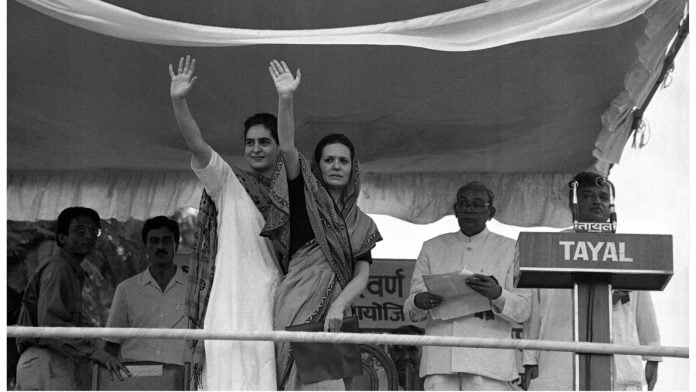
On 24 August 1995, Sonia Gandhi broke her four years of deliberate silence after Rajiv Gandhi’s assassination. At a large public meeting in Amethi, the Uttar Pradesh constituency long associated with the Nehru-Gandhi family, formerly represented by her husband Rajiv, she addressed the crowd in fluent Hindi for roughly seven to ten minutes. She was wearing a simple cotton saree.
“I have the honour of being a member of the family that spent its life in the service of people,” she said, accompanied by her daughter Priyanka Gandhi. “Jawaharlal Nehru, Indira Gandhi and Rajiv Gandhi had certain principles and a vision. They never compromised on their principles.”
She pointed to the disharmony in the country at the time.
“The principles for which they sacrificed their lives are under test today. Divisiveness is spreading in the country,” she said.
She spoke of her personal grief. She told the on-looking villagers, who called her bahu (daughter-in-law), that “you people can understand my anguish.”
“Even after four years and three months, investigations into my husband’s assassination are progressing slowly,” she added, implicitly criticising the government of the day, under P.V. Narasimha Rao.
The appearance marked her first formal public speech, and to most, it signaled that the family’s most private figure was prepared to take a step forward into public life.
“He sacrificed his life for this country,” she said. “After his death I started to feel his dreams must be realised. And that would be the only tribute to him.”
Contemporary accounts, including John F. Burns’ report in The New York Times, noted that the first rally struck many as more of a memorial service than a bare-knuckled political event, but marked the formal beginning of a barnstorming campaign.
Also Read: What Sonia Gandhi said in her 1998 Sriperumbudur speech
1998 Sriperumbudur speech
Nearly two and a half years later, on 11 January 1998, Sonia Gandhi made the leap into active electoral politics.
At Sriperumbudur in Tamil Nadu, the very town where Rajiv Gandhi had been assassinated by a suicide bomber on 21 May 1991, she stood in a orange and green saree near the site of his death and paid tribute at the memorial with Priyanka. She then launched the Congress campaign for the general election before over 10,000-20,000 people.
She began with a traditional greeting in Tamil—“Sahodharar, sahodharigal” (brothers and sisters)—before delivering her speech mostly in English.
“I stand today on the soil drenched by the blood of my husband who died a martyr for the unity of the country,” she said. “In the years since Rajiv Gandhi left us, I have chosen to remain a private person and live away from the political arena. My grief and loss has been deeply personal but the time has come to put away my personal concerns and step forward.”
She added that the tradition of duty before personal considerations has been a deepest conviction to the Gandhi family. She further emphasised her roots and devotion.
“When I entered the family of my husband 30 years ago I had become a part of India,” she said. “It is this devotion that brings me before you today, not to seek office, but to share my concerns about the future of the country.”
She described the Congress as “the only party which has the experience and capability to give India what it needs most at this time—a secular country which will work without fear or favor for the benefit of all Indians.”
She further urged the people to vote for the party, insisting that “a vote for the Congress Party is a vote for an India that Rajiv Gandhi envisioned, an India that is strong, independent and self-confident.
I had chosen to remain a private person after my husband’s death in 1991,” she said. “The time has come when I feel compelled to take the plunge and put aside my own feelings.”
(Edited by Stela Dey)