



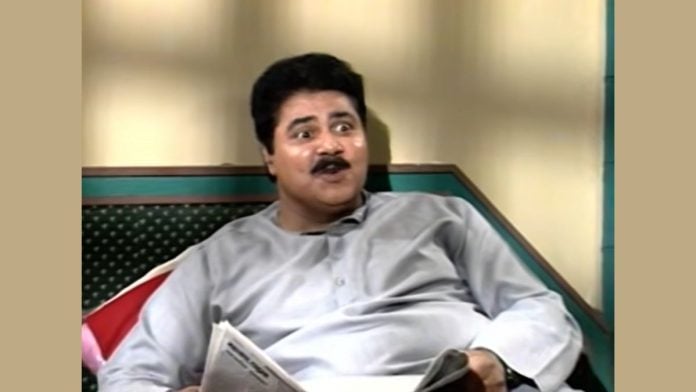
Satish Shah acted in nearly 250 films and became a household name with iconic shows such as Sarabhai vs Sarabhai. Yet, as JD Majethia, who worked with Shah for nearly two decades and directed him in the beloved sitcom, pointed out, no one could play a corpse quite like him.
“We have many brilliant actors, but no one could play a dead body quite like him. It was simply outstanding,” Majethia said. He recalled becoming a fan of Shah after watching him in Jaane Bhi Do Yaaro (1983), where Shah turned a dead body into an unforgettable performance.
He even received a newspaper headline that read, “Satish Shah, better dead than alive.” Shah recalled that as he grew bored of playing a corpse, he kept himself involved by offering suggestions to Om Puri and his co-stars, effectively performing through them. Even in death, Shah refused to stay out of the action.
“I enjoyed playing the dead body; that’s why I guess people enjoyed seeing me as a dead body. I could not actively participate; I was participating through my colleague,” he said in an interview with News18.
From playing a corpse in Jaane Bhi Do Yaaro to inhabiting 55 different characters in Yeh Jo Hai Zindagi (1984), Shah brought precision, observation, and imagination to comedy. Yet, to remember him only for the laughter he created would be to overlook the range of an actor who moved between parallel cinema, mainstream Bollywood and television with equal ease.
A familiar face
A 1976 graduate of the Film and Television Institute of India, Satish Shah died on 25 October 2025, aged 74. But his contribution to Indian cinema went far beyond playing the comic sidekick or providing comic relief. Before becoming a familiar face in mainstream films and television, Shah was part of some of the most significant films of parallel cinema, including Albert Pinto Ko Gussa Kyoon Aata Hai (1980), Arvind Desai Ki Ajeeb Dastaan (1978) and Mohan Joshi Hazir Ho! (1984). He also played a dacoit in Govind Nihalani’s Ardh Satya (1983). In Umrao Jaan (1981), he played Dilawar, a local goon who kidnaps the young Amiran and sells her to a brothel in Lucknow, demonstrating a range that the industry rarely allowed him to explore.
Over time, however, filmmakers increasingly typecast him in comic roles, overlooking the depth and versatility he could bring to more complex characters. Actor Ratna Pathak Shah, who admired his abilities, said he deserved opportunities that would have allowed his observational skills to flourish.
“Usko agar aise role mile hote jahan woh observation zayda khilne ka mauka milta toh Satish kya actor ban sakta tha. Gaata tha, beautifully, naachta tha,” she said to Pinkvilla
Satish Shah’s acting range was evident in his first major television success, the 1984 sitcom Yeh Jo Hai Zindagi. Over its 55 episodes, Shah played 55 different characters, transforming himself from a Bengali neighbour to a Gujarati man, a sofa salesman and even a thief obsessed with gulab jamun or one who needed mustard oil to hear properly. The show demonstrated his ability to build distinct comic personalities through accents, mannerisms, and physical gestures.
In the years that followed, Shah appeared in popular television shows such as Filmi Chakkar (1996), P.A. Sahab (1994) and Ghar Jamai (1997), establishing himself as a familiar face in Indian households. But his success was not confined to television. The 1990s marked a turning point in his film career, as he began appearing in commercially successful Hindi films, often alongside some of the industry’s biggest stars.
In 1994, Shah appeared in Sooraj Barjatya’s Hum Aapke Hain Koun..!, which became the highest-grossing Indian film of its time. The following year, he was part of Aditya Chopra’s Dilwale Dulhania Le Jayenge, which went on to surpass that record. By appearing in two consecutive industry hits in supporting roles, Shah achieved a distinction that few actors could match. According to trade estimates, films featuring him earned close to Rs 500 crore worldwide during the 1990s.
He continued to appear in successful comedies directed by his FTII batchmate David Dhawan, including Saajan Chale Sasural (1996), Judwaa (1997), Hero No. 1 (1997) and Anari No. 1 (1997). His performances in these films helped establish him as a dependable comic presence in mainstream Hindi cinema. Yet, even as his commercial standing grew, the roles offered to him increasingly drew on the comic persona audiences had come to recognise.
Yet, Shah was not always comfortable with the comic roles he was offered. In Main Hoon Na (2004), he played a professor who frequently spits while speaking, a character he personally found “disgusting”. In an interview, Shah recalled that Shah Rukh Khan had persuaded him to take the role.
“I wanted to play the principal, which Boman Irani did. Shah Rukh told me, ‘Satish bhai, you’ve done many such roles before and anyone can do them. I think you should do this one because we can’t imagine anyone else playing it’,” he recounted.
The performance, however, was not as easy as it appeared. Shah revealed that he would take a gulp of water, hold it in his mouth and speak in a way that made it come out like a spray. But getting the scene right became increasingly difficult because Khan would burst out laughing during the takes.
“I used to work so hard on it, but Shah Rukh would laugh, and we had to do retakes,” Shah recalled. After seven takes, when everyone on the set, including Khan, was laughing, Shah lost his patience and declared that he would not do another take. He did not appear in the following shot; the film instead used a filler shot to complete the sequence.
Also read: Ismat Chughtai was the most infamous woman in Urdu literature. Lihaaf made her immortal
Wildlife to guns
Shah was never just a funny man, Ratna Pathak Shah said. When she visited his home, she would sometimes encounter a python or a Russell’s viper. Away from the camera, the actor had a deep fascination with wildlife, kept snakes, and was an accomplished marksman with a collection of guns.
“He used to keep snakes. He was a fantastic wildlife lover and expert. He was a fantastic marksman. He had a whole collection of guns. He was not just a funny man. He never was. He had great depth about him,” Ratna said.
In June 2026, Satish Shah was posthumously conferred the Padma Shri, recognising his contribution to Indian cinema and television. The honour came after a career spanning nearly 250 films and several television shows, during which he never won a National Film Award. In 2005, he had won the Indian Television Academy Award for Best Actor in a Comic Role for Sarabhai vs Sarabhai, where his portrayal of Indravadan Sarabhai made him a household name.
His cousin Arvind Mamania, who received the Padma Shri on his behalf, said the family wished Shah had received the honour during his lifetime.
“We wished the honour would come earlier, when he was alive but nonetheless we cannot change what has happened,” he said.
(Edited by Aamaan Alam Khan)