





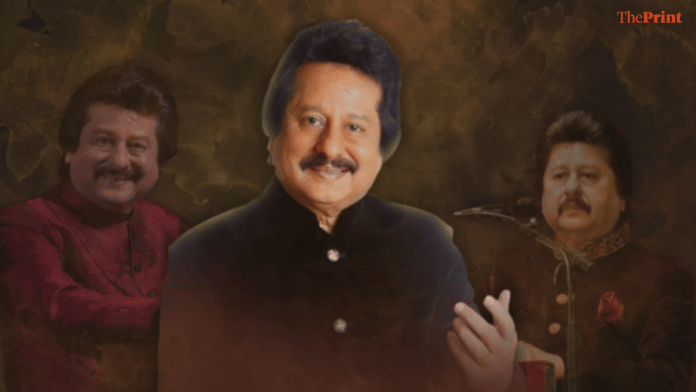


New Delhi: ‘Chitthi Aayi Hai’ from the 1986 movie Naam, starring Sanjay Dutt, might have launched a thousand flights back home. That’s the kind of impact Pankaj Udhas had on the ghazal scene in India—one of the few who transformed the genre’s reach.
“In the pantheon of ghazal singing, Pankaj Udhas is a really big name. In the ’80s-’90s, he took ghazal singing from the elite class and spread it to the common people. He has sung the poems of many shayars (poets), including Nida Fazli,” Saalim Salim, poet and editor at Rekhta Foundation, told ThePrint.
‘Chitthi Aayi hai’ is a song hummed along by every ghazal lover. In concert, Udhas would explain the finer nuances of poetry.
Some of his iconic songs are ‘Aur Aahista Kijie Batein’, ‘Niklo Na Benaqab Zamana Kharab Hai’, ‘Diwaron se Milkar Rona Achcha Lagta Hai’, ‘Jiye toh jiye kaise’ and ‘Aap Jinke Qareeb Hote Hai’.
Udhas carved a niche for himself in Bollywood, singing for young faces like Meenakshi Seshadri, Madhuri Dixit, Salman Khan and Saif Ali Khan in films such as Ghayal (1990), Saajan (1991), Yeh Dillagi (1994), among others.
Over the course of a prolific career spanning four decades, he released over 50 ghazal albums, collaborating with other musicians until 2018. He was awarded the Padma Shri in 2006.
“With his tours, he was instrumental in popularising the ghazal among the Indian diaspora across the globe. His singing tugs at our heartstrings, making us engage beyond the superficial level. He immersed himself in ghazal singing,” added Salim.
The 10,000 hours (aka ‘The Beatles in Hamburg’) grind
The early influences in Udhas’s life were his family—his father practising the dilruba, a stringed musical instrument, akin to a saarangi. And his musically gifted elder brothers and mother.
A 1972 playback opportunity did little to give Udhas’s career the start he had hoped for. Music director Usha Khanna had become a family friend and was duly impressed with Udhas’s voice. The movie, Kaamna, came and sank, but Udhas did get high praise from Amin Sayani, the host of Binaca Geet Mala on All India Radio, for his rendering of Naksh Lyallpuri’s ghazal ‘Tum Kabhi Saamne Aa Jao’. However, it seemed that the movie took young Udhas’s still budding career with it.
He kept doing the rounds of the music directors in Bombay. But with greats such as Mohammed Rafi, Kishore Kumar, Mukesh, and Manna Dey still around, it was well-nigh impossible.
He went back to the drawing board and identified a niche that felt less crowded—the ghazal. He started learning Urdu from an ustaad (teacher) who used to come and teach his brother. Soon, the three brothers formed the band ‘Fabulous Three Singers,’ which extensively toured Indian auditoriums. The touring was a hit, but a hamster’s wheel, and felt frustrating.
Young Udhas felt stuck in Bombay. His elder brother, Manhar, had broken into Bollywood playback singing and was working with the industry bigwigs. In 1976, Pankaj decided to move to Canada. Almost on arrival, he had to sing at the birthday party of his friend and host.
Once the community got a whiff of his talent, life was an endless series of concert tours across the United States and Canada, ghazals 90 per cent of the time—along with the inevitable question—what was he doing in Canada when all the opportunities lay in India?
Having found and perfected his niche away from the cruel Bombay ecosystem, a confident Udhas dared the world. “Bring it on”, seemed to be his war cry. His first album Aahat, came out in 1980. Then, an album every year till Aafreen (1986). A body of work and street cred swell was building.
Also Read: President in the bathtub. Fakhruddin Ali Ahmed was India’s most controversial head of state
‘Chitthi aai’ moment
Around 1984, yesteryear star Rajendra Kumar was making Naam. Through Manhar (Tu Mera Hero Hai, Hero, ’83), he called Udhas and said that he would be in the film.
Taken aback, he asked for time to think and revert. Confused that he might have to act, Udhas did not call Kumar for longer than the agreed-upon time window. Manhar intervened to ensure the call happened and the confusion was cleared.
Udhas realised that he would have to sing in concert ,and the entire sequence would be recorded for the film. And so, ‘Chitthi Aayi Hai…’ came to be. It was an anthem for homesick Indians.
Impact and evolution
Over the next three decades, Udhas and Jagjit Singh did most of the work of bringing ghazals from the intimate baithaks to concert halls, albums, cassettes, and CDs.
Salim, on the inevitable comparison between the two greats and contemporaries, said, “Jagjit Singh is the emperor of ghazal singing and the key to spreading Mirza Ghalib to every household. While Singh is classical and emotional, Pankaj Udhas is softer; his ghazals have easier, simpler tunes. They are more accessible to the masses, and very easy to memorise.”
They took the baton from classicists such as Begum Akhtar & Mehdi Hassan and handed it over to the likes of Hariharan and others.
In discussions and interviews, regarding his songs celebrating the drinking culture, Udhas defended himself, saying that alcohol-related songs comprise only 5-6 per cent of his total body of work.
People tend to listen to artists’ songs using playlists and to ghazals in groups while drinking. He felt that it was nothing more than the “association effect”.
He also pointed out that he never endorsed alcohol nor did any ad, while that might have been a low-hanging fruit to make a quick buck.
“Ae gham-e-zindagi, kuch toh de mashvara / Ek taraf uska ghar, ek taraf maikada (O, the sorrows of life, give me some counsel / On one side is her home, on the other is the tavern),” as he famously sings in his ghazal, ‘Ae Gham e Zindagi Kuch Toh De Mashwara‘.
But for Udhas, the “hard choice” never came. By reconciling the classical with the popular, he achieved success on every front. He found a home in the collective consciousness of a generation, bequeathing a 600-song body of work that remains a timeless source of peace, entertainment and melody.
(Edited by Insha Jalil Waziri)