


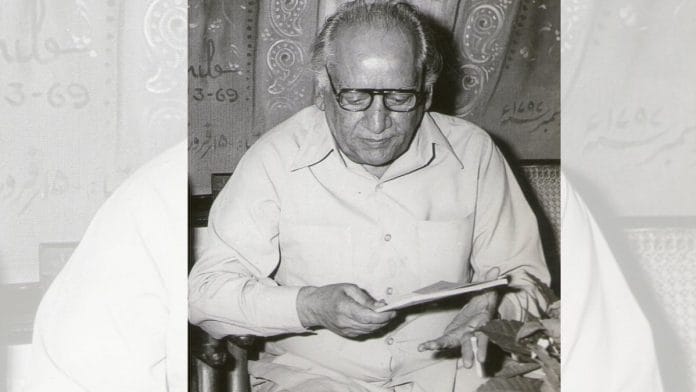
New Delhi: In 1962, when India and Pakistan were at odds, Pakistani artist Salima Hashmi got an invitation to attend an art event in India. Unsure whether she should travel at a time when tensions were running high, she turned to her father—the Pakistani poet Faiz Ahmed Faiz—for advice.
“Dekho, achche waqto’n mein toh sab jaate hain. Bure waqto’n mein jaana chahiye—In good times, everyone turns up. It is in the bad ones that one should be there,” he told his daughter Salima Hashmi, 84.
It was a small piece of advice, but it captured the convictions of a poet who said and wrote that political borders should not dictate human relationships. Hashmi accepted the invitation immediately.
“When other people are too afraid, when other people measure their own safety or their own reputation, that is the time when you have to really show what your values are and what your belief is. That is when you have to walk that path alone,” she recalled, in a conversation with ThePrint. “He felt that this is when you need to stand up and be counted.”
Forty-two years after his death on 20 November 1984, Faiz remains a perennial presence in the public life of the subcontinent. His verses, particularly Hum Dekhenge, written in 1979 as a protest against General Zia-ul-Haq’s martial law, have travelled from the political struggles of his own time to contemporary protests in India—from anti-Citizenship Amendment Act protests to Special Intensive Revision (SIR) demonstrations to the NEET leak agitation—his verses have become an enduring vocabulary of resistance.
His younger daughter, 81-year-old Moneeza, recalls someone once telling her father that every time they heard Hum Dekhenge, it felt as though it had been written that very year.
Faiz’s response was characteristically wry: “Hum kya karein, tum apni haalat hi nahi badalte—What can I do? You never change your circumstances.”
But beyond the image of the poet of resistance was a man his daughters remember for his gentleness, intellectual generosity and an instinctive sense of solidarity with others. But they also remember the private man behind the public figure—a father whose long absences were shaped by imprisonment and exile, and whose presence they often experienced through letters.
A father in letters
When Moneeza was five, Faiz was imprisoned for his alleged involvement in the Rawalpindi Conspiracy Case in 1951.
As a prominent member of the Communist Party, he was first arrested that year for his alleged involvement in a conspiracy to overthrow the Liaquat Ali Khan government and establish a left-wing, pro-Soviet administration. After spending four years in prison, he was released in April 1955 following the commutation of his sentence by then prime minister Huseyn Shaheed Suhrawardy.
He returned when she was 10, leaving much of her early childhood marked by his absence. His years in jail and subsequent periods of exile meant that she often knew her father through brief visits and correspondence rather than everyday family life.
Faiz subsequently travelled to London and Moscow, becoming an influential figure in the Progressive Writers’ Movement.
Her earliest memories of him are of a gentle man whose presence she remembers through small, almost tactile details: the softness of his hands, the pinkish inner part of his palm when they would hold hands to take a walk, the perfume he wore and the care with which he dressed.
What she remembers most is his gentleness.
“Never in my life have I heard anyone say that they had heard him get angry, that they had heard him abuse or speak loudly,” she said. “He was the most well-dressed and well-behaved man wearing matching socks,” she said.
His return to Pakistan in 1958 was followed by another detention under then president Iskander Mirza, reportedly over his communist views and alleged pro-Soviet sympathies. His sentence was commuted in 1960, and he eventually returned to Pakistan in 1964, settling in Karachi, where he was appointed rector of Abdullah Haroon College.
Moneeza remembers visiting him in jail with her mother, Alys, and sister Salima. Alys did not explain the imprisonment directly to her younger daughter, who was too young to understand.
“I would love going to jail because I could dance around, prance around, sit on,” Moneeza recalled.
As she grew older, she began to understand the reasons for his absences. Even outside prison, Faiz’s work as editor of the Pakistan Times kept him away from home. Exile added to the distance. He was first exiled for eight years, and then for another stretch.
“In a manner of speaking, my father was with me through his letters,” she said.
Alys, who had left Britain and built a life in Pakistan, held the family together through the years of imprisonment and political uncertainty.
When Faiz returned home, Moneeza recalled the lunches she shared with him while studying at Kinnaird College in Lahore, between 1963 and 1967. She would talk about college, her teachers and the heat; he would smoke and listen.
“I would say to him, ‘Did you hear me? Abba, I’m talking to you.’ And he would reassure her: ‘Of course, of course I do.’”
The inheritance of Hum
Faiz rarely spoke of himself in the singular, Moneeza said, preferring the collective pronoun “hum” — we.
“He always said hum, which is that I’m a part of mankind,” she recalled.
She sees this not merely as a linguistic habit but as an expression of his belief that the individual was part of a larger human community. It also shaped how he treated people, including those assigned to keep watch on him.
Faiz had entered public service through his association with Zulfikar Ali Bhutto, initially during Bhutto’s tenure as foreign minister under president Ayub Khan in 1965. He subsequently served as an adviser on culture and education in Bhutto’s government. After General Zia-ul-Haq’s military takeover of the government in 1979, Faiz left Pakistan for Beirut, Lebanon.
There, he edited Lotus, a magazine supported by Egyptian and Soviet institutions, and developed associations with prominent intellectuals and political figures, including Edward Said and Yasser Arafat. He returned to Pakistan in 1982, following the renewed conflict in Lebanon, in declining health. And thus began his surveillance.
Moneeza remembers intelligence officials stationed outside their home to monitor the family. Faiz would chat with them, ask after them and even offer them tea. He did not allow the surveillance to dictate how he treated the people carrying it out.
He was equally reluctant to place himself above other writers. When people praised his work, he would redirect the conversation to the poets he admired.
“He’d say, let’s talk about Iqbal, Ghalib, what am I compared to them?” Moneeza said.
Salima, meanwhile, remembers a father who treated her as an independent thinker. When Faiz was preparing a speech for a UNESCO conference in East Africa, possibly on the beginnings of civilisation, he handed her the draft and asked her to read it.
He approved of it, telling him, “Haan, abba, theek hai, chalega—it is fine, will work.”
Then, once, when she was around 12, Faiz once came across her reading Émile Zola’s Germinal, a novel about miners that contains graphic descriptions. He turned to his wife and asked whether their daughter should be reading it.
“Abba, I’m a grown-up now,” she told him. He paused and replied, “Yes, I suppose you are.”
Also Read: Faiz Ahmad Faiz: The years that preceded Hum Dekhenge
Faiz’s poems that remain
Among Faiz’s poems, Salima says her personal favourites have changed over the years. One that has stayed close to her is Shaam, which she describes as a painter’s poem. She had once suggested that it be interpreted visually; her father agreed.
The poem compares a suspended twilight to a temple and the sky to a Brahmin priest.
“The temple is looking for an excuse to let go entirely, tumble into ruins. The sky is a Brahmin priest, body smeared with ashes, forehead stained vermilion. The sky is bowed in timeless, silent reverie,” reads the English translation of a few stanzas.
For Salima, its power lies in the quietness with which it evokes decay.
“It describes decay and describes difficult times. And at the end of it, you know, it is a very visual poem. It’s a very, very quiet poem,” she said.
Faiz died in Lahore in 1984 from complications related to lung and heart disease, shortly after being nominated for the Nobel Prize in Literature.
The Faiz Foundation, of which Moneeza is a trustee, was established a year after his death. It organised the Faiz Aman Mela in 1985, which became the Faiz Festival after Pakistan returned to democracy in 1988. The festival seeks to take his work and ideas to younger audiences.
“More than 60 per cent of our voters are young people,” Moneeza said, explaining the foundation’s focus on younger generations. The message she wants them to encounter in Faiz’s work is one of “peace, human rights, justice for all, equality for all” — including equality for women and children.
For Salima, the best way to mark her father’s 42nd death anniversary is not necessarily to talk about him. She plans to spend the day with a few artists, in the kind of gathering she thinks her father would have enjoyed.
“We will gather but we won’t talk about Faiz,” she said. “Yet, I believe he will be there with us.”
(Edited by Stela Dey)