


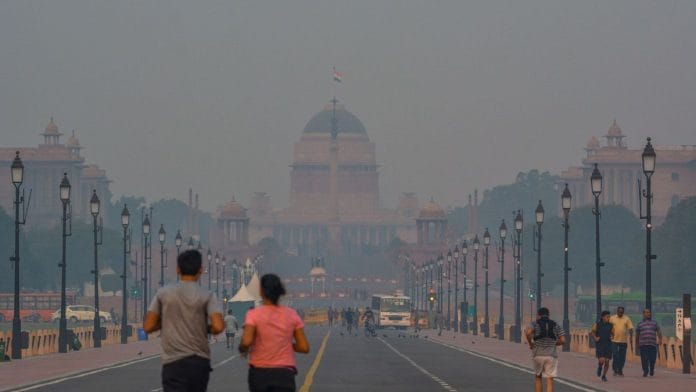
New Delhi: As Delhi’s sky filled with fireworks on Diwali night, the city’s air quality readings varied sharply across platforms — 1,700 on AQI.in, 260 on IQAir and 370 on the Central Pollution Control Board’s (CPCB) website.
The differences are not necessarily the result of irregularities or gaps in data. They can stem from the way these platforms collect, process, and report air quality information, including the sensors they use and the AQI scales they follow.
Government agencies, including state and central bodies, rely on data from the CPCB’s monitoring network for official air quality assessments. Private platforms such as AQI.in and IQAir provide readings to the public, drawing on their own sensors and, in some cases, data from government monitoring stations.
Delhi currently has 59 air quality monitoring stations managed by the CPCB, the Delhi Pollution Control Committee (DPCC) and the Indian Institute of Tropical Meteorology (IITM). These include Continuous Ambient Air Quality Monitoring Stations (CAAQMS), which measure air quality around the clock without requiring manual sampling.
The stations monitor several pollutants, including PM2.5, PM10, sulphur dioxide (SO2), carbon monoxide, and ozone. To calculate the AQI, the measured concentration of each pollutant is converted into a sub-index. The overall AQI is then determined using the highest sub-index.
Meanwhile, platforms such as AQI.in and IQAir have their own networks of sensors across cities and regions. Many of these are described as ‘low-cost sensors’ because they use relatively inexpensive technology and are easier to install than regulatory-grade monitoring equipment. Their readings can therefore differ from those recorded by government stations.
“CPCB, DPCC, or other government agencies’ sensors are more scientifically robust and are regulatory grade,” Sunil Dahiya, founder and lead analyst of Envirocatalysts, a data-driven environmental research organisation, told ThePrint.
What are ‘low-cost’ sensors?
Many low-cost sensors used by private platforms rely on optical particle counter (OPC) technology to estimate particulate matter concentrations. These instruments shine a beam of light through an air sample and measure how particles scatter or block the light. The readings are then used to estimate the number and size of particles in the air.
This technology can offer a broad picture of particulate pollution and is relatively inexpensive and easy to deploy. However, its accuracy can vary depending on the sensor and environmental conditions.
Humidity, for instance, can cause particles to absorb moisture and appear larger to optical sensors, potentially leading to an overestimation of particulate matter concentrations, including PM2.5.
By contrast, a CAAQMS is not a single sensor but a monitoring station equipped with different instruments to measure various pollutants. These may include Beta Attenuation Monitors (BAMs), which draw air through a filter tape.
Particles accumulate on the tape, and the instrument measures the attenuation of beta radiation passing through it to estimate particulate matter concentration.
Also read: Have pollution policies helped Delhi AQI? What the decade’s data shows
Placement of sensors
Government monitoring stations are considered more suitable for regulatory reporting because they use standardised equipment, calibration procedures and monitoring protocols. Their locations are also selected according to prescribed criteria, which take into account factors such as nearby buildings, trees and pollution sources.
The placement of a monitoring station can affect its readings. A sensor installed close to a road or another local source of pollution, for instance, may record higher concentrations than one located farther away. This does not necessarily make the reading inaccurate: it may reflect pollution levels in that particular location rather than the wider city.
Private sensor networks can be useful for understanding such hyperlocal variations. However, differences in sensor technology, calibration, placement, and the methods used to calculate AQI mean their readings may not be directly comparable with those from the government network.
(Edited by Maryam Hassan)