



New Delhi: India’s archers have made history at the Asian Games, but for many viewers, the name of the event can be almost as unfamiliar as the precision required to win it.
On Friday, Ankita Bhakat, Kirti Sharma and Kumkum Mohod won India’s first-ever women’s recurve team gold at the Asian Games, beating South Korea 5-3 in the final. A day later, 17-year-old Mohod added another landmark, beating South Korea’s Oh Yejin in a shoot-off to win India’s first individual women’s recurve gold at the Games.
So, what exactly is recurve archery?
The simplest clue is in the bow itself.
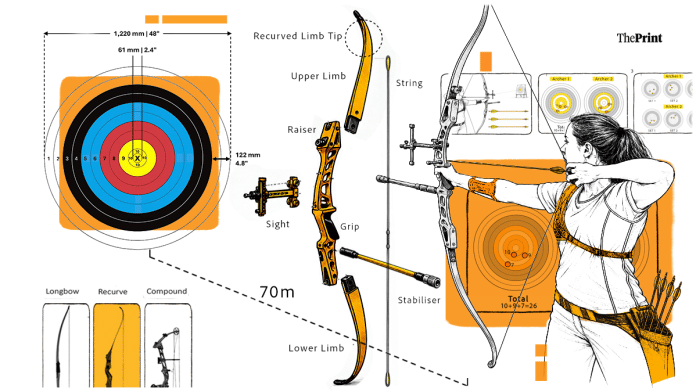
A recurve bow has limbs whose tips curve away from the archer when the bow is unstrung. That shape allows the bow to store and transfer energy efficiently when the string is drawn and released.
The modern competition bow is more than just the curved limbs. It has a central section called the riser, along with flexible limbs, a string, a sight and stabilisers. The equipment is designed to help the archer aim consistently and control the bow through the shot.
Unlike a compound bow, a recurve does not use a system of cams and pulleys to mechanically reduce the force needed to hold the string at full draw.
That makes the archer’s technique particularly important. The same movement has to be repeated with remarkable consistency, while factors such as wind can affect the arrow’s flight.
How far away is the target?
At international outdoor competitions, recurve archers shoot from 70 metres away.
The target itself is 122cm in diameter, but the most valuable part is much smaller. The 10-ring at the centre measures just 12.2cm across. An arrow outside the scoring area gets zero.
The target has 10 concentric scoring rings. The innermost ring is worth 10 points, followed by nine, eight and so on down to one point at the outer ring.
That means an archer is trying to repeatedly put an arrow into an area only about the width of a dinner plate from 70 metres away.
Also read: 1 gold, 4 women, 44 years—India’s Asian Games relay streak lives on
How does a recurve match work?
This is where recurve can be confusing for people watching it for the first time.
The qualification stage is based on cumulative points. Each archer shoots 72 arrows, with the total used to rank competitors and determine the matchplay draw.
The elimination rounds use a different system.
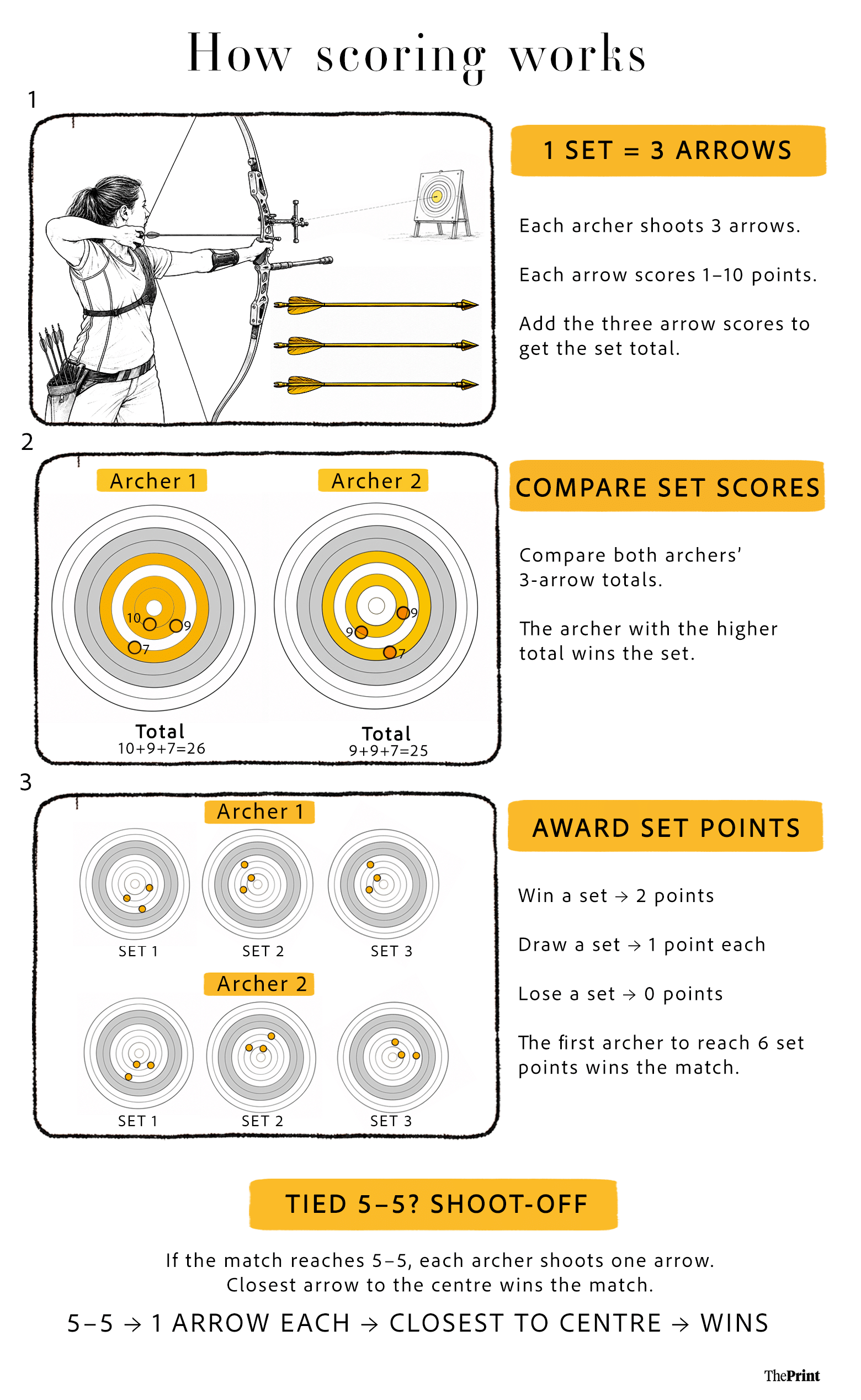
In an individual match, an archer shoots three arrows per set. The archer with the higher score in the set gets two set points. If both have the same score, they each receive one.
The first archer to reach six set points wins. So the winner is not necessarily the person who has accumulated the most points over the entire match. An archer can lose a set narrowly, recover in the next one and still win the match.
The team format works on the same principle. Three archers form a team, with each member shooting two arrows in a six-arrow set. The first team to five set points wins.
What happens if it is tied?
This is where a long match can come down to one arrow.
If an individual match reaches 5-5, it goes to a shoot-off. Each archer shoots one arrow, and the arrow closest to the centre wins.
That is exactly what happened in Mohod’s final against Oh on Saturday. The two were tied 5-5 after five sets. Mohod then shot a 10 in the shoot-off, while Oh managed an 8, giving the Indian the gold.
So, how is recurve different from compound?
Both disciplines involve shooting at a target, but the equipment and match format are different.
Recurve archers shoot from 70 metres at a 122cm target and use the set-point system in match play. Compound archers shoot from 50 metres at a smaller 80cm target, with matches decided by cumulative score.
The recurve bow is also the form of archery used at the Olympic Games. It has been part of the Olympics since archery became a permanent fixture on the programme in 1972.
That is what makes India’s latest achievement particularly significant. Mohod’s gold was not just a win in a sport where every millimetre matters. It was India’s first individual women’s recurve gold at the Asian Games, while the team title had ended South Korea’s long run of dominance in the event.
Also read: Top 3 questions global aviation experts are asking about the flydubai cockpit incident