



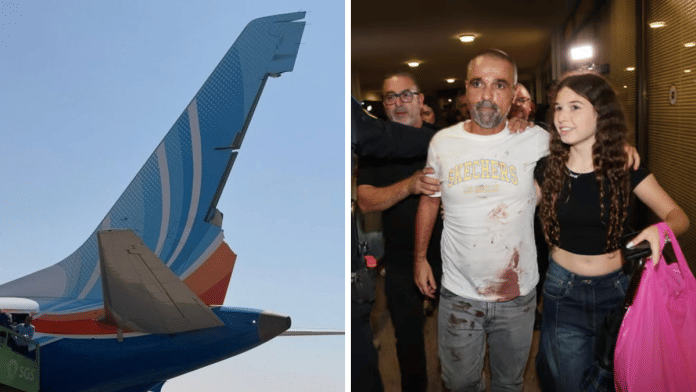
New Delhi: The most revealing clues about what happened aboard flydubai flight FZ1073 are not necessarily the dramatic passenger accounts. They are hidden in the aircraft’s flight data: a sudden 14,000-foot plunge in 29 seconds, emergency transponder codes that changed from 7700 to 7500 and back again, a second descent after the initial recovery and apparent damage to the aircraft’s tail.
Those details have sent aviation enthusiasts and pilots digging through flight-tracking data and photographs of the Boeing 737 MAX 8 that landed in Tabuk, Saudi Arabia, on 30 September.
But there is an important distinction between what the data shows and what it means.
The UAE General Civil Aviation Authority has said the incident is under investigation and warned against unofficial information or conclusions before investigators complete their work.
Here is what aviation watchers are looking at.
The first big question: How did the 737 descend so fast?
Flightradar24 recorded FZ1073 dropping from 30,875 feet to 16,750 feet between 05:22:07 and 05:22:36 UTC, a loss of 14,125 feet in 29 seconds.
That is an extraordinary vertical descent rate.
But flight-tracking data does not provide a complete picture of what was happening inside the cockpit. Automatic Dependent Surveillance–Broadcast (ADS-B) can show an aircraft’s position, altitude and other transmitted parameters, but it does not tell an observer exactly what the pilots were doing with the controls.
That is why aviation specialists are reluctant to reconstruct the cockpit sequence from the flight track alone.
The Aviation Herald has also documented the aircraft as a Boeing 737-8 MAX, registration A6-FKF, and records the emergency sequence and subsequent diversion to Tabuk.
The descent followed an alleged cockpit attack in which the co-pilot stabbed the captain, according to Israeli officials, prompting passengers and crew to intervene
Then there were the strange squawk codes
One of the details that immediately caught the attention of aviation watchers was the sequence of transponder codes.
FZ1073 first transmitted 7700, the internationally recognised code for a general emergency.
It then changed to 7500, the code indicating unlawful interference or a hijacking.
It later returned to 7700 before landing at Tabuk.
Flightradar24 published the sequence while the aircraft was still in the air, but at the time stressed that it had no confirmation of what was happening on board.
That distinction is important.
A squawk code tells air traffic controllers something is wrong. It does not explain exactly what happened.
In this case, however, the eventual accounts of a cockpit struggle gave the otherwise unusual 7500 transmission a very different significance.
The really strange bit: The 737 climbed again, and a passenger may have helped
The flight path was not simply a straight dive.
Tracking data shows the aircraft dropping sharply, recovering altitude and then experiencing another major descent before eventually being stabilised. That has prompted one of the biggest questions among aviation watchers: who actually regained control of the aircraft?
Passenger accounts suggest that the two additional flydubai pilots travelling in the cabin played a crucial role. After the cockpit incident, passengers reportedly located the pilots and brought them towards the flight deck so they could help.
But before one of those pilots took over, there was an extraordinary moment involving passenger Yaniv Hayoun.
Hayoun, who had entered the cockpit during the chaos, said he briefly took hold of the aircraft’s controls while it was descending. When asked how he knew what to do, he said he had watched the television series Air Crash Investigation. He reportedly pulled back on the control column, helping bring the aircraft towards level flight before a qualified flydubai pilot took over.
The account does not mean Hayoun flew the 737 or single-handedly saved it. A passenger with no flight training would not have the knowledge required to manage an airliner through a prolonged emergency. His reported intervention appears to have lasted only briefly, with the additional flydubai pilot then taking control.
If the accounts are confirmed, it would explain one of the strangest features of the flight data: the aircraft did not simply continue descending. It recovered altitude before another descent and was eventually stabilised.
Exactly what happened during those crucial seconds, however, remains unclear. Public flight-tracking data cannot show who was holding the controls, whether the autopilot was engaged, what flight-control inputs were being made or how the aircraft’s systems responded.
Those answers will have to come from the flight-data recorder and cockpit-voice recorder.
And then aviation watchers spotted the tail damage
Photographs of the aircraft after landing appeared to show significant damage to its rudder.
Aviation publications, including The Aviationist, highlighted the apparent damage alongside the flight-tracking data.
The rudder is the movable surface on the vertical tail that controls yaw, or the aircraft’s movement around its vertical axis.
That does not mean the aircraft lost its entire ability to turn.
Airliners have multiple flight-control surfaces and redundant systems. A damaged rudder can make an aircraft more difficult to control, but it does not automatically mean the aircraft becomes uncontrollable.
The big question for investigators will be when and how that damage occurred.
Some aviation commentary has linked it to the extreme descent and speed. But that remains an inference, not an established finding.
The speed is another rabbit hole
Flight-tracking data circulated by aviation enthusiasts showed the aircraft’s groundspeed rising dramatically during the descent.
One aviation forum discussion noted a reported increase from about 411 knots to almost 600 knots during the plunge.
That number has generated considerable discussion online, but there is an important aviation caveat: groundspeed is not the same thing as indicated airspeed or Mach number.
An aircraft’s structural and aerodynamic limits are governed by parameters such as calibrated/indicated airspeed and Mach, not simply the speed at which it moves across the ground.
This is one reason investigators cannot simply look at a flight-tracking speed figure and conclude that the aircraft exceeded a particular certified limit.
They will need the aircraft’s recorded flight parameters.
Why aviation forums are asking: how did it survive?
The photograph of the damaged tail has become one of the biggest talking points among aviation enthusiasts.
A thread on Reddit’s r/aviation discussing the aircraft’s damaged tail drew thousands of reactions, with users particularly focused on how the 737 remained controllable after the violent descent. One of the most repeated questions was essentially: how did the aircraft land with that damage?
That is a useful question, but not proof of anything by itself.
A modern airliner is designed with multiple layers of control and redundancy. Even if one flight-control component is damaged, pilots may still have other means of controlling pitch, roll and yaw.
The fact that FZ1073 ultimately landed safely therefore tells investigators something important: whatever happened, the aircraft retained enough controllability for the crew to complete an approach and landing.
It does not tell them exactly which systems were functioning.
What pilots and aviation specialists are watching next
The biggest unknown is the cockpit data.
Investigators will want to establish the position of the flight controls, stabiliser and rudder; airspeed, altitude and angle of attack; whether the autopilot was engaged; what warnings were generated; what the engines were doing; and exactly when the aircraft exceeded or approached its operating limits.
The cockpit voice recorder could be equally important because it could establish the sequence of the cockpit confrontation and the point at which control of the aircraft changed hands.
The National newspaper has also highlighted another aviation-safety question: whether cockpit video could have helped investigators reconstruct what happened. Commercial aircraft generally record cockpit audio, but there is no equivalent universal requirement to record images of the flight deck. The US NTSB has supported cockpit-video requirements in the past, while pilot groups have raised privacy concerns.
What regulators are saying
So far, the official aviation response has been notably cautious.
The UAE’s GCAA has described the event as a security incident, confirmed the diversion and injuries to crew members, and said its investigation teams are working with relevant authorities on both the operational and security aspects. It has specifically urged the public not to circulate unofficial information or pre-empt the findings.
European Union Aviation Safety Agency (EASA) has also pointed to the existing regulatory chain rather than offering a theory about the incident. In comments to Reuters, the European agency said flydubai’s certification and safety oversight rest with the UAE GCAA, including requirements concerning flight crews and their fitness to fly.
That is significant because much of the online discussion has moved quickly towards questions about pilot screening and cockpit security.
Israel, meanwhile, said it would increase security checks on pilots flying into the country after the incident.
The aviation world’s biggest warning: don’t solve the crash before the black boxes do
The incident has already produced a remarkable amount of online analysis.
Some of it is useful: enthusiasts have reconstructed the altitude profile, tracked the emergency codes, examined photographs of the aircraft and discussed the behaviour of a 737 MAX during the descent.
But aviation professionals know there is a line between reading the clues and writing the conclusion.
The flight track can show that FZ1073 plunged.
It can show that emergency codes changed.
Photographs can show apparent damage.
Passenger accounts can describe what people saw and felt.
But none of those, on their own, can establish exactly what happened to the aircraft’s flight controls during those critical seconds.
For that, investigators need the aircraft’s recorded data.
And that is why, beneath all the chatter about the 737’s extraordinary survival, the most important aviation question remains unanswered: what exactly was happening inside the cockpit and inside the aircraft’s flight-control system during those 29 seconds?