



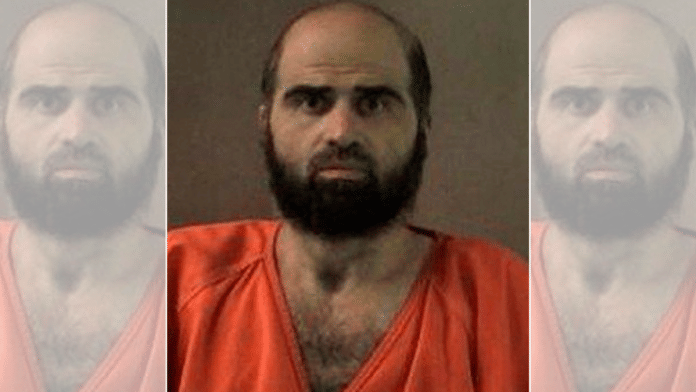
New Delhi: The United States is preparing to livestream an execution for the first time, reopening a debate over whether the public should be allowed to watch the state put someone to death.
The Pentagon has said the execution of Nidal Malik Hasan, the former US Army psychiatrist convicted of killing 13 people and injuring 32 others in the 2009 Fort Hood shooting, will be livestreamed on 3 December. Hasan is scheduled to be executed by firing squad at Fort Hood, Texas, where the attack took place. President Donald Trump approved his death sentence on 2 October, following the completion of the military appeals process.
The announcement, backed by Defence Secretary Pete Hegseth, marks a departure from nearly nine decades of executions being conducted out of public view in the US. It also raises questions about the government’s authority to broadcast an execution, the rights of the condemned and whether a livestream would improve transparency or turn state-sanctioned killing into a spectacle.
Is it legal to livestream an execution?
There is no established precedent for the US government livestreaming an execution to a general audience. The Supreme Court has not directly ruled on whether the government can broadcast an execution over the internet, and legal experts say the Pentagon’s announcement leaves important questions unanswered.
The distinction is between allowing witnesses to observe an execution and broadcasting it to millions of people. Modern US executions are generally attended by a limited group of authorised witnesses, which can include journalists, relatives of the victim and representatives of the condemned person. That restricted access does not automatically establish a right to televise or livestream the event.
The First Amendment protects freedom of the press and public access to certain government proceedings. But courts have not established a general constitutional right to broadcast an execution. Whether the military can make this one publicly available could depend on the legal authority for the decision, applicable military rules and any challenge brought by Hasan.
Eugene Fidell, a military law expert who teaches at Yale Law School, told Reuters that Hasan would need to bring a federal court challenge if he wanted to block the public display of his death. Hasan could also seek further judicial review through a habeas petition, potentially delaying the execution itself.
The announcement therefore does not settle the legal question. The Pentagon has said the execution will be livestreamed, but details of how the broadcast will be conducted have yet to be provided.
Why did executions become private?
Public executions were once common in the US. In the 18th and 19th centuries, hangings were often held in public squares or other open spaces, drawing crowds who gathered to watch the punishment carried out.
Authorities frequently presented these events as a deterrent to crime. Executions could include sermons, speeches and religious ceremonies, with the condemned person sometimes addressing the crowd. But they also became public spectacles, attracting onlookers who treated them as entertainment.
That began to change during the 19th century. States increasingly moved executions behind prison walls, partly in response to concerns about disorder, the degrading treatment of prisoners and the carnival-like atmosphere surrounding public hangings. Reformers argued that executions should be solemn state procedures rather than public entertainment.
The shift was gradual rather than uniform. By the middle of the 19th century, several states had enacted laws requiring executions to take place in private enclosures. The last widely recognised public execution in the US was the 1936 hanging of Rainey Bethea in Owensboro, Kentucky, which drew thousands of spectators. A hanging in Missouri followed in 1937, also attracting public attention.
Privacy, however, did not mean that every execution became entirely secret. Selected witnesses, including members of the press, continued to observe many executions. The change was primarily about ending mass public attendance and restricting the spectacle.
Read More: Yellow fever mosquitoes find male humans more attractive to bite, new US study says
Does broadcasting make executions more transparent?
Supporters of wider access argue that a livestream could allow the public to see how the government carries out its most irreversible punishment. This argument has gained fresh relevance following recent scrutiny of lethal injections, including Tennessee’s failed attempt to execute Christa Pike in September.
Death penalty experts are divided. Deborah Denno, a law professor at Fordham University, has argued that broadcasting an execution could help the public understand what capital punishment entails. Other legal scholars have questioned the purpose of making a person’s death a public spectacle and raised concerns about dignity, the government’s motives and the consequences of distributing the footage online.
The debate also touches on the limits of transparency. Public scrutiny could expose problems in the execution process, but a livestream would not, by itself, guarantee independent oversight or reveal every aspect of how the procedure was conducted.
What happens next?
The Pentagon’s announcement has set a date for Hasan’s execution, but it does not guarantee that the broadcast will go ahead as planned. Further legal proceedings could delay the execution, while a challenge specifically targeting the livestream could test a question US courts have not directly resolved.
The proposal also marks a sharp break from the historical decision to move executions away from public crowds. Nearly a century ago, US authorities increasingly concluded that the public spectacle surrounding executions undermined their solemnity. Now, the Pentagon is proposing to make one visible to a far wider audience than any group of witnesses could accommodate.
Whether that amounts to greater accountability or a return to public spectacle is the question at the centre of the controversy.