



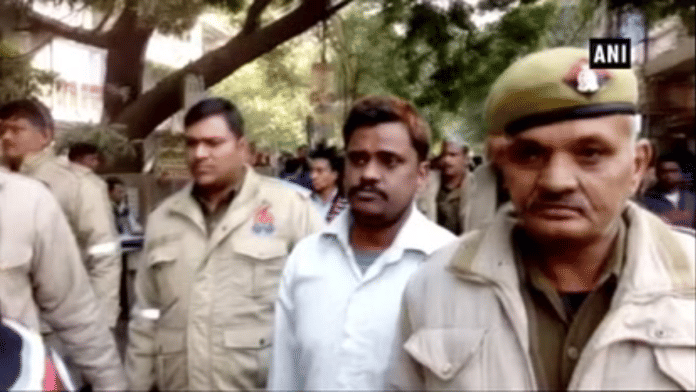
New Delhi: Surendra Koli, the man once branded the “Nithari cannibal” and convicted in the grisly serial killings that gripped India for months, was found dead at a tea stall he had been running in Haridwar, Uttarakhand, on Friday—less than a year after the Supreme Court set him free in the last surviving 2006 Nithari killings case. While the police suspect suicide, no note has been found, and a forensic examination and a post-mortem are pending.
Koli (55), who spent nearly 19 years in prison, had moved to Haridwar after walking out of Kasna jail last November. The domestic worker was a key figure in one of the most notorious criminal investigations in recent history—a case of missing children, skeletal remains pulled from drains behind a Noida bungalow, allegations of rape, murder, dismemberment, and cannibalism, and a prosecution that collapsed in court.
The case involved at least 19 victims, and the remains of children and young women were found in Noida in December 2006. Their disappearances had preceded the discovery by years. Koli had initially confessed to killing six children and a 20-year-old woman after sexually assaulting them at his employer’s home in Noida’s Sector 31. He was convicted in multiple cases, while his employer, businessman Moninder Singh Pandher, was also sentenced to death. In 2023, both were acquitted by the Allahabad High Court.
The gory horror of Nithari later entered popular culture with Netflix’s 2024 crime thriller Sector 36, starring Vikrant Massey and Deepak Dobriyal. The case was also examined in journalist Anirban Bhattacharyya’s book The Deadly Dozen: India’s Most Notorious Serial Killers (2021).
The case
Nithari, an urban village in Noida’s Sector 31, had seen a pattern of disappearances of women and children from the early 2000s. The Supreme Court’s account records that disappearances had been reported from the area in early 2005.
The case broke open on 29 December 2006, when skeletal remains were discovered in a drain behind House D-5, owned by Pandher. Police pulled skulls and bone fragments from the drains and overgrown areas behind the bungalow, along with torn clothes, children’s belongings, and a school bag.
Complaints from families of the missing children and young women started pouring in. A missing-person investigation quickly became one of the country’s most notorious criminal cases.
Among those searching for a missing daughter was Nand Lal, whose 20-year-old daughter Payal had disappeared in May 2006. Her phone was traced to a handcart puller, who told police it had come from someone associated with the Pandher residence.
Both Koli and Pandher were arrested soon after. The investigation was eventually transferred to the CBI amid widespread criticism of the Uttar Pradesh Police. The CBI, after its preliminary findings, called Koli a “psychopath”.
A total of 19 FIRs were registered in connection with alleged crimes involving 19 girls and women. The CBI filed chargesheets in 16 cases.
The prosecution said Koli had lured victims to the house, raped or sexually assaulted some of them, strangled them, dismembered their bodies, and disposed of the remains around the property.
Investigators also attributed a confession to Koli in which he allegedly described sexual violence and cannibalism. He was subsequently branded the “Nithari cannibal” in sections of the media.
Also read: Ahmedabad or Constructionabad? Gujarat city is all dug up
Koli, the main accused
The prosecution’s case rested heavily on Koli’s confession, and recoveries said to have been made based on information he provided. In 2007, Koli’s statement was recorded before a magistrate. The prosecution treated it as a detailed confession describing how he had killed victims and disposed of their bodies.
The problem, courts later found, was the circumstances in which that confession was obtained.
The Supreme Court’s 2025 judgment records that Koli had been in police custody for about 60 days before the confession was recorded. The Court noted the absence of proper legal assistance during this period, and concerns over whether safeguards against coercion had been properly followed.
The Court also pointed to the absence of a timely medical examination that could have addressed Koli’s allegations of physical torture. The prosecution even claimed that Koli’s disclosures led investigators to the remains.
But the courts found problems here too.
The scene had not been properly secured before excavation began. The disclosure was not recorded in time or in the manner expected. Remand papers contained contradictory versions.
No forensic evidence
The prosecution’s theory required the killings and dismemberment to have taken place at or around D-5. Yet, the forensic evidence did not provide a clue.
The Supreme Court noted the absence of bloodstains or other evidence inside the house that could independently support the theory that multiple victims had been murdered and dismembered there.
A knife and an axe allegedly recovered from the Nithari house were later found insufficiently connected to the crimes. The investigative record, including the handling and documentation of recoveries, became one of the reasons the case began to unravel.
The prosecution had to prove that Koli was the person who committed those crimes. The courts ultimately found that it had not done so as required in a criminal trial.
Also read: Less ‘Jai Shri Ram’, more Fire NOCs—Satya Niketan tragedy has rewritten DUSU campaign
The doctor next door
The house at D-5 was adjacent to another property belonging to a doctor who, the Allahabad High Court noted, had apparently been a suspect in an earlier organ-trade case.
The doctor was not established by the courts to have been involved in the Nithari killings, and the courts did not conclude that an organ-trafficking racket was behind the disappearances.
The Allahabad High Court’s 2023 judgment criticised investigators for failing to properly examine the possibility of an organ-trade angle despite recommendations from a high-level committee constituted by the Ministry of Women and Child Development.
The court described the failure to investigate that possibility as a serious lapse. No investigation indicated that the doctor was an accomplice, nor that an organ-trafficking syndicate ring was behind the murders.
There were other theories too—including whether Pandher’s domestic worker Maya had lured some of the victims—but these, like the organ-trade theory, didn’t hold.
Death sentences
The first major conviction came in 2009, when a special CBI court convicted Koli and Pandher in the rape and murder of a 14-year-old teenager Rimpa Haldar and sentenced both to death.
On appeal, the Allahabad High Court acquitted Pandher but upheld Koli’s conviction and death sentence. The Supreme Court upheld Koli’s conviction in 2011. Koli’s review petition was dismissed in 2014.
Eventually, Koli was sentenced to death in 13 separate cases arising from the Nithari investigation. Pandher, too, faced convictions and death sentences in some cases.
The verdicts kept coming. Koli was convicted in the murder of 7-year-old Arti Prasad in 2010 and 9-year-old Rachna Lal later that year. By December 2012, he had accumulated five death sentences. At one point, he was due to be hanged on 12 September 2014.
In 2015, the Allahabad High Court commuted Koli’s death sentence in the Haldar’s murder case to life imprisonment, citing the inordinate delay in deciding his mercy petition.
Then, in October 2023, the Allahabad High Court acquitted Koli in 12 cases and Pandher in the two pending cases.
The court found flaws in the collection and presentation of evidence, including problems with Koli’s confession, the alleged recoveries, procedural safeguards, and the failure to investigate alternative possibilities.
It also questioned the conduct of the investigation and the possibility that Koli’s statements had been obtained after prolonged custody and alleged coercion.
Koli remained in prison because one conviction had survived. It came under scrutiny in 2025.
By then, Koli had been acquitted in 12 cases in which the prosecution had relied on the same confession and evidence.
In July 2025, the Supreme Court dismissed the state’s appeals against the 2023 acquittals. In November, the Supreme Court considered Koli’s petition in the final case.
On 11 November 2025, a bench headed by then Chief Justice BR Gavai, with Justices Surya Kant and Vikram Nath, set aside Koli’s conviction and ordered his release.
Koli walked out of Kasna Jail the following day, after almost two decades in custody.
(Edited by Prasanna Bachchhav)