



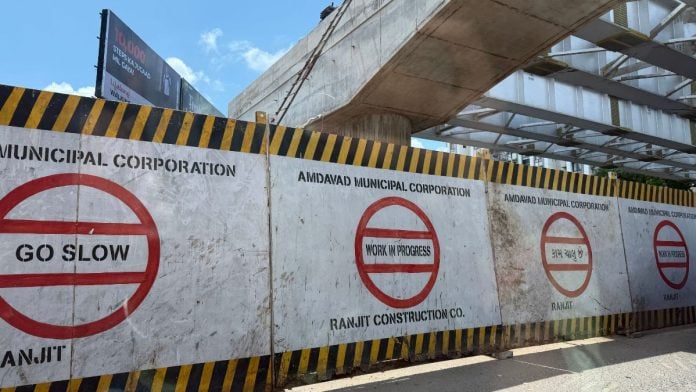
Ahmedabad: Gujarat’s financial capital is a giant construction site nowadays. Roads are dug up, and bridges and flyovers are at various stages of being built and rebuilt. This frenzied infrastructure construction is underway for the 2030 Commonwealth Games in Ahmedabad.
The construction has become difficult to ignore, and more than that, difficult to escape. Local media has described it as a “dug-up city”, while residents on social media have called it a “giant construction site” and said the city is “permanently under construction”. Some have even coined the term “Constructionbad”.
With 126 traffic diversions reported across the city, the frustration extends beyond social media jokes. Commuters say journeys that once took 10 minutes can now stretch to nearly an hour.
“Ahmedabad now should be named Constructionbad,” one Reddit user commented on a video showing bridge construction across the city.
A city under construction
Across Ahmedabad, construction has become part of the cityscape. At one end, the 53-year-old Subhash Bridge is being dismantled and rebuilt. At another, the historic Ellis Bridge is undergoing restoration. Work is also underway on flyovers and railway overbridges at places such as Vadaj, Naroda Patiya and Makarba.
The civic project lists show just how extensive the construction programme has become. The Ahmedabad Municipal Corporation (AMC) currently has 15 bridge projects under construction, with several more in the pipeline – flyovers, railway overbridges, river bridges and elevated structures, some of which will stretch to 2027 and beyond.
For residents, however, the transformation is less about the finished flyover or widened road, and more about the journey to get there.
For Kalu Manat, 30, getting around Ahmedabad has become increasingly difficult. Manat, who moved to the city five years ago, spends much of his day navigating through traffic jams, diversions, and barricaded roads.
“All this construction makes my work extremely difficult. One day I had to pick a ride, and I was only 500 metres away. But due to traffic caused by the Panjrapole bridge construction, I was stuck for 50 minutes.”
Amit Bhatt, 23, travels around 8 km by scooter every day from Makarba to Vejalpur. Before construction began, the journey took him about 25 minutes. Now, he says, it takes nearly an hour.
The Makarba overbridge is under construction and is intended to improve connectivity between SG Highway, Makarba and Vejalpur.
“I know all of this will eventually help us, but the inconvenience is annoying,” said Bhatt, who lives in Makarba.
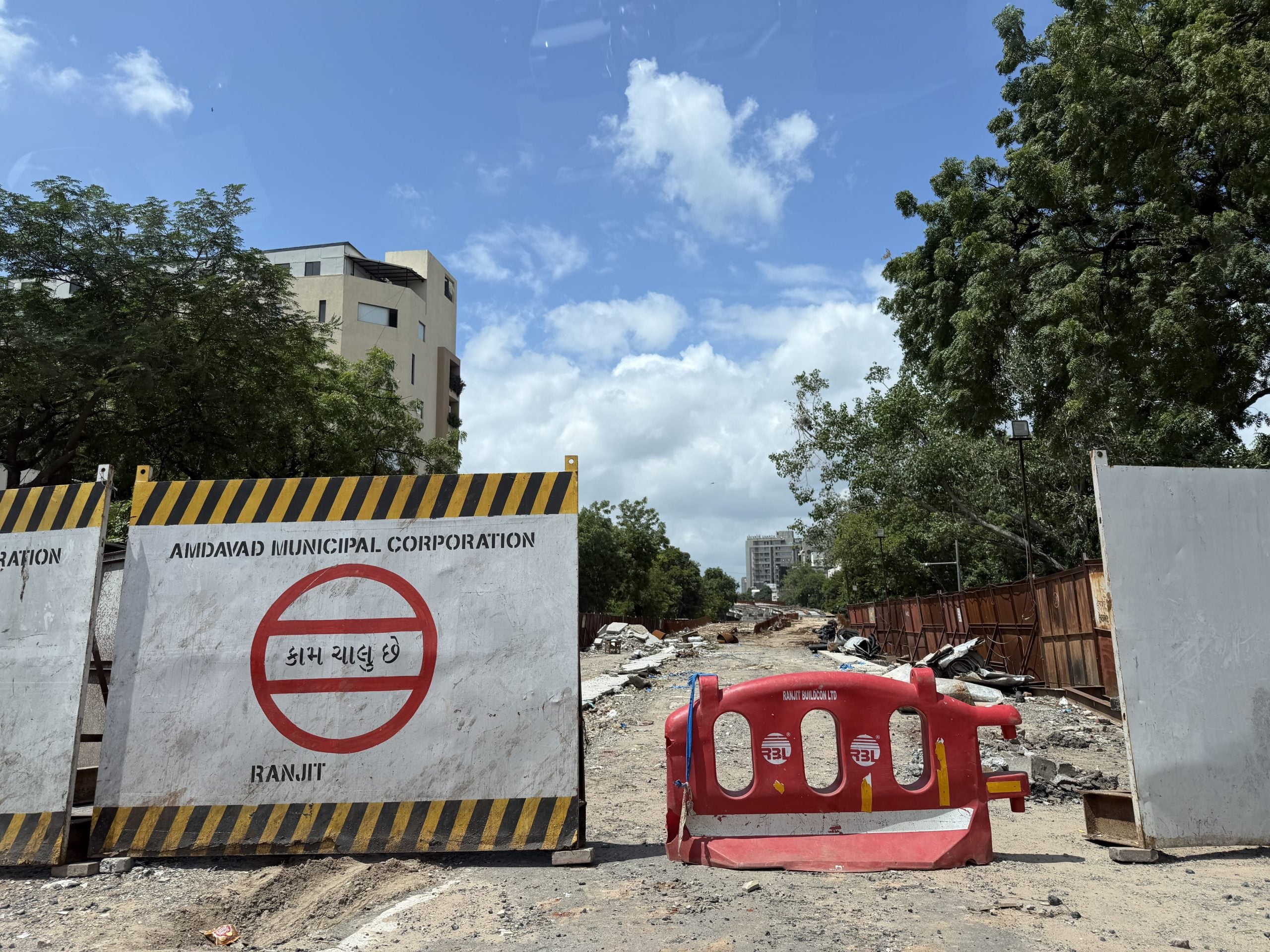
Building for the traffic of tomorrow
According to AMC, bridges and railway overbridges are being built to reduce congestion, improve connectivity, and allow traffic to move more easily, particularly at railway crossings and busy junctions that bottleneck the city.
“Bridges are built based on the requirements identified through traffic surveys. Railway overbridges are constructed where there are railway crossings, while some existing bridges need to be reconstructed. There are also cases where traffic diversions create a need for a new bridge. When an old bridge reaches the end of its lifespan, it has to be rebuilt. That is why Subhash Bridge had to be dismantled and will now be rebuilt,” Jignesh Shah, Deputy City Engineer, AMC told ThePrint.
The civic body’s infrastructure plans are also tied to the city’s preparations for the 2030 Commonwealth Games, when Ahmedabad is expected to handle more movement of visitors and participants.
“In light of the Commonwealth Games, we also need to be prepared with good infrastructure. There should not be a traffic problem either,” Shah said.
Also Read: Ahmedabad 2030 Commonwealth Games can bring in yoga and kabaddi. It’ll be a turning point
Construction misses its deadline
The disruption becomes harder to navigate when projects themselves run beyond schedule.
Several of Ahmedabad’s bridge projects have already run past their original deadlines. The Naroda Patiya flyover was scheduled to be completed by July 2026, but its deadline has now been pushed to June 2027. AMC has cited delays related to forest land, execution, and shifting of underground utilities; the contractor has also been fined Rs 50 lakh.
The Makarba railway overbridge, meanwhile, was originally scheduled for November 2024. The Rs 70.7-crore project remained incomplete nearly one-and-a-half years after that deadline, with AMC officials citing a collapsed drainage line and delays in obtaining railway permission for work over the tracks.
At Vadaj, the flyover project has similarly stretched beyond its original schedule. Launched in July 2023, it was expected to be completed within 30 months, putting its completion date at November 2025. It remained incomplete this year, leaving commuters to battle the barricades, dust and bottlenecks around the junction.
Delays are not necessarily the result of one problem, AMC officials say.
“Delays can happen because of design changes and other modifications. But there is no data to suggest that modifications happen in every project. When modifications are required, however, they can lead to delays,” said Shah, pointing to the roughly year-long slippage at Naroda and the ongoing delays at Vadaj. For railway overbridges specifically, he blames delayed permissions from the Railways.
Recent AMC projects show how these problems can overlap. In the Naroda Patiya project, the civic body had to deal with forest-land requirements and underground utilities. In railway projects, coordination and approvals from other agencies add another layer to already complex construction schedules.
An AMC analysis of older flyover projects has similarly identified utility conflicts, land disputes, inter-agency coordination, and design changes midway through construction as recurring causes of delays and cost escalation.
The wait between the old city and the new one
AMC promises a city that eventually moves faster. For now, the reality is a city that moves barely at all. Barricades, diversions, narrowed roads, and bottlenecks crowd Ahmedabad’s busiest corridors.
With multiple projects running simultaneously, the question is not only when Ahmedabad’s new bridges will open, but how much longer the city will have to live with the disruption before they do.
Edited by Maryam Hassan