


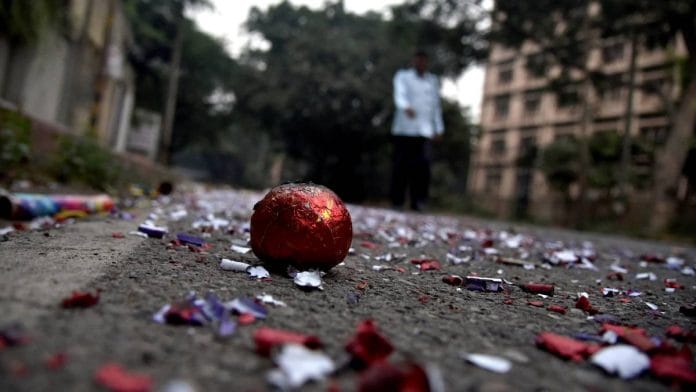
New Delhi: A firecracker does not become harmless simply because its box carries a green logo. It still explodes, releases smoke and sends fine particles into the air. The difference is supposed to lie in what goes into it and how much pollution it produces.
The Supreme Court has allowed the sale and bursting of certified green crackers in Delhi-NCR for two days, 7 and 8 November, ahead of Diwali. But the relaxation comes with strict conditions: crackers can be burst only between 6am and 7am and 8pm and 10pm on those days. A complete ban will return from 9 November.
So what makes these crackers different, and how much cleaner are they?
What makes a cracker green?
Conventional fireworks use chemical mixtures that produce light, colour, sound and the explosion itself. Their combustion releases particulate matter, sulphur dioxide, nitrogen oxides and metals, adding to pollution that is already a concern in Delhi-NCR during winter.
Green crackers are designed with modified chemical formulations to reduce these emissions. The Council of Scientific and Industrial Research’s National Environmental Engineering Research Institute, or CSIR-NEERI, has developed and tested formulations that use changes in the proportions of raw materials and additives to improve how efficiently the cracker burns.
The institute’s criteria require a reduction of at least 30 per cent in particulate matter emissions, or a reduction of at least 20 per cent in particulate matter along with at least 10 per cent in gaseous emissions, compared with conventional crackers in the same category.
That does not mean every green cracker releases exactly 30 per cent less pollution. The reduction depends on the formulation and the type of firework being tested.
What is different inside them?
Some formulations use additives to improve combustion or reduce the amount of material released as airborne particles.
Three types have become familiar: SWAS, SAFAL and STAR.
SWAS stands for Safe Water Releaser. It uses a polymer-based material intended to release water vapour and capture some of the particulate matter produced during bursting.
SAFAL, or Safe Minimal Aluminium, reduces the quantity of aluminium used in the formulation.
STAR, or Safe Thermite Cracker, uses iron oxide to improve the efficiency of combustion.
The formulations are also designed to avoid certain harmful chemicals, including barium compounds. The Supreme Court’s latest order has specifically prohibited crackers containing barium.
But a lower-emission formulation is not the same as a pollution-free one. Green crackers still release pollutants and can worsen air quality, particularly when large numbers are burst in a short period.
Also Read: 2 killed after under-construction building collapses in Delhi’s crowded Chawri Bazar
How can buyers identify them?
Certification is central to the system because conventional crackers have previously been sold under the label of green crackers.
For the current Delhi-NCR relaxation, the Supreme Court has restricted manufacture to products approved by CSIR-NEERI, with valid certification from the Petroleum and Explosives Safety Organisation as required by the order.
The boxes must carry product-specific, non-transferable QR codes. These are meant to provide details of the manufacturer, registration and product certification, allowing authorities to check whether a cracker is genuinely approved.
The court has also ordered that only designated locations can be used for sale. Online sales are not permitted under the directions. Crackers joined in series, commonly called ladis, and garlands are prohibited.
Are green crackers enough to solve the pollution problem?
No. They are an attempt to reduce one source of pollution, not eliminate it.
Even a product that meets the prescribed emission-reduction standard releases pollutants when it is burst. The impact also depends on how many crackers are used, where they are burst and how pollution from other sources is behaving at the time.
Delhi-NCR’s winter pollution has several contributors, including vehicle exhaust, road and construction dust, industrial emissions and weather conditions that can trap pollutants close to the ground. Firecrackers add to that burden, particularly around Diwali.
The Supreme Court has directed authorities to monitor air quality before, during and after the two-day relaxation. That data will matter: it could help establish whether allowing certified green crackers produces a measurable difference.
For now, the distinction is worth remembering. Green crackers are designed to pollute less than conventional ones. They are not clean, harmless or an answer to Delhi’s air pollution.