





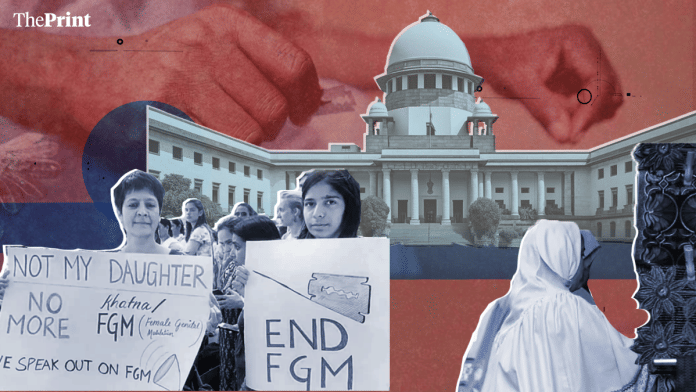


New Delhi: She was seven when a woman came to her Mumbai home to perform khatna—or female genital mutilation. Her own mother stood by her, holding her hands.
The Dawoodi Bohra Muslim community’s ritual of mutilation lasted only minutes, but left behind a lifetime of anger and violation.
“I remember being cut, and then I completely blanked out after that,” she said, recalling the painful and oppressive procedure—also known as khafd or khafz—that young girls are subjected to, a practice that the Supreme Court is finally hearing this week.
“Like maybe I fainted. I don’t know. But that’s the only memory I have. They say we black out our worst memories.” The next thing she remembers is sitting on a toilet seat, an open wound burning as she urinated.
She is now in her early 30s. And is one of India’s foremost warriors against this brutality that passes off as tradition. For nine years, she has been anonymously advocating against the practice. She speaks carefully, like someone who has spent a long time making sense of what happened to her.
“I think I began by talking from my wounds, not my scars…I’ve reached a stage where I’ve healed. I’m not speaking from trauma anymore. I’m speaking from a place beyond it,” she said.
After more than seven years of pendency, the Supreme Court is set to hear a batch of cases that could redefine the limits of religious freedom under the Constitution, which also includes a 2017 PIL that challenges female genital mutilation (FGM) among the Dawoodi Bohra community. The petition tagged with a series of high-stakes cases on gender and faith, such as Sabarimala temple entry for women, seeks to have the practice declared unconstitutional, and calls for both a specific law banning it and stricter enforcement under existing criminal provisions.
A wake-up call
“By staying in denial and being quiet about it, you can’t wish it away.”
The 2018 study, ‘The Clitoral Hood: A Contested Site’, commissioned by WeSpeakOut and Nari Samata Manch and conducted by independent researchers Lakshmi Anantnarayan, Shabana Diler and Natasha Menon, found that three in four Bohra women surveyed had undergone khatna even in the 21st century. This surprised many because community elders have long maintained that female genital mutilation is a thing of the past.
Of those who went through the procedure, 97 per cent recalled it as painful. Nearly 35 per cent said it had affected their sexual lives. Another 10 per cent reported urinary problems, recurring infections, burning, and incontinence.
The study was released in Delhi on the eve of the International Day of Zero Tolerance for Female Genital Mutilation in February 2018 — just weeks after the Ministry of Women and Child Development told the Supreme Court that no official data confirmed the practice in India.
In the Dawoodi Bohra community, the practice known as khatna is generally described as falling under WHO Types Ia and Ib: the partial or total removal of the clitoral hood or the clitoris.
Supporters within the community — including the Dawoodi Bohra Women’s Association for Religious Freedom (DBWRF), which claims to represent over 65,000 women — describe it as a minor, harmless ritual.
But activists, survivors, and medical evidence say otherwise. In the 2018 study, a gynaecologist who had researched this procedure described the difficulties: removing only part of the prepuce was nearly impossible when a child, given no anaesthesia, was physically resisting. Traditional cutters interviewed for the study reported having performed the procedure on thousands of girls, with little formal medical training.
Masooma Ranalvi, who is now 59 and an intervening petitioner in the female genital mutilation case, was cut without warning. She was lured by her grandmother with a promise of ice cream.
“I was seven and, pretty much like the others in my community, I was taken without knowledge, without information on what was going to happen,” she said. “I was taken on a subterfuge — I was told that we’re going to buy you some ice cream. And then I was taken, and it just happened.”
For years, she did not have a language for what had been done to her. “We don’t call it FGM,” she said, “We call it khatna in the community. So we did not associate with that term.”
The memory stayed — fragmented and unprocessed — something she did not speak about, not even to her two elder sisters who had undergone the same practice before her, nor to her mother or, later, her husband.
It was only in her late 20s that she read a media report about female genital mutilation in Africa.
“I felt very eerie about it, because I kind of went back to what had happened to me. And it was like I was connecting the dots. And I was in complete denial in my own mind.”
That denial lasted another decade. In 2012, when a case involving two young Dawoodi Bohra girls was prosecuted in Australia, the issue resurfaced with force.
“By staying in denial and being quiet about it, you can’t wish it away,” she said. “It was continuing. And that was actually my wake-up call.”
Ranalvi wrote about her experience in a blog published in 2015 on a news channel’s website.
The response was immediate and overwhelming. Women she had never met wrote to her, echoing her words, recounting eerily similar experiences.
“I felt acknowledged. And I felt good that people were there to support. And at that moment, I felt that I should take this forward and not stop at this blog,” she said.
She created a WhatsApp group and called it “We Speak Out.” Fifty women joined — most of them were strangers scattered across cities. They spoke about what had long remained unspeakable: about sex, pain, pleasure, marriages, trauma.
“People generally do not talk about their own sex life, their own sexual problems. Most don’t even talk to their partner, their sisters, their friends, anybody. So this was liberating in a sense,” Ranalvi said.
The group would go on to become WeSpeakOut, a survivor-led organisation that commissioned the 2018 study and has been pushing the issue into public discourse.
There is also a heavy price for speaking out against the community—a price that many couldn’t afford.
Ranalvi was only able to attach her real name to the movement because she was already living outside the community’s fold, currently in Goa. In the 1970s, her father had been socially boycotted from the Bohra community for participating in a reform movement that demanded financial accountability from the sect’s religious leadership. The family moved out of Muslim-dominated neighbourhoods, away from the community’s tight-knit social network.
That distance, Ranalvi said, made a difference. Already on the margins, she had less to lose by speaking up and more room to do so openly. For many in the movement, anonymity is a necessity.
The women who cannot openly speak
“I’m speaking from my scars”
A 27-year-old filmmaker has a story like Ranalvi. When she was seven, her mother lied about taking her out for an ice cream, and they landed at a doctor’s clinic instead. It was near the community mosque in Mumbai.
“My personal experience was not entirely very painful,” she said. “I remember feeling a little bit of a sting, but also, there was more than pain. There was a betrayal — because I was not told what was happening to me. It was completely unbeknownst and a complete surprise.”
For years, the memory lay dormant. It wasn’t until she was 17, working on a documentary for her assignment at film school, that she began to understand what had been done to her. She interviewed family members — her mother, her sisters, her cousins, her aunts for this film, and in the process of asking others about their experiences, she had to confront her own.
Around the same time, she agreed to appear in a news clip. She did not tell her family. The video went viral overnight. The fallout was immediate.
She was cut off by her friends in the community. Her mother was furious. Her cousin, a student at Aljamea-tus-Saifiyah, an educational institute run by the Bohra community, was called into the principal’s office and asked whether the girl in the video was his sister.
“My actions caused a lot of ripples in my family. A decision was made, and I called the publication and asked them to remove my part. They had to take down the video from YouTube and then other platforms. They had to cut my part out, and then they re-uploaded. I believe the video still exists, but if you go back and check, I will not be there,” she said.
The 17-year-old went quiet for years. It was only recently that she began attending small activist events again — still anonymously. She is now 27.
She speaks in measured but cautious language about what khatna has meant for her sexuality. For years, she identified herself as asexual — something she now understands as “shaped partly by the procedure and partly by an environment that left little room for a young woman’s sexual exploration”.
When she became sexually active in her mid-20s, that understanding shifted.
“It was like this whole new world that had opened up. I know that I don’t get as much physical pleasure from it as a lot of uncut women do. I enjoy the psychological, intimate aspects of sex, but I know that physically I’m not achieving as much,” she said.
Her return to activism, she said, has been driven by something immediate and personal. A cousin got pregnant.
“I took up my activism again because a cousin was pregnant, and I thought: if she has a girl, I wouldn’t want my niece to go through what I went through. So far, I’ve only been blessed with nephews,” she said. She now goes by a pseudonym on public discourse forums and blog sites—like many other Bohra women speaking up against FGM.
The 30-year-old Mumbai-based activist, who has spent a decade anonymously and with a pseudonym, advocating against female genital mutilation, said she fears social boycott.
“It’s a very small and tight-knit community. Everyone knows everyone, and for economic reasons, it is beneficial to stay within the community because that’s where our business comes from,” she said.
In the early days of organising, she was asked to join a WhatsApp group. Though she feared someone might report to her family, she agreed. In the group, strangers shared things they had never spoken about to the people closest to them.
“You don’t know who’s going to be in the room and who can snitch. We were participating in a movement like this against our families. So imagine how much they wanted to talk about their trauma — that they first had to meet people who they could speak to about this, complete strangers. And then be well-resourced enough to go back and talk to their families about it.”
She has, in the years since, interviewed mothers—for surveys, to help build a body of work on FGM— who carried out or arranged khatna for their daughters. There’s almost a pattern: a neighbour, a friend, a trusted voice in the immediate circle, telling a woman that genital mutilation was good for her child.
“Our immediate circle that we are surrounded by is constantly reinforcing the goodness of the practice,” she said.
Many supporters believe the practice is mandated by religion, as they interpret texts on male circumcision as applicable to women as well. They frame it as a cleansing or purifying ritual.
Her own mother was among them. Before she died, the two of them watched a documentary together in which survivors of genital mutilation told their stories. For the first time, her mother said she was proud of her speaking up against FGM. For the first time, she apologised.
“She said, ‘I’m sorry, but I had no idea that this was harmful to you. It’s just that I have done it and everybody’s done it.’ And for the first time, my belief in what I was doing was reinforced — because this was the same mother I was once very angry with for doing what she did,” the daughter said.
For her, forgiving is a part of healing.
“I have done the very important work of not just processing what happened to me, but also forgiving those I once held responsible,” she said.
“I’m not speaking from my wounds anymore — I’m speaking from my scars.”
She recounts travelling to the interior of the country where Bohra communities live, and meeting a mother in Indore who described what she had witnessed when her daughter was cut. The cutter, she said, had shown the excised tissue in her palm.
“So the talk that probably it’s just nicking, pricking, it’s harmless — is actually false, because really nobody knows how much is being cut and what is being cut,” she said.
She called what she and many other survivors experience as a kind of interrupted intimacy — a sudden intrusion of memory during sex. “Sometimes out of nowhere, it hits you — and that kind of incapacitates you. It turns into a mental health issue as well. It’s a mental health issue and it’s an agency issue,” she said.
Also read: Lady bouncers of Delhi NCR and their fight for dal, roti, respect
In the absence of law
“There was a lot of pressure that started coming on all of us through community channels.”
India has no law explicitly banning female genital mutilation. Although the court has acknowledged that the bodily integrity of women could not be violated, so far, it has not ruled on the matter.
The legal silence has been accompanied by the government’s denial. The WeSpeakOut study 2018 was in direct response to the Ministry of Women and Child Development’s claim that there is no data to confirm the prevalence of female genital mutilation. Eighty-eight respondents in the survey were able to identify 1,248 others in their immediate circles who had undergone it.
Other countries have moved faster. In 2015, Australia convicted three members of the Bohra diaspora for female genital mutilation-related offences. In 2017, two doctors in Detroit were arrested for allegedly cutting at least six Bohra girls. Reports emerged that, in the wake of legal pressure in the diaspora, some Bohra families were bringing their daughters to India specifically to have the procedure performed.
Ranalvi has had meetings with the National Commission for Women, the National Human Rights Commission, and the Ministry of Women and Child Development. She also approached community leaders directly, asking for a conversation.
“We even went to our own community leaders, saying that this is happening, please talk to us, have a conversation with us. We are modern society, let’s stop this. But there was no response. And in fact, there was a lot of pressure that started coming on all of us through community channels,” she said.
The power to put an end to FGM rests with the religious leadership that holds the community together—known as the ‘Syedna.’ Families speak of calls that arrive right on time, just as a girl reaches the khatna age. Recording-keeping is often done through quiet coordination with dai’s— or traditional cutters — ensuring that the practice continues and is monitored. They have every contact detail of every household.
(Edited by Ratan Priya)