



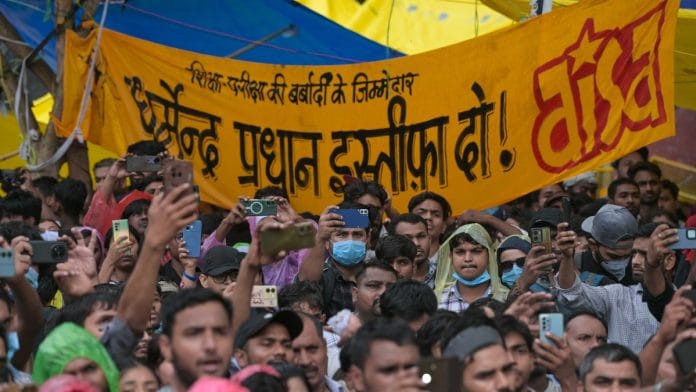
New Delhi: The Indian Cyber Crime Coordination Centre (I4C) under the Ministry of Home Affairs (MHA) has asked the cloud-based web platform GitHub to remove three pages hosting the source code of Bitchat, the Bluetooth mesh messaging app built by Block chief executive and Twitter co-founder Jack Dorsey. This comes amidst usage of the app by protesters at Jantar Mantar demanding resignation of Union Education Minister Dharmendra Pradhan.
Dorsey put the order out on X Friday, posting images of the two-page notice. “…the government of india does not like technologies like bitchat and wants it taken down,” he wrote. The order is timestamped 23 July, 2026, 23:16 hours.
It has been issued under Section 79(3)(b) of the Information Technology Act, 2000, read with Rule 3(1)(d) of the IT Rules, 2021, and lists three URLs: the Bitchat repository, the Bitchat Android repository, and the releases page of the Android repository, all under the account permissionlesstech.
ThePrint could not independently verify the authenticity of the order.
ThePrint reached Rajesh Kumar, CEO of I4C, over call and message. This report will be updated if he responds.
A senior government official, asked about Dorsey’s claim, said Friday on condition of anonymity, “Bitchat is illegal so it has to be taken down.”
the government of india does not like technologies like bitchat and wants it taken down pic.twitter.com/gjzMg1NGCi
— jack (@jack) July 24, 2026
GitHub, owned by Microsoft, is a code hosting service used by developers to publish and collaborate on software. Open-source projects such as Bitchat keep their source files there, and users download the finished app from the releases page.
Paragraph 5 of the notice says that “the intermediary GitHub is hereby notified to remove and disable access to the concerned URLs within 3 hours of the issue of this communication without vitiating the evidence in any manner”.
Also Read: Delhi Police moves to block 400-plus ‘Pakistani’ social media handles amid CJP protest
What the order says
I4C states in the notice that it has identified the applications as “a communication platform capable of establishing decentralized peer-to-peer messaging over Bluetooth mesh networks without relying on mobile networks, internet connectivity, or centralized servers”.
The design, it says, “significantly impedes lawful interception, attribution, and investigation by law enforcement agencies”, and the platform “can be misused to evade lawful surveillance, facilitate anonymous coordination, and circumvent lawful restrictions imposed by competent authorities during situations involving public disorder, riots, terrorism, organized crime, or internet shutdowns”.
The order cites intelligence inputs to say such platforms are “capable of being exploited for coordinating unlawful assemblies, violent protests, dissemination of misinformation, radicalization, criminal conspiracies”.
It adds that the absence of a central service provider limits the ability of agencies to obtain subscriber information or communication records. The provisions listed as violated are Sections 43, 84B and 84C of the IT Act, 2000, and Section 61 read with Sections 196 and 197 of the Bharatiya Nyaya Sanhita, 2023. The signatory is described as a Nodal Officer designated to notify intermediaries.
Order follows protest use
The notice comes in the fourth week of the Cockroach Janta Party (CJP) agitation in Delhi, which is seeking the resignation of Union Education Minister Dharmendra Pradhan over irregularities in national entrance examinations.
Over 10,000 people tried to march to Parliament on July 20. CJP founder Abhijeet Dipke said 150 protesters were injured after police fired tear gas and used batons, and told a press conference the next day: “We will not march again because the police will hurt the youth again.”
Mobile internet suspensions and signal jammers have been used around protest sites in the Capital, and demonstrators have shifted to offline Bluetooth mesh messaging apps, including Briar and Bitchat, for coordination.
Bitchat passes messages from phone to phone over Bluetooth Low Energy, up to seven hops, and needs no phone number, account or internet connection. It has been used during protests in Madagascar, Uganda, Nepal, Indonesia and Iran, and in April, Apple pulled it from its China App Store at the request of the Cyberspace Administration of China, which cited rules on services with public opinion or social mobilisation capability.
The code is under the MIT licence for Android and in the public domain for iOS, and has been copied to over 2,000 forks on GitHub, which remain outside the scope of the order. The three URLs named in the notice were accessible at the time of publication. GitHub has not said whether it will comply.
(Edited by Amrtansh Arora)
Also Read: TV news showed the CJP protest live. Then it rewrote the story on primetime